

 Travel Essentials
 Travel Essentials

Explore America’s most iconic buildings, from soaring skyscrapers and grand memorials to historic cathedrals and modern engineering feats.
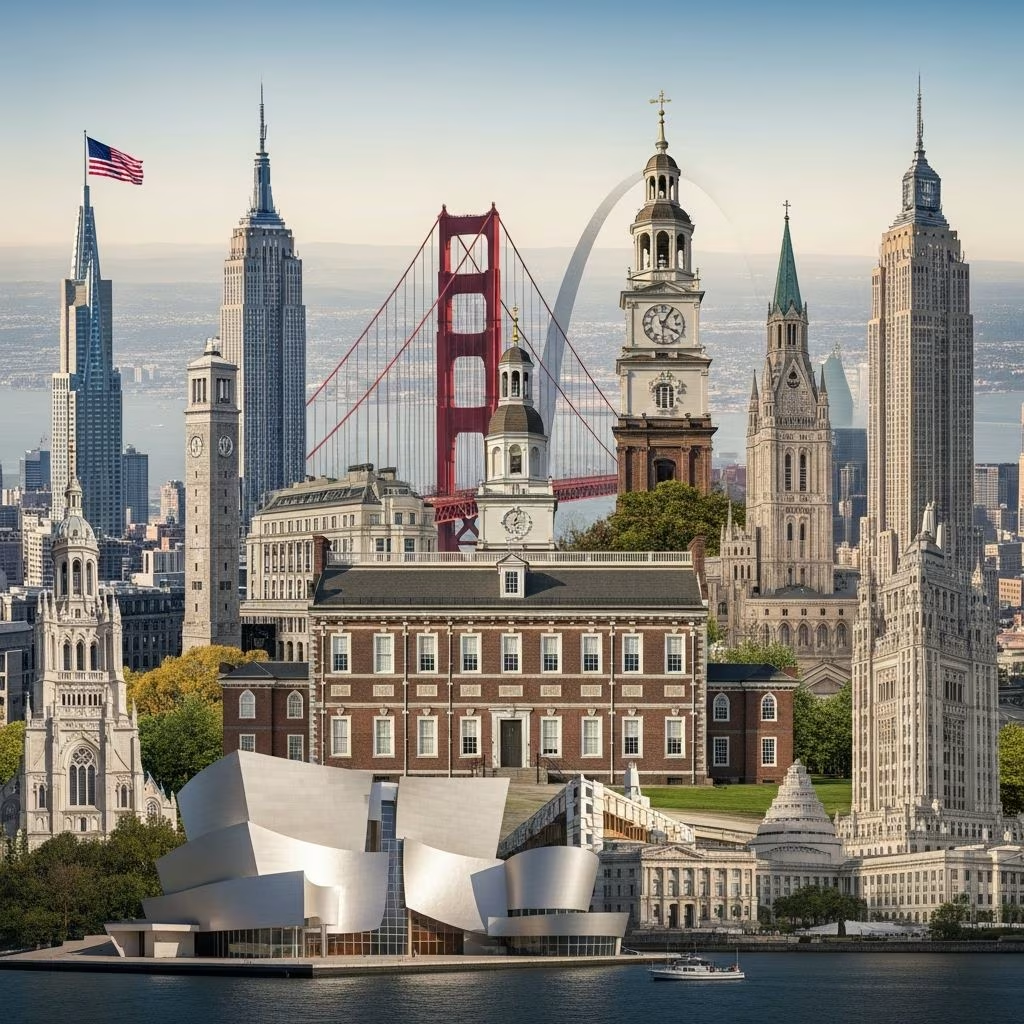 Travel Essentials
The architectural landscape of the United States reflects centuries of innovation, ambition, and artistic vision. From towering skyscrapers that pierce the clouds to stately government buildings that embody democratic ideals, American architecture tells the story of a nation constantly evolving and reimagining itself. These structures serve as more than functional spaces; they are cultural landmarks that inspire awe, preserve history, and define the visual identity of cities across the country.
The most celebrated buildings in America have been recognized by leading architectural organizations and millions of visitors annually. These structures represent diverse architectural styles, from the ornate Gothic Revival cathedrals to the sleek geometric forms of contemporary design. Understanding these masterpieces provides insight into the aesthetic values, engineering capabilities, and cultural priorities that have shaped American development.
Manhattan’s skyline stands as one of the most recognizable urban profiles in the world, dominated by structures that revolutionized vertical living and working. Among these, certain buildings achieved legendary status through their innovative design, historical significance, and enduring influence on the built environment.
The Empire State Building represents the pinnacle of Art Deco achievement in American architecture. Completed in 1931, this 104-story structure reaches beyond 1,450 feet into the sky, making it an unmistakable feature of New York City’s landscape. The building’s design incorporates distinctive setbacks that create a stepped silhouette, a characteristic feature of Art Deco style that addresses both aesthetic and regulatory requirements. The structure’s continued prominence in American culture extends beyond its architectural merit; it has become emblematic of Americana itself, appearing in countless films, photographs, and artistic works. Visitors can access observation decks on the 86th and 102nd floors, with ticket pricing ranging from $31-57 depending on age and deck selection.
The Chrysler Building stands as another testament to Art Deco mastery. Completed in 1930, just months before the Empire State Building, the Chrysler Building held the distinction of being the world’s tallest structure at the time of its completion. Its crown features distinctive triangular windows arranged in a radiating sunburst pattern, crafted from stainless steel that catches and reflects light throughout the day. The building’s status as the world’s tallest lasted merely eleven months before being surpassed, yet many architectural critics argue that its aesthetic sophistication rivals or exceeds that of its taller successor. As the tallest brick building ever constructed, the Chrysler Building demonstrates remarkable engineering achievement. The building lacks formal public tours, though visitors can appreciate its exterior grandeur and access the striking public lobby with its vaulted ceiling and geometric ornamentation.
American political architecture reflects the nation’s foundational values through careful design choices that communicate authority, accessibility, and democratic principles. The nation’s capital houses several structures that have become synonymous with American governance and constitutional ideals.
The White House serves as the official residence and workplace of the President, embodying neoclassical principles that reference democratic traditions dating to ancient Greece and Rome. Constructed between 1792 and 1800, the building’s design emphasizes symmetry, proportion, and classical ornamentation. The structure’s familiarity to millions worldwide through photographs, media coverage, and visits establishes it as one of America’s most recognized buildings. Its neoclassical style, featuring columns and a central rotunda, communicates permanence, legitimacy, and democratic governance.
The United States Capitol represents an even more ambitious neoclassical statement, completed in stages between 1793 and 1962. Situated on Capitol Hill at the eastern terminus of the National Mall, the Capitol’s monumental dome has become the visual symbol of American legislative power. The four-acre complex houses the chambers where the House of Representatives and Senate conduct the nation’s business. The building’s architectural language reinforces its democratic function through its monumental scale and open design philosophy. Free admission is available for visitors, though advance passes are required for guided tours, making the building accessible to citizens wishing to understand the seat of legislative authority.
The Jefferson Memorial honors the nation’s third president through a striking neoclassical rotunda overlooking the Tidal Basin in Washington, DC. Designed by architect John Russell Pope and completed between 1939 and 1943, the memorial features a domed structure that references the Pantheon in Rome, establishing a visual connection between American democratic ideals and classical civilization. The interior houses a monumental statue of Jefferson, while inscriptions on the walls include some of his most profound reflections on liberty and human rights.
American religious architecture combines European traditions with New World innovation, creating spaces that serve both spiritual and architectural purposes. The nation’s most celebrated ecclesiastical buildings demonstrate exceptional craftsmanship and design sophistication.
The Washington National Cathedral stands as the second-largest church building in the United States and the fourth-tallest structure in Washington, DC. This Neo-Gothic Episcopal cathedral represents decades of construction from 1906 to 1988, with contributions from architects George Frederick Bodley, Henry Vaughan, and Philip H. Frohman. The cathedral’s pointed arches, ribbed vaults, and extensive stained glass create an interior environment that evokes centuries-old European traditions while serving contemporary American spiritual needs. The building’s scale and architectural ambition reflect the religious aspirations of a growing nation seeking to create monuments comparable to those of older civilizations.
St. Patrick’s Cathedral in New York City represents the architectural aspirations of the nineteenth-century Irish-American community. Designed by James Renwick and constructed between 1858 and 1878, this Gothic Revival structure features twin spires that rise dramatically above the surrounding streetscape. The cathedral’s front facade incorporates pointed arches, decorative stone tracery, and vertical emphasis characteristic of Gothic architecture. Its position along Fifth Avenue near Rockefeller Center creates a striking juxtaposition of religious and commercial architecture, illustrating New York City’s diverse architectural vocabulary.
The Cathedral of St. John the Divine in Manhattan represents perhaps the most ambitious ecclesiastical undertaking in American architecture. Construction began in 1892 and continued through 1911, with design contributions from architects Heins and LaFarge as well as Ralph Adams Cram. The cathedral’s enormous scale and Gothic Revival styling create one of the most impressive interior volumes in North America, featuring soaring stone vaults and elaborate decorative programs.
Beyond individual buildings, certain structures demonstrate American engineering prowess and innovative approaches to infrastructure design. These works showcase the intersection of functional necessity and aesthetic ambition.
The Golden Gate Bridge spanning the entrance to San Francisco Bay represents one of the most photographed structures in the world. Completed in 1937 and designed by Irving F. Morrow and Gertrude C. Morrow, the suspension bridge’s distinctive International Orange color and elegant cable design have made it an iconic symbol of California and the American West. The bridge’s graceful proportions and engineering sophistication create a structure that functions as both practical infrastructure and sculptural art. Like the Statue of Liberty on the eastern seaboard, the Golden Gate Bridge has welcomed immigrants and visitors to American shores for nearly nine decades.
The Lincoln Memorial honors the sixteenth president through a monumental Greek Revival structure completed between 1914 and 1922. Architect Henry Bacon designed a building that references the Parthenon, communicating the elevated status accorded to Lincoln in American historical consciousness. The memorial’s position at the western terminus of the National Mall creates a visual anchor for the nation’s ceremonial center. The structure’s simple geometric form and classical proportions create a timeless quality, while Daniel Chester French’s monumental sculpture of a seated Lincoln dominates the interior chamber.
The Washington Monument completed between 1848 and 1854 stands as the world’s tallest obelisk and a dominant feature of Washington’s skyline. Designed by Robert Mills, the monument’s Egyptian Revival styling reflects nineteenth-century fascination with ancient civilizations. The structure’s radical simplicity and vertical emphasis create a striking visual statement that can be seen from extensive distances throughout the capital city.
American wealth and architectural ambition found expression in magnificent private residences that rivaled European palaces in scale and elaboration. These structures demonstrate the aesthetic aspirations of America’s industrial magnates.
The Biltmore Estate in Asheville, North Carolina represents the most ambitious privately constructed residence in American history. Designed by Richard Morris Hunt with landscape architecture by the renowned Frederick Law Olmsted, the estate’s château-inspired architecture draws upon European precedent while asserting American wealth and sophistication. Constructed between 1889 and 1895, the main residence contains 250 rooms and incorporates Châteauesque styling with towers, turrets, and elaborate stone ornamentation. The estate’s extensive grounds feature formal gardens, forests, and recreational facilities that create a self-contained world reflecting the aspirations of the Gilded Age.
The Hearst Residence at San Simeon in California represents another expression of private architectural ambition. Designed by Julia Morgan and constructed between 1919 and 1947, the residence combines Spanish Revival styling with eclectic decorative elements assembled from around the world. The complex sprawls across hillside terrain, creating a dramatic silhouette that dominates the coastal landscape.
Beyond government buildings and residences, certain civic structures have achieved iconic status through architectural distinction and cultural significance. These buildings serve public functions while becoming destinations for architectural tourism.
| Structure | Location | Completed | Architectural Style | Significance |
|---|---|---|---|---|
| Union Station | St. Louis, Missouri | 1892 | Romanesque | Historic transportation hub with monumental design |
| Union Station | Los Angeles, California | 1939 | Spanish Revival | Passenger terminal reflecting regional architectural character |
| Tribune Tower | Chicago, Illinois | 1925 | Gothic Revival | Newspaper headquarters with distinctive crown |
| Transamerica Pyramid | San Francisco, California | 1972 | Modern | Iconic pyramidal form defining city skyline |
| Guggenheim Museum | New York, New York | 1959 | Modern | Frank Lloyd Wright’s sculptural masterpiece |
The Guggenheim Museum in New York represents the visionary modernism of Frank Lloyd Wright, completed in 1959. The building’s distinctive spiral form defies conventional architectural categories, creating a sculptural presence that commands attention. The museum’s circular galleries ascending around a central void create innovative exhibition spaces while making the building itself a work of art to be experienced and appreciated.
The Philadelphia Museum of Art stands atop a commanding hill, accessible by the famous
