

 Travel Essentials
 Travel Essentials

Explore captivating geography facts including continental drift rates, extreme elevations, unique seas, and U.S. oddities that challenge common perceptions.
 Travel Essentials
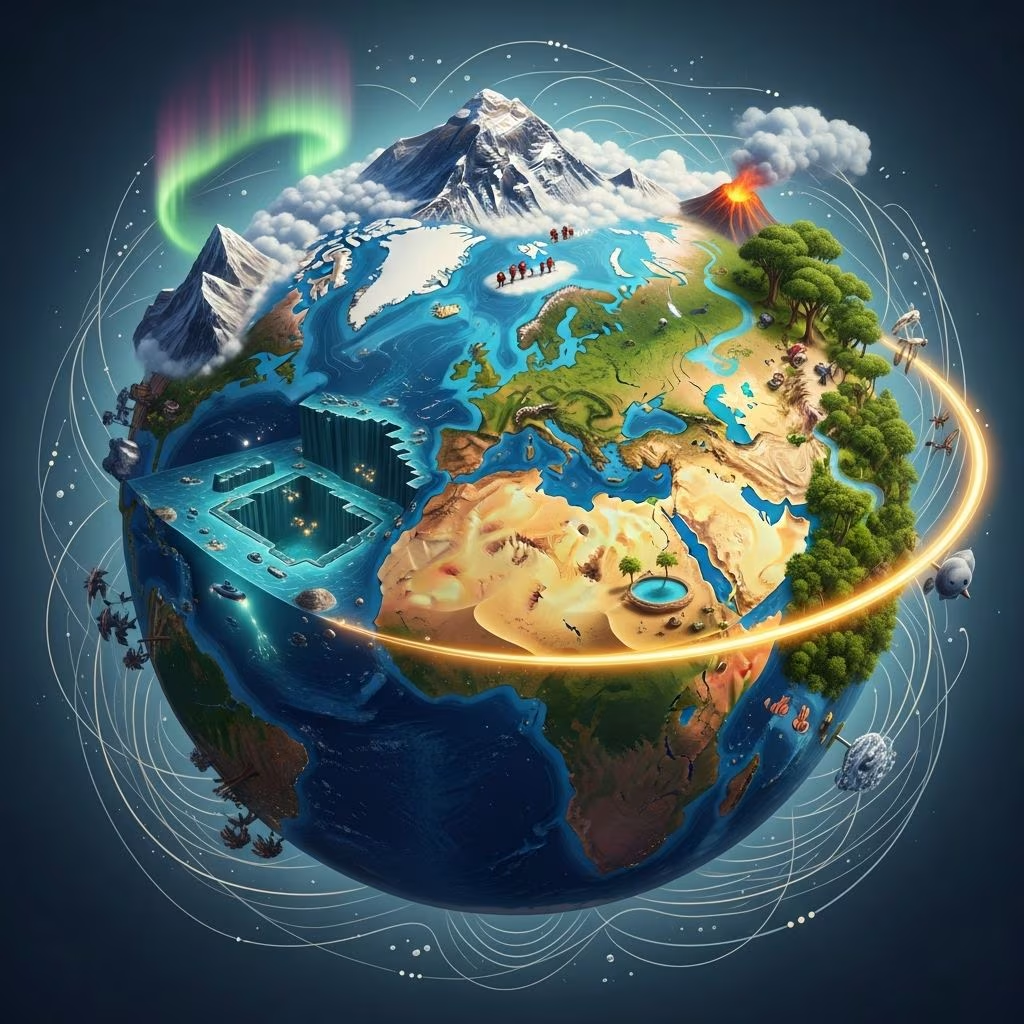
Our planet holds countless surprises in its physical features, from the slow dance of tectonic plates to the bizarre boundaries of nations and natural wonders. These facts illuminate the intricate and often counterintuitive nature of Earth’s geography, drawing from authoritative observations of landscapes, oceans, and climates.
Earth’s continents are not fixed; they move at a pace comparable to human fingernail growth, roughly 2-5 centimeters per year due to plate tectonics.
Such movements influence everything from earthquake zones to the formation of new islands, reminding us that our world is dynamically evolving.
Canada boasts the highest number of lakes globally, totaling over 31,752, making it a watery paradise.
The Caspian Sea, spanning 371,000 square kilometers, qualifies as the world’s largest lake by area, surpassing even Lake Superior.
These waterways sustain ecosystems, support agriculture across 41% of the U.S. via the Mississippi Basin (1.2 million square miles), and have even reversed flow during historic earthquakes like those in New Madrid in 1811-1812.
While Mount Everest claims the title above sea level at 8,848 meters, Mauna Kea in Hawaii towers higher overall at 32,808 feet from its oceanic base.
| Mountain | Height Above Sea Level | Total Height from Base | Location |
|---|---|---|---|
| Mount Everest | 8,848 m | ~8,848 m | Himalayas |
| Mauna Kea | 4,207 m | 9,966 m | Hawaii |
| Mount Chimborazo | 6,263 m | Farthest from Earth’s center | Ecuador |
Mount Chimborazo, though shorter above sea level, is the farthest point from Earth’s core due to the planet’s equatorial bulge.
In the U.S., California’s Mount Whitney (4,421 m) and Death Valley’s Badwater Basin (-86 m) lie just 85 miles apart, showcasing extreme elevation contrasts from tectonic activity.
Kentucky leads with the most caves worldwide, highlighted by Mammoth Cave National Park’s over 400 miles of explored passages—potentially 200 more undiscovered.
These subterranean worlds reveal hidden biodiversity and geological histories beneath our feet.
Alaska holds the unique status of being both the easternmost and westernmost U.S. state, thanks to the 180th meridian slicing through its Aleutian Islands.
Maine edges closer to Africa than Florida does, flipping typical distance assumptions.
Norway’s fjord-indented coast stretches 64,000 miles, exceeding Russia’s despite the latter bordering 14 countries alongside China.
The Sargasso Sea stands alone as the ocean’s only coastless body, bounded by Atlantic currents and blanketed in sargassum seaweed.
Vatican City is the smallest sovereign nation at 0.44 square kilometers.
Damascus, Syria, endures as the oldest continuously inhabited city, now sheltering 1.7 million residents.
Antarctica hosts the largest desert—a polar expanse of nearly 14 million square kilometers, dwarfing sandy counterparts.
Alaska’s Tongass National Forest is Earth’s largest temperate rainforest at 16.7 million acres, rich in old-growth trees despite logging threats.
Australia’s Mount Augustus is the planet’s largest rock monolith, rising over 2,300 feet and visible from 100 miles away.
Sudan surpasses Egypt in pyramid count with ancient structures dotting its landscape.
The Philippines features Vulcan Point: an island in a lake on an island in a lake on an island.
Hawaii’s Big Island grows via Kilauea volcano’s lava flows, birthing black sand beaches.
Earth’s oblate spheroid shape—flattened poles, bulging equator—affects measurements like Chimborazo’s stellar proximity.
California outpopulates all of Canada.
Yellowstone harbors a supervolcano.
The U.S. population clusters east of San Diego-Tallahassee line.
Ninety percent of humanity resides in the Northern Hemisphere.
Africa uniquely straddles all four hemispheres.
The Pacific Ocean exceeds all land area combined.
Mauna Kea, measured from its base, at nearly 10,000 meters total height.
France with 12, including overseas areas.
Yes, the Sargasso Sea, defined by currents.
Over 31,752, the most worldwide.
Mammoth Cave in Kentucky, exceeding 400 miles explored.
