

 Travel Essentials
 Travel Essentials

Explore the best national parks in France, featuring dramatic mountains, coastal inlets, ancient forests, and diverse wildlife in protected wilderness areas.
 Travel Essentials
France boasts eleven remarkable national parks that safeguard diverse ecosystems, from towering alpine summits to serene coastal fjords and lush woodlands. These protected areas offer unparalleled opportunities for outdoor pursuits, wildlife observation, and cultural immersion, drawing millions of visitors annually who seek respite in nature’s embrace.
Established under strict conservation laws, France’s national parks encompass core zones with minimal human impact and surrounding buffer areas for sustainable activities. Spanning regions from the Pyrenees to Provence, they protect over 2,000 square kilometers of pristine terrain collectively. Key goals include biodiversity preservation, geological heritage maintenance, and public education on environmental stewardship. Visitors must adhere to rules like staying on marked trails to minimize ecological disturbance.
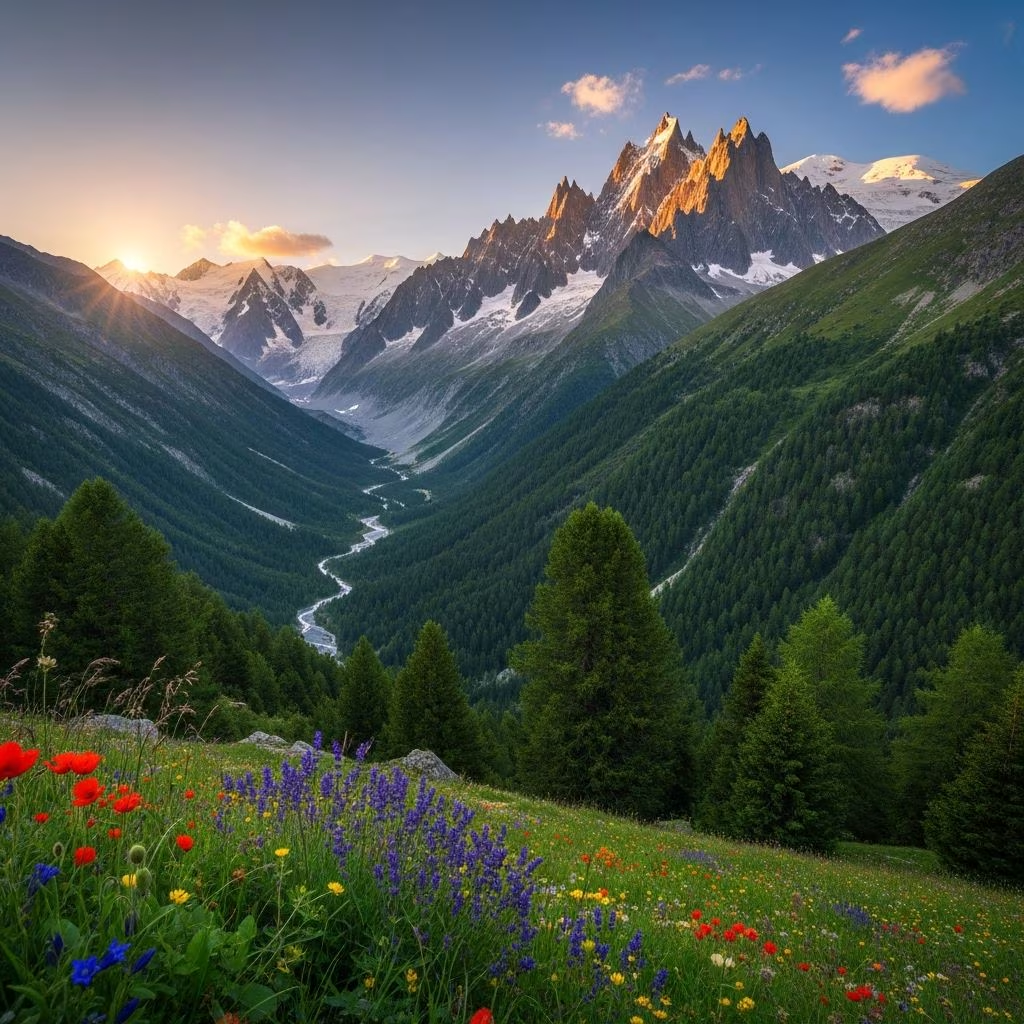
Nestled in the Savoie and Haute-Savoie departments, Vanoise National Park stands as France’s oldest, founded in 1963, covering 1,250 square kilometers. This vast expanse links seamlessly with Italy’s Gran Paradiso National Park, forming Europe’s largest contiguous protected alpine area. Over 100 peaks exceed 3,000 meters, framing glaciers, high meadows, and crystal-clear lakes ideal for mountaineers and botanists alike.
Wildlife thrives here, with chamois gracefully leaping across rocky slopes, ibex scaling sheer cliffs, and elusive lynx prowling the forests. Summer brings vibrant edelweiss blooms, while winter transforms trails into snowshoe paths. Popular activities include the challenging GR5 long-distance hike, which traverses the park’s heart, offering panoramic views of the Tarentaise Valley. Nearby ski resorts like Tignes provide access without compromising the park’s integrity.
Situated between Isère and Hautes-Alpes, Écrins National Park spans 925 square kilometers of dramatic terrain, home to France’s second-highest peak, Barre des Écrins at 4,102 meters. Glaciers—over 40 remain—carve deep valleys, creating a rugged landscape that feels like true wilderness amid the Alps. Established in 1973, it prioritizes mountaineering and high-altitude trekking.
Steep trails lead to alpine refuges where hikers refuel before summiting aiguilles (sharp peaks) or exploring glacial moraines. Biodiversity shines with golden eagles soaring overhead and marmots whistling warnings. For a moderate adventure, the Vallon du Lauvitel loop showcases turquoise lakes and wildflower meadows. Climate change threatens the ice fields, underscoring the park’s role in research and conservation efforts.
| Park Feature | Vanoise | Écrins |
|---|---|---|
| Size (sq km) | 1,250 | 925 |
| Established | 1963 | 1973 |
| Top Peak (m) | 3,885 | 4,102 |
| Key Wildlife | Chamois, Lynx | Marmots, Eagles |
On the Italian border in the Alpes-Maritimes, Mercantour National Park covers 685 square kilometers of sun-drenched peaks blending French and Ligurian influences. Less crowded than its northern counterparts, it features over 600 kilometers of trails winding through pine forests, lavender fields, and Bronze Age petroglyphs at Mont Bégo. The Vallée des Merveilles reveals thousands of ancient carvings, a UNESCO tentative site.
Lac d’Allos, Europe’s largest high-altitude mountain lake, mirrors snow-capped summits and hosts rare aquatic life. Wolf packs roam freely, reintroduced in the 1990s, alongside chamois and ptarmigan. Multi-day treks like the six-day circuit explore remote valleys, while day hikes suit families. The Mediterranean climate ensures mild winters for cross-country skiing.
Straddling the Spanish border across Hautes-Pyrénées and Pyrénées-Atlantiques, this 1,000-square-kilometer park dazzles with glacial cirques—immense amphitheaters like Gavarnie, Troumouse, and Estaubé. Waterfalls plunge hundreds of meters, and canyons twist through lush valleys. Six primary valleys (Aspe, Ossau, Aure, Luz, Cauterets, Azun) offer varied access points for exploration.
Isards (Pyrenean chamois) and marmots inhabit steep slopes, while brown bears, reintroduced from Slovenia, occasionally appear. The GR10 trail challenges thru-hikers over 700 kilometers from Atlantic to Mediterranean. Pont d’Espagne serves as a gateway with easy walks to lakes and cascades. Summer festivals celebrate local Basque and Occitan traditions.
France’s youngest park, created in 2012 near Marseille in Provence-Alpes-Côte d’Azur, protects 520 square kilometers—85% marine. Limestone calanques (inlets) plunge into turquoise Mediterranean waters, fringed by 400-meter cliffs. Hiking trails like those to Calanque d’en Vau reward with pebble beaches and pine-shaded paths.
Diverse marine life includes octopus, groupers, and posidonia seagrass meadows, vital for biodiversity. Kayaking and snorkeling reveal underwater canyons, while cliff-top walks offer vertigo-inducing views. Regulations limit daily visitors to preserve this urban-adjacent oasis. Spring wildflowers and fall calm provide ideal visiting seasons.
In the Lozère, Gard, Ardèche, and Aveyron departments, Cévennes spans 937 square kilometers of schistous plateaus, deep gorges, and chestnut forests. A UNESCO Biosphere Reserve, it pioneered French park models with farmer-rancher involvement. Vultures and wild horses roam free, symbolizing rewilding successes.
The GR70 Stevenson Trail follows Robert Louis Stevenson’s footsteps through autumnal hues. Mont Lozère summits yield 360-degree vistas, and gorges host via ferrata routes. Culinary highlights include local cheeses and honey from beekeepers practicing sustainable methods.
Established in 2019 across Haute-Marne and Côte-d’Or, this 560-square-kilometer park preserves Europe’s largest old-growth beech-fir forests. Towering trees up to 50 meters create a cathedral-like atmosphere, sheltering lynx, deer, and rare birds. Bike paths and interpretive trails educate on forest ecology.
Seasonal highlights: spring bluebells, summer birdwatching, autumn foliage rivaling New England. Nearby Champagne vineyards add a cultural layer.
In the Var department, this archipelago park protects 1,250 hectares of land and 1,345 square kilometers of sea around Porquerolles, Port-Cros, and Bagaud islands. Crystal waters teem with 500 fish species; no private boats allowed in core zones. Hiking, diving, and biking immerse visitors in subtropical vibes.
Fortified trails link beaches and forts, evoking pirate lore. Night skies dazzle without light pollution.
Best visited May-October for weather; book refuges early. Pack layers, sturdy boots, and binoculars. Respect ‘leave no trace’ principles. Apps like IGN Rando aid navigation.
Eleven, covering diverse biomes from mountains to seas.
Generally no in core zones; leashed in buffers.
Calanques or Pyrenees gateways with short trails.
Only in designated bivouac areas; no wild camping.
Entry is free; some shuttles or refuges charge.
