

 Travel Essentials
 Travel Essentials

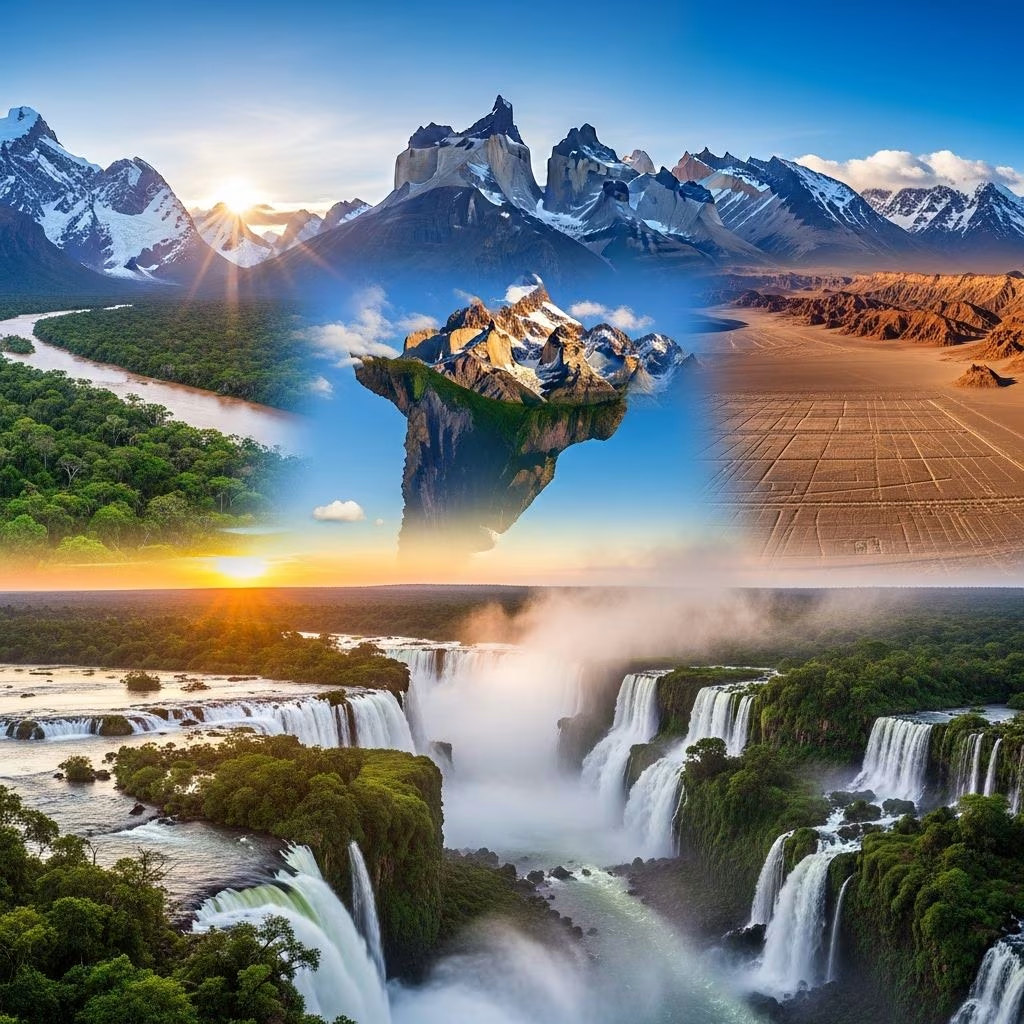
Explore South America's most awe-inspiring natural wonders, including Iguazu Falls, Salar de Uyuni, Perito Moreno Glacier, and more, with tips for sustainable visits.
 Travel Essentials
South America boasts some of the planet’s most dramatic and diverse natural spectacles, drawing millions of adventurers annually. From colossal waterfalls that thunder across borders to endless salt expanses that mirror the sky, these sites showcase the continent’s raw power and beauty. This guide delves into 12 standout wonders, offering insights into their geology, wildlife, and visitor essentials for an unforgettable journey.
Waterfalls in South America are not just scenic; they are geological titans shaped by millennia of erosion and tectonic forces. Leading the pack is Iguazu Falls, a sprawling system straddling Argentina and Brazil. Comprising nearly 300 individual drops spanning 2.7 kilometers, this cascade pours over 1,500 cubic meters of water per second into the Devil’s Throat chasm, generating perpetual mist and rainbows.
Declared a UNESCO World Heritage site, Iguazu’s surrounding subtropical rainforest pulses with life—jaguars prowl, toucans soar, and orchids bloom in profusion. Visitors access viewpoints via catwalks on the Argentine side or panoramic helicopter rides from Brazil. Best visited during the wet season (November to March) for maximum flow, though trails can get slippery.
Further north, Venezuela’s Angel Falls claims the title of the world’s highest uninterrupted waterfall at 979 meters. Plunging from Auyán-tepui in Canaima National Park, its mist nourishes tabletop mountains teeming with unique flora like bromeliads and endemics found nowhere else. Reaching it requires a curiara boat ride up the Río Churún, followed by a hike—plan for multi-day treks with indigenous Pemon guides.
The Atacama Desert in northern Chile stands as the driest non-polar expanse on Earth, with some spots receiving less than 1mm of rain yearly. Spanning moon-like valleys, geysers, and colorful lagoons, it hosts flamingo flocks at Salar de Atacama and the steaming El Tatio geysers at dawn. Valle de la Luna’s eroded dunes shift hues at sunset, mimicking an alien planet. Astrotourism thrives here due to minimal light pollution—observatories like ALMA offer public stargazing.
Bolivia’s Salar de Uyuni eclipses all as the globe’s largest salt flat, covering 10,500 square kilometers at 3,656 meters elevation. Formed from evaporated prehistoric lakes, its hexagonal salt crust cracks underfoot, while the rainy season (December to March) transforms it into a celestial mirror reflecting volcanoes and skies seamlessly. Island cactus outcrops like Inca Wasi provide hiking spots; nearby train cemetery adds rusty intrigue. Jeep tours with local cooperatives ensure sustainable access.
| Wonder | Location | Key Feature | Best Time to Visit |
|---|---|---|---|
| Salar de Uyuni | Bolivia | Mirror effect in wet season | Dec-Mar |
| Atacama Desert | Chile | Driest place on Earth | Year-round |
| Iguazu Falls | Argentina/Brazil | 300+ cascades | Nov-Mar |
Patagonia’s Perito Moreno Glacier in Argentina’s Los Glaciares National Park is a rare advancing behemoth, growing 2 meters daily due to abundant precipitation. Spanning 30 kilometers and 60 meters above Lago Argentino’s surface (with 170 meters submerged), it calves thunderous icebergs in spectacles viewable from boardwalks. The 72-hour rupture cycle, where it bridges and collapses over the channel, mesmerizes onlookers. Kayaking or ice trekking requires permits; eco-lodges in El Calafate base operations.
Torres del Paine National Park in Chilean Patagonia features granite monoliths rising 2,800 meters, encircled by lakes, glaciers, and pampas. The W Trek (4-5 days) traverses Grey Glacier’s icebergs and French Valley’s hanging icefalls, spotting guanacos and condors. Paine Grande offers multi-day circuits amid fjords. Higher up, Aconcagua (6,960 meters) in Argentina towers as the Americas’ highest peak, challenging climbers on its Polish Glacier route. Ecuador’s Avenue of Volcanoes boasts symmetric Osorno and active Cotopaxi, with wild horses grazing lava fields.
Sprawling across nine countries but dominated by Brazil and Peru, the Amazon covers 5.5 million square kilometers—40% of South America’s land. This biodiversity hotspot harbors 10% of global species: pink dolphins navigate igapó forests, anacondas lurk in floodplains, and 3,000 fish varieties swim blackwaters. Manaus gateways lodges like Cristalino, where canopy walks reveal scarlet macaws. River cruises on the Rio Negro spot sloths; sustainable tourism supports indigenous reserves against deforestation threats.
Lake Titicaca, straddling Peru and Bolivia at 3,812 meters, is the world’s highest navigable lake (8,372 sq km). Uros floating islands, crafted from totora reeds by indigenous Uru, host communities fishing piracón. Taquile Island’s terraced fields and Isla del Sol’s Inca ruins evoke ancient spirituality.
Peru’s Colca Canyon plunges 3,270 meters—twice the Grand Canyon’s depth—framing Andean condors with 3.2-meter wingspans soaring thermals. Cruz del Cóndor viewpoint peaks at dawn. Bolivia’s Isla del Sol mirrors Greek isles with ruins and beaches on Lake Titicaca. Galápagos Islands off Ecuador birthed Darwin’s evolution theory: giant tortoises, blue-footed boobies, and marine iguanas thrive on volcanic isles. Strict quotas preserve this UNESCO gem.
Timing matters: Dry seasons (May-September) suit Andes hikes; wet periods amplify waterfalls and salt mirrors. Altitude sickness hits high sites—acclimatize with coca tea or meds. Fly into hubs like Lima, Buenos Aires, or La Paz; internal buses or flights connect. Sustainable practices: Use reef-safe sunscreen in Galápagos, stick to trails in Patagonia, support community tourism in Uyuni.
Budget: Entry fees range $10-50 USD; multi-day treks $200-1000. Visas vary—most nationalities get 90 days visa-free. Health prep includes yellow fever vaccines for Amazon/Iguazu.
Iguazu Falls tops lists, welcoming over 1 million visitors yearly for its accessible trails and thundering power.
Yes, with reputable 4×4 tours; avoid solo driving in wet season due to disorientation on the flats.
Fly to El Calafate, then 80km bus or shuttle; boardwalks are free, ice hikes bookable on-site.
Dry season (June-November) concentrates animals at river edges.
No—overnight cruises required; book via Galápagos National Park-approved operators.
Climate change accelerates glacial melt (Perito Moreno notwithstanding) and desertifies Atacama. Overtourism pressures Iguazu and Galápagos—opt for low-impact visits, offset carbon, and donate to funds like World Wildlife Fund. These wonders endure through collective stewardship.
