

 Travel Essentials
 Travel Essentials

Discover premier destinations, practical planning strategies, and essential tips for witnessing the August 12, 2026 total solar eclipse across Europe.
 Travel Essentials
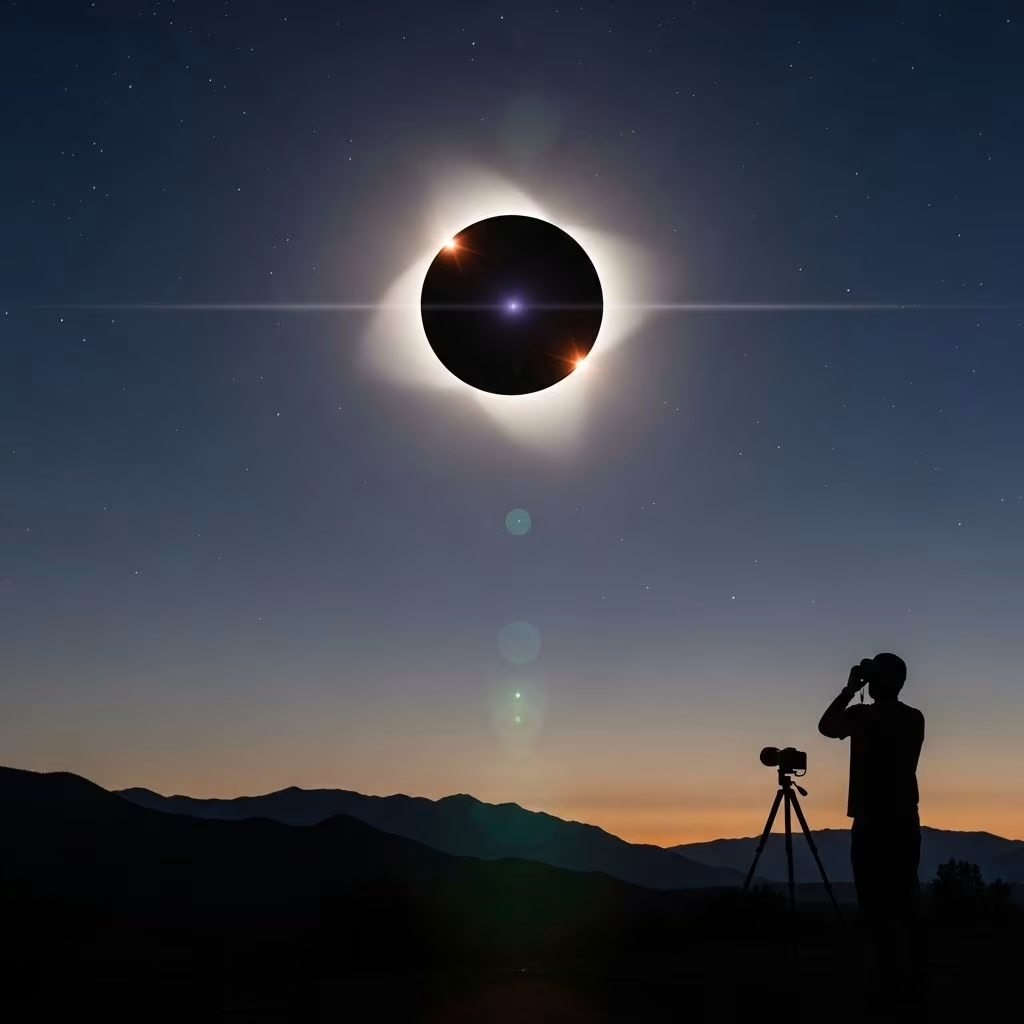
The celestial calendar presents a remarkable opportunity in August 2026 when the Moon will move directly between Earth and the Sun, casting its shadow across a narrow but breathtaking path. This astronomical phenomenon, known as a total solar eclipse, will be visible from select locations in Europe and the Arctic regions on August 12, 2026. Unlike partial eclipses or annular varieties, a total solar eclipse represents one of nature’s most awe-inspiring events, offering observers a chance to witness the Sun’s corona and experience the remarkable transition from day to twilight.
For travelers seeking to position themselves in the path of totality, this guide provides comprehensive information on the best destinations, practical logistics, and preparation strategies to maximize this once-in-a-generation viewing opportunity.
The August 12, 2026 total solar eclipse will traverse a specific geographic corridor where the Moon completely obscures the Sun. Understanding this path is fundamental to planning a successful eclipse expedition. The shadow will cross the Arctic Ocean, eastern Greenland, Iceland, the Atlantic Ocean, Portugal, and northern Spain, creating multiple accessible viewing opportunities across Europe.
A crucial distinction exists between being in the path of totality and viewing a partial eclipse from outside this path. During totality, the daylight fades to twilight, stars become visible in the daytime sky, and the Sun’s corona—its outer atmosphere—becomes visible without protective equipment. Outside this narrow band, observers will experience only a partial eclipse, which significantly diminishes the dramatic nature of the event.
Spain emerges as the most accessible destination for North American and international travelers seeking optimal viewing conditions. The eclipse path crosses through a broad section of northern Spain, with the path of totality extending through multiple cities and regions. Cities including León and Zaragoza lie directly in the path of totality, offering diverse accommodation options, established tourism infrastructure, and cultural attractions to enhance your visit.
The advantage of selecting a Spanish destination involves straightforward logistics. Major international airports serve the region, accommodations range from budget hostels to luxury resorts, and transportation networks are well-developed. Additionally, the path extends beyond Madrid and Barcelona, providing eclipse chasers with flexibility in selecting viewing locations while still exploring Spain’s renowned cultural heritage.
Reykjavík, Iceland’s capital, will experience totality for the first time since 1433—a five-hundred-year gap that underscores the rarity of this astronomical alignment. Western Iceland lies directly in the path of totality, offering stunning natural landscapes as a backdrop to this celestial spectacle.
Iceland presents both advantages and challenges for eclipse tourism. The dramatic terrain, from volcanic landscapes to glacial formations, creates a visually spectacular setting. However, Iceland’s weather patterns are notoriously unpredictable, with cloud cover and fog potentially obscuring the eclipse. Many experienced eclipse chasers view Iceland as a premium destination despite meteorological risks, considering the historical significance of totality returning to the country after five centuries.
Eastern Greenland lies in the path of totality, presenting the most remote and challenging viewing option. The path of totality crosses this Arctic territory, and cruise vessels represent the most practical approach for most travelers. Companies including National Geographic–Lindblad Expeditions, HX Expeditions, and Quark Expeditions are offering specialized eclipse voyages to this region.
Venturing into Greenland’s interior offers superior atmospheric clarity, as clearer skies typically occur further from coastal regions. However, limited road infrastructure and restricted transportation options make independent travel logistically complex. Cruise-based expeditions provide structured access while accounting for harsh Arctic conditions and unpredictable sea circumstances.
Eclipse tourism operates on accelerated timelines compared to conventional travel planning. Experienced eclipse chasers, known as umbraphiles, frequently book expeditions years in advance, creating competitive pressure for limited inventory. As of April 2026, fewer than four months remain before the eclipse event, making immediate booking action essential.
Popular tours, premium accommodations, and cruise berths have likely reached capacity or appeared on waiting lists. Travelers should expect elevated prices, limited availability, and potential cancellations due to supply constraints. Beginning searches immediately and remaining flexible regarding dates and specific locations will improve booking success.
Cloud cover and atmospheric conditions represent the primary variables determining eclipse visibility success. Developing a weather-monitoring strategy weeks before the event allows for tactical repositioning if meteorological forecasts indicate unfavorable conditions at your initially selected location. Maintaining flexibility in accommodations and willingness to travel to alternative viewing sites within the path of totality significantly enhances the probability of witnessing totality.
Roads in eclipse regions will experience substantial congestion as thousands of observers converge on optimal viewing locations. Planning for traffic delays—potentially spanning several hours—requires substantial time buffers in travel schedules. Early departure times and routes avoiding major population centers can mitigate traffic impacts. Cruise-based expeditions eliminate terrestrial traffic concerns but introduce marine considerations including sea conditions and scheduling constraints.
Observing a total solar eclipse requires appropriate equipment during all phases except totality itself. ISO 12312-2 certified solar glasses or handheld solar viewers provide safe observation during the partial phases preceding and following totality. During the totality phase—when the Moon completely obscures the Sun’s photosphere—observers may view the eclipse without protective equipment, allowing for unobstructed viewing of the corona.
Telescope and binocular users must employ specialized solar filters meeting international safety standards. Failure to use appropriate protection during partial phases risks permanent eye damage or blindness.
Different locations present distinct environmental challenges requiring tailored preparation:
| Destination | Accessibility | Infrastructure | Weather Reliability | Unique Features |
|---|---|---|---|---|
| Northern Spain | Excellent | Extensive | Moderate | Cultural attractions, established tourism, diverse accommodations |
| Iceland | Good | Developed | Low | Dramatic landscapes, first totality in 500 years, natural phenomena |
| Greenland | Challenging | Limited | Variable | Remote expedition experience, clear skies in interior regions, Arctic wilderness |
Duration varies by specific location within the path of totality. The greatest eclipse occurs just off Iceland’s western coast, where totality reaches maximum duration. Locations in Spain will experience shorter totality periods, typically lasting several minutes depending on exact coordinates.
Partial eclipse visibility extends far beyond the path of totality. However, the experience differs dramatically. A partial eclipse—even 99% coverage—lacks the distinctive phenomena of totality, including corona visibility, dramatic darkening, and the psychological impact of complete solar obscuration.
Northern Spain offers the optimal balance of accessibility, infrastructure support, and practical logistics for first-time viewers. The established tourism infrastructure minimizes complications, while the clear path through multiple cities provides flexibility if weather requires repositioning.
Immediate booking is advisable given the current date proximity to the August 12 event. Most premium options have likely sold out or appeared on waiting lists, but cancellations may create opportunities for flexible travelers willing to adapt plans based on availability.
For travelers unable to arrange 2026 travel, subsequent eclipse opportunities will occur. An August 2, 2027 total solar eclipse will traverse southern Spain, northern Africa, and portions of the Middle East, with locations like Luxor, Egypt experiencing over six minutes of totality. A July 22, 2028 eclipse will cross Sydney and Australia’s Kimberley region.
The 2026 eclipse, however, represents a singular opportunity to witness this phenomenon from Europe, making the travel investment particularly compelling for those able to arrange it.
