

 Travel Essentials
 Travel Essentials

Explore London’s hidden rivers, oldest subway, royal ravens, and other surprising facts that reveal the city’s layered history and culture.
 Travel Essentials
London stands as a global powerhouse of history, culture, and innovation, yet beneath its familiar landmarks lie layers of extraordinary tales waiting to be uncovered. From subterranean waterways to peculiar royal customs, this city pulses with surprises that challenge even the most seasoned residents. This exploration delves into over a dozen captivating aspects, revealing how London’s past shapes its present in unexpected ways.
The capital’s underground realm extends far beyond the famous Tube network. Over 20 concealed rivers course silently below the surface, remnants of a time when these waterways fed into the Thames before urbanization forced them underground. Notable examples include the Fleet, once a major tributary now channeled through sewers, and the Tyburn, which surfaces briefly in places like Regent’s Park.
These hidden streams occasionally make their presence known during heavy rains, causing floods that remind modern Londoners of the city’s watery foundations. While no formal tours exist, enthusiasts can trace their paths via maps from the London Museum or spot outlets near Brentford and Romford.
At just 1.1 square miles, the City of London qualifies as the United Kingdom’s smallest city by area, a compact enclave surrounded by the larger Greater London sprawl. This ancient core, once fully walled during Roman times, retains fragments of those defenses today, visible near the Tower of London and St. Paul’s Cathedral.
Its autonomy grants it unique governance, including its own mayor and police force, separate from the rest of the capital. This distinction arose from its Roman origins as Londinium, established around AD 43, making it a preserved slice of antiquity amid skyscrapers.
Perched at the Tower of London, a minimum of seven ravens—nicknamed Jubilee, Poppy, and others—serve as symbolic protectors. Folklore warns that if they depart, the kingdom and fortress will crumble, a belief so potent that spares are kept on hand.
Maintained by the Yeomen Warders, these birds receive royal rations and even pensions. The tradition traces back to Charles II in the 17th century, blending myth with military pomp at one of England’s oldest fortresses, founded post-1066 conquest.
London birthed modern global timekeeping with the Greenwich Meridian, established in 1884, dividing the world into time zones. The Royal Observatory in Greenwich remains a pilgrimage site for this legacy.
Complementing this, the Underground, opened in 1863, claims the title of the world’s oldest subway, initially steam-powered before electrification in 1890. Surprisingly, over half its tracks run above ground, and it has witnessed rare miracles like births during WWII air raids, including that of broadcaster Jerry Springer in 1944.
| Milestone | Date | Significance |
|---|---|---|
| Tube Opening | 1863 | First underground railway globally |
| Electric Conversion | 1890 | World’s first metro system |
| Greenwich Meridian | 1884 | Standard for world time |
Romans founded Londinium nearly 2,000 years ago, only for Queen Boudicca to raze it in AD 60-61 during her revolt. Rebuilt stronger, the city endured plagues, fires, and invasions. The Temple of Mithras, dating to AD 240, stands as London’s oldest surviving structure, now reconstructed near the Bank of England.
Medieval sanitation horrors included 50,000kg of daily waste from humans and animals, equivalent to multiple double-decker buses, dumped into streets before modern sewers.
King Henry III housed a polar bear at the Tower in 1252, gifted by Norway’s king; it swam in the Thames on a chain. Elizabeth I abolished the ‘Groom of the Stool’ role, the intimate attendant to monarchs.
King Charles I met his end by beheading in Whitehall in 1649, with spectators dipping handkerchiefs in his blood for supposed healing powers.
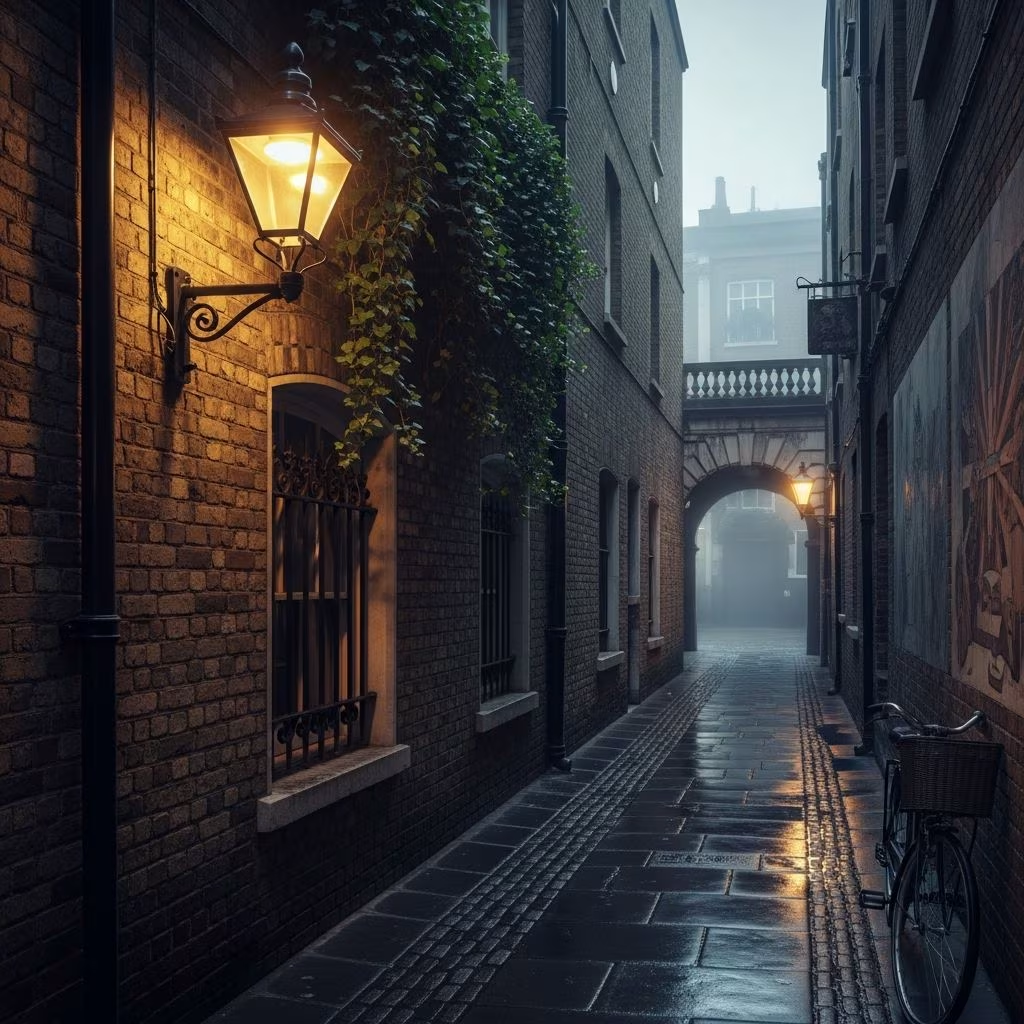
Near Hyde Park, 23-24 Leinster Gardens facade a mere five meters deep, masking a rail cutting from the 1860s. In Covent Garden, Brydges Place squeezes to 15 inches wide, London’s skinniest alley.
These deceptions highlight Victorian ingenuity in blending infrastructure with aesthetics.
Wild ring-necked parakeets, numbering thousands, flock to Kensington Gardens, their origins debated—possibly escaped pets or WWII imports. Feed them apples for an interactive encounter.
London’s eight royal parks, including Kew Gardens (a UNESCO site), offer verdant contrast to urban density.
The city hosted Olympics thrice (1908, 1948, 2012), a record unmatched elsewhere. Four UNESCO sites—Tower of London, Westminster, Greenwich, Kew—underscore its heritage.
Samuel Pepys noted the first Punch and Judy show in 1662; today, London leads in live comedy, from pubs to arenas hosting stars like Chris Rock.
The Shard, at 309.6 meters, pierced the skyline in 2012, eclipsing Canary Wharf’s One Canada Square. Historic London Bridge (1176-1209) brimmed with shops before demolition.
Over 300 languages echo in streets, fueling diverse cuisine and festivals. The British Museum safeguards the Rosetta Stone, pivotal for decoding Egyptian hieroglyphs.
Despite reputation, London sees less rain than Paris, Rome, or Miami, with about 600mm annually versus higher in those cities.
The City of London spans just 1.1 square miles, the UK’s tiniest city.
Yes, over 20, like the Fleet and Tyburn, buried centuries ago.
At least seven, per legend to protect the realm.
Indeed, Henry III’s pet in the 13th century.
Opened 1863, yes—the world’s first.
To experience these secrets, visit the Postal Museum for the abandoned Mail Rail (6.5 miles, operational 1911-2003), spot parakeets in Kensington, or walk Brydges Place. Combine with Tower tours for ravens and history.
London’s allure lies in these juxtapositions: ancient under modern, hidden amid hustle. Whether tracing lost rivers or marveling at ravens, each fact unveils deeper layers of this eternal city.
