

 Travel Essentials
 Travel Essentials

Embark on a 5-day adventure through Ireland's Ancient East, exploring Neolithic wonders, medieval fortresses, and Viking heritage across stunning landscapes from Dublin to Waterford.
 Travel Essentials
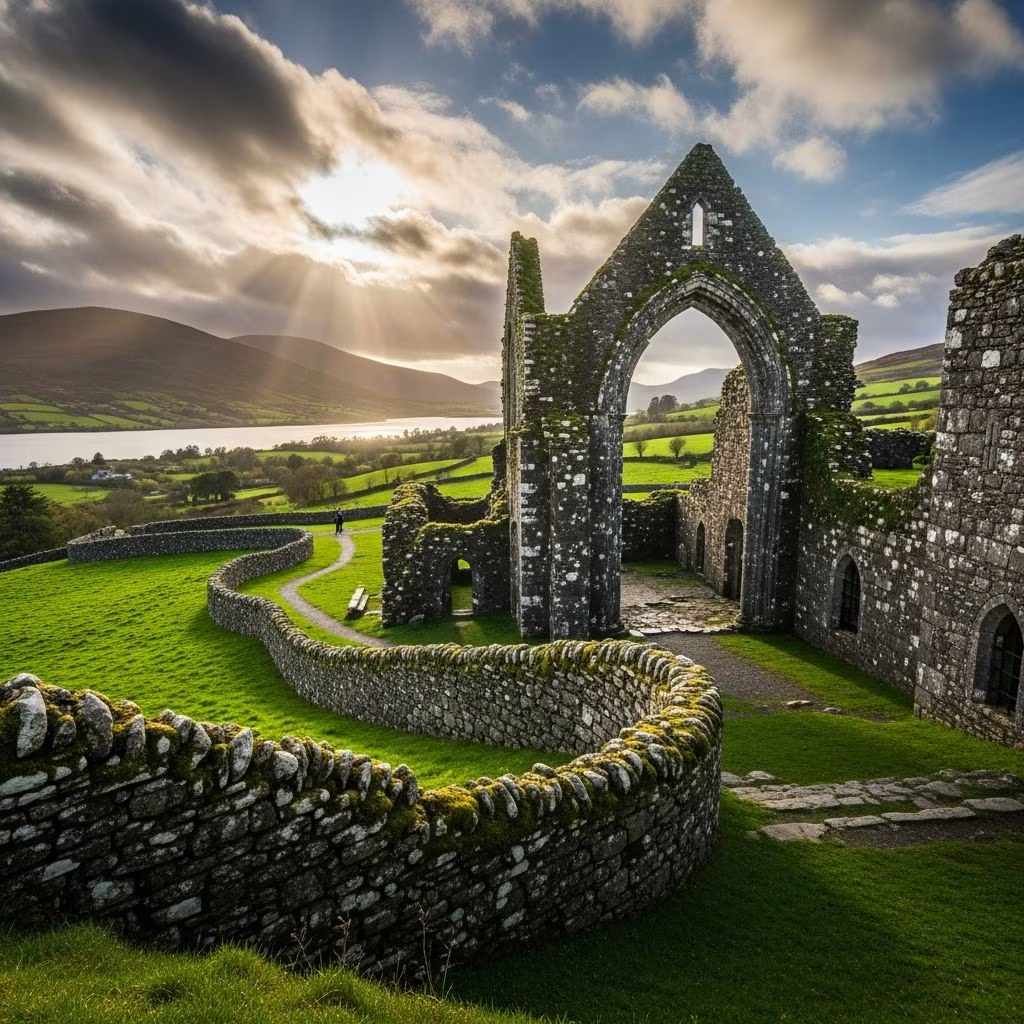
Immerse yourself in millennia of human achievement on a carefully crafted 5-day road trip through Ireland’s Ancient East. Spanning from the bustling streets of Dublin to the Viking-founded city of Waterford, this route covers approximately 560 kilometers of emerald landscapes dotted with prehistoric monuments, early Christian sites, and imposing medieval structures. Designed for self-drive explorers, it offers a seamless blend of history, nature, and culture, revealing how Ireland’s past shaped its enduring legacy.
Begin your adventure in Dublin, Ireland’s vibrant capital, where layers of history await discovery. Start at the National Museum of Ireland – Archaeology, established in 1877, housing one of the world’s premier collections of ancient artifacts. Marvel at the meticulously preserved Iron Age bog bodies, complete with skin, hair, and fingernails, offering a haunting glimpse into pre-Christian rituals. The museum’s galleries on Medieval and Viking Ireland showcase exquisite Celtic metalwork and treasures unearthed from Dublin’s Wood Quay excavations, setting the stage for your journey into deeper antiquity.
After absorbing Dublin’s archaeological riches, collect your rental car and head north on the M1 motorway toward the Boyne Valley. This initial drive of about 50 kilometers introduces the fertile farmlands that have sustained communities for thousands of years. As evening approaches, settle into accommodations in Drogheda or nearby, preparing for the prehistoric marvels ahead.
Dawn breaks over Brú na Bóinne, a UNESCO World Heritage site dating to around 3200 BC, older than Stonehenge by a millennium and Egypt’s pyramids by centuries. This expansive Neolithic complex features passage tombs like Newgrange, a monumental structure 80 meters wide and 13 meters tall, faced with sparkling white quartzite. Its corbelled passage aligns precisely with the winter solstice sunrise, illuminating the chamber in a celestial spectacle engineered by Stone Age builders. Nearby, Knowth boasts over 200 carved stones adorned with spirals, chevrons, and lunar calendars, while Dowth offers serene sheep-grazed fields and additional megalithic art.
Continue 24 kilometers south to the Hill of Slane, steeped in Christian legend. Here, in 433 AD, St. Patrick defied High King Logaire by lighting an Easter fire atop the hill, symbolizing the triumph of Christianity. Patrick famously used a shamrock to explain the Holy Trinity, igniting Ireland’s conversion. The site’s commanding views over the Boyne Valley enhance its spiritual aura.
Just a short drive away lies the Hill of Tara, ancient seat of Ireland’s high kings and a ceremonial center for over 5,000 years. This Iron Age enclosure includes passage tombs, standing stones like the Lia Fáil (Stone of Destiny), and ring forts. Free to wander, Tara’s earthworks whisper tales of druids, Tuatha Dé Danann mythology, and pivotal battles that defined Irish sovereignty.
Venture into County Wicklow’s monastic heartland, beginning with a detour to Monasterboice, home to Ireland’s finest high crosses from the 10th century. Muiredach’s High Cross, standing 5.5 meters tall, is a biblical storyboard carved in stone, used to educate the illiterate faithful with scenes from Adam and Eve to the Crucifixion.
Nearby, the Moone High Cross from the 8th or 9th century captivates with intricate panels depicting biblical narratives amid weathered Celtic knots. Further south, Browne’s Hill Dolmen impresses with its colossal 100-tonne capstone, one of Europe’s largest, perched atop a granite chamber from 5000 years ago—a testament to Neolithic engineering prowess.
A thrilling side trip to Dunmore Cave reveals glittering stalactites and stalagmites in limestone depths. Viking annals record a gruesome 928 AD massacre where 1,000 sought refuge here, only to perish from smoke; 1973 excavations uncovered coins and bones confirming the tragedy. This 10-kilometer diversion adds a dark chapter to Ireland’s saga.
| Site | Era | Key Feature |
|---|---|---|
| Monasterboice High Crosses | 10th Century | Biblical carvings for teaching |
| Moone High Cross | 8th-9th Century | Figural reliefs |
| Browne’s Hill Dolmen | Neolithic (5000 years) | Massive capstone |
| Dunmore Cave | Viking Age | Historical massacre site |
Ascend the Rock of Cashel, a limestone plateau crowned by a 1,000-year-old complex of fortifications, cathedrals, and chapels. Once a Munster kings’ seat gifted to the church in 1101, it features Cormac’s Chapel (1127), Ireland’s earliest Romanesque building with vibrant fresco remnants; a 13th-century Gothic cathedral; and a soaring 12th-century round tower. The Hall of the Vicars Choral provides entry to this ecclesiastical fortress, where kings and clergy wielded immense power.
Twenty kilometers south, Cahir Castle exemplifies Norman might. Built in 1142 on an island amid the River Suir, its moat, turrets, and dungeons remain remarkably intact. Explore banquet halls and battlements, then contrast eras at the Swiss Cottage—a fanciful 1810 Regency thatched villa in landscaped gardens, embodying Romantic escapism.
Overnight in Cahir or nearby, reflecting on the transition from pagan kings to Christian overlords and Norman invaders.
Conclude in Waterford, Ireland’s oldest city, founded as a Viking longphort in 914 AD. The Viking Triangle concentrates 1,000 years of history: Reginald’s Tower, a 13th-century cylindrical keep that’s Ireland’s oldest civic building, served as mint, prison, and fortress. The Medieval Museum displays rare 15th-century vestments and urban artifacts. Housed in an 18th-century Georgian mansion, the Bishop’s Palace traces Waterford’s evolution from 1700 to modern times.
This finale ties Neolithic beginnings to Viking enterprise, with cobblestone streets and harbor views evoking Norse shipwrights. From here, return your car or extend into Waterford’s crystal heritage.
This region stands apart by compressing 5,000 years into accessible drives, unlike Ireland’s wilder coasts. Each site builds chronologically: from Neolithic farmers’ cosmic tombs, through Celtic-Christian synthesis on sacred hills, to Viking and Norman conquests. It’s an open-air timeline where folklore meets archaeology, rewarding curious travelers with profound insights into Ireland’s resilient spirit.
Yes, sites offer kid-friendly legends like St. Patrick’s shamrock and interactive museums, though some walks involve uneven terrain.
Average 100-150km, with ample stops; total under 6 hours driving time spread out.
Moderate trails at Brú na Bóinne, Tara, and Glendalough (near Day 3 route) provide scenic history walks.
Per person (sharing car): €500-800 including fuel, entries (€15-25/site), meals, and mid-range lodging.
Limited; self-drive recommended for flexibility among rural sites.
Add days for Glendalough’s monastic valley, Kilkenny Castle’s medieval grandeur, or Loughcrew Cairns’ equinox-aligned tombs. Ireland’s Ancient East spans 17 counties, offering endless detours.
