

 Travel Essentials
 Travel Essentials

Discover seven extraordinary libraries within UNESCO World Heritage Sites, from Portugal's baroque treasures to Korea's ancient wooden script halls, blending culture and intellect.
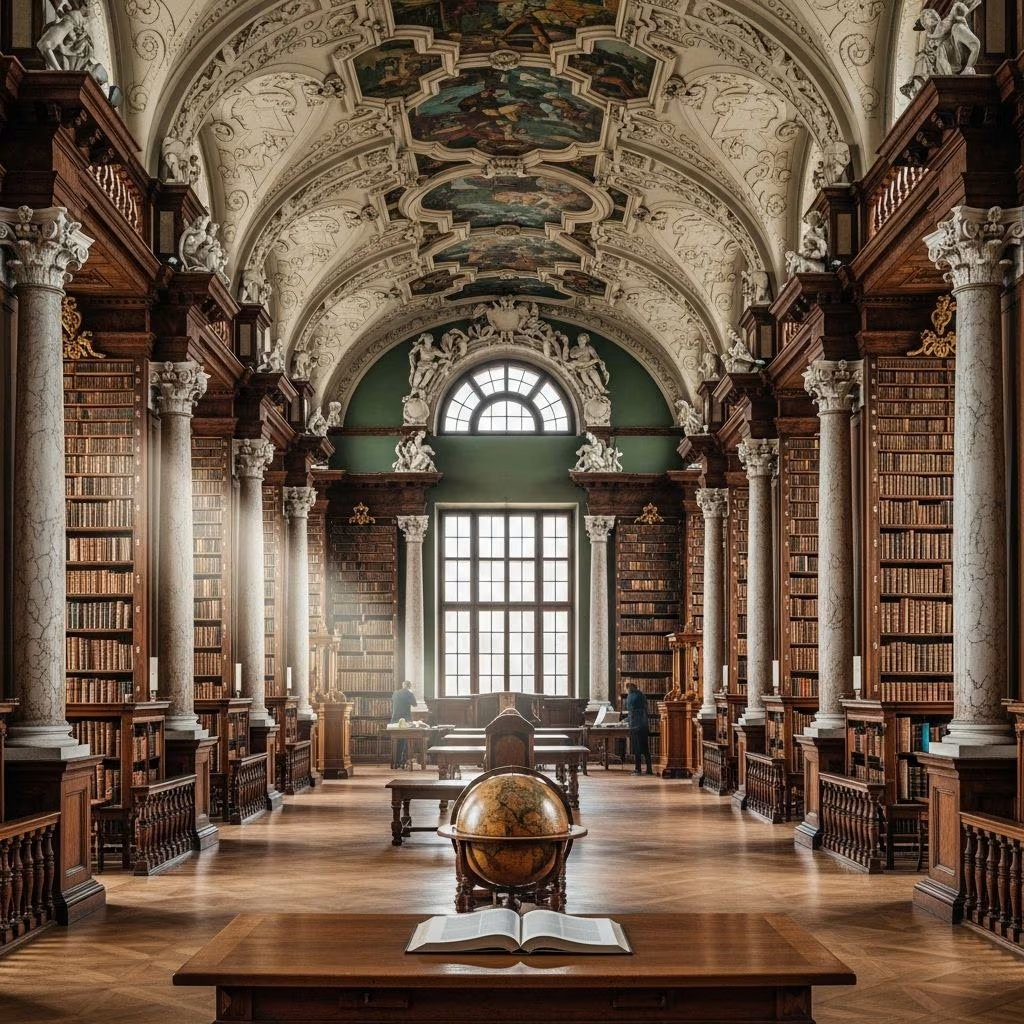 Travel Essentials
Scattered across the globe, certain libraries transcend their role as mere repositories of books. Nestled within UNESCO World Heritage Sites, these institutions embody the pinnacle of human achievement in architecture, preservation, and intellectual pursuit. They invite travelers to step into spaces where centuries-old manuscripts whisper stories of bygone eras, ornate ceilings depict philosophical ideals, and innovative designs protect fragile knowledge from the ravages of time. This exploration highlights seven such libraries, each a jewel in its cultural crown, offering profound insights into the civilizations that built them.
Libraries within UNESCO-designated areas are more than architectural spectacles; they are living museums of thought. UNESCO recognizes these sites for their outstanding universal value, often encompassing monastic complexes, ancient universities, and royal palaces that have safeguarded knowledge through wars, revolutions, and natural disasters. Visitors to these libraries encounter not just books but the very essence of cultural continuity. From the gilded shelves of Europe to the wooden halls of Asia, these spaces challenge the modern traveler to appreciate knowledge as a tangible heritage asset.
Architecturally, they showcase diverse styles: Baroque exuberance, Renaissance restraint, and Eastern minimalism. Functionally, many incorporate unique preservation techniques, such as bat colonies for pest control or elevated wooden blocks for humidity resistance. Beyond aesthetics, they host rare collections—over 80,000 woodblocks in one case, or 170,000 medieval items in another—making them essential stops for anyone seeking depth in their wanderings.
Perched atop a hill in the University of Coimbra, a UNESCO-listed gem since 2013, the Joanina Library stands as a testament to 18th-century opulence. Commissioned by King João V, this Baroque wonder features three vaulted rooms adorned with Brazilian rosewood shelving, intricate gilt carvings, and trompe-l’œil frescoes glorifying sciences and arts. Housing over 60,000 volumes, many from the 16th century on theology, medicine, and law, the library’s leather-bound tomes gleam under ornate chandeliers.
What sets it apart is its ecosystem: a colony of bats emerges nightly to devour insects, naturally protecting the collection—a clever Baroque-era solution still in practice. Visitors must don shoe covers to preserve the flooring, enhancing the sense of stepping into a sacred space. The library’s integration into the university’s historic core amplifies its allure, blending education with preservation.
In the serene town of St. Gallen, part of the UNESCO-listed Abbey of St. Gall since 1983, the Abbey Library captivates with its Rococo splendor. Dating to the 8th century but redesigned in the 18th, this hall boasts pastel frescoes, stucco arabesques, and multi-tiered galleries holding 170,000 items, including the priceless Plan of St. Gall—the oldest surviving architectural drawing from the West.
The collection spans medieval Latin manuscripts, Old High German texts, and incunabula, reflecting the abbey’s role as a Carolingian-era knowledge center. Globes, scientific instruments, and anatomical models line the walls, underscoring the monastic blend of faith and inquiry. Access is strictly regulated, with a modern annex housing most treasures, allowing the hall to remain a pristine time capsule.
Within Puebla’s Historic Centre, a UNESCO site since 1987, the Biblioteca Palafoxiana claims the title of the Americas’ first public library, founded in 1646 by Bishop Juan de Palafox y Mendoza. Housed in a former archbishop’s palace, its single nave features Churrigueresque shelving rising to 10 meters, framing 40,000+ volumes in languages from Hebrew to Nahuatl.
Rare maps, colonial chronicles, and Enlightenment works fill the space, symbolizing Mexico’s intellectual bridge between Old and New Worlds. Ceiling paintings exalt reading as divine, while iron grilles and cedar wood deter decay. Open to the public since inception (with caveats for women until the 19th century), it embodies democratic access to knowledge.
Strahov Monastery’s library in Prague’s Historic Centre (UNESCO since 1992) comprises two magnificent rooms: the Theological Hall (1679) and Philosophical Hall (1790). Boasting 200,000+ volumes, including globes, herbariums, and astronomy texts, the halls feature walnut paneling, frescoed vaults depicting knowledge’s triumph, and brass chandeliers.
The Theological Hall’s Bible wall and the Philosophical Hall’s illusionistic dome create immersive scholarly atmospheres. Once a Premonstratensian hub, it survived fires and wars, preserving medieval manuscripts amid Enlightenment ideals. Rolling ladders and scholarly busts invite contemplation.
Michelangelo’s Biblioteca Laurenziana in Florence’s Historic Centre (UNESCO since 1982) elevates library design to art. Built 1523–1571 for the Medici, its reading room features rhythmic pietra serena columns and carved desks, with a vestibule of Mannerist drama—elongated supports and riccio consoles challenging classical norms.
The collection of 11,000 manuscripts, including Greek classics and biblical codices, fueled the Renaissance. Subterranean storage protects against floods, a nod to Florence’s Arno woes. It’s a pilgrimage site for architecture buffs and humanists alike.
The Monastery of El Escorial, UNESCO-listed since 1984, houses King Philip II’s library in a 54-meter barrel-vaulted hall by Juan de Herrera. With 40,000+ volumes—Greek, Arabic, scientific texts, and maps—shelves use slanted supports for airflow, aiding preservation.
Frescoes illustrate liberal arts, while royal portraits oversee the space. Integrated into the vast complex, it reflects Spain’s Golden Age imperial ambitions, blending piety with patronage of learning.
At Haeinsa Temple in Gayasan National Park (UNESCO since 1995), the Janggyeong Panjeon shelters 81,258 woodblocks of the Tripitaka Koreana, carved 1236–1251. Four halls with slatted floors and louvered windows ensure ventilation, protecting blocks stacked upright like books.
This Joseon-era feat, reborn after Mongol invasions, represents Buddhist devotion and printing mastery. No nails or glue bind the structures, harmonizing with nature. Pilgrims circumambulate the halls, absorbing millennia of wisdom.
Visiting these libraries requires foresight: most charge entry (e.g., €12.50 for Joanina), limit photography, and mandate guided tours. Combine with site explorations—Coimbra’s fado nights, Prague’s bridges, Florence’s Uffizi. Best seasons avoid peak crowds: spring in Europe, fall in Korea.
| Library | Location | Key Feature | UNESCO Year |
|---|---|---|---|
| Joanina | Portugal | Bat pest control | 2013 |
| St. Gall | Switzerland | Plan of St. Gall | 1983 |
| Palafoxiana | Mexico | First public in Americas | 1987 |
| Strahov | Czech Rep. | Frescoed domes | 1992 |
| Laurenziana | Italy | Michelangelo design | 1982 |
| El Escorial | Spain | Airflow shelves | 1984 |
| Janggyeong Panjeon | S. Korea | 81k woodblocks | 1995 |
Yes, all offer visitor access with tickets and rules; reservations advised for peak times.
Outstanding universal value in cultural, historical, or scientific terms, per UNESCO criteria.
No, viewing is from designated areas to protect collections.
Varies; check sites for ramps, audio guides—e.g., St. Gall has modern facilities.
They prioritize preservation and symbolism over lending, focusing on cultural legacy.
