

 Travel Essentials
 Travel Essentials

Comprehensive guide covering optimal visiting times, ticket strategies, navigation tips, and ancient monuments to explore at Athens' most iconic archaeological site.
 Travel Essentials
The Acropolis stands as one of the world’s most visited archaeological sites, attracting millions of visitors annually to witness the remnants of ancient Greek civilization perched atop a rocky plateau overlooking modern Athens. As a UNESCO World Heritage Site that has been systematically explored and organized since 1833, the Acropolis represents far more than a collection of ruins—it embodies the cultural and architectural zenith of classical antiquity. For first-time visitors, understanding how to navigate this iconic destination transforms what could be an overwhelming experience into a meaningful journey through history.
Timing plays a crucial role in determining your Acropolis experience. The shoulder seasons of April, May, and October emerge as the optimal windows for exploration, offering a perfect equilibrium between manageable crowds and favorable weather conditions. During these months, temperatures remain comfortable without the intense heat that characterizes summer, and visitor numbers have not yet reached the overwhelming peaks of July and August.
Summer months present the busiest period, with both extreme temperatures and congested pathways making navigation challenging. If you must visit during summer, arriving at opening time (8:00 AM) provides the best opportunity to experience the site with relative tranquility before midday tour groups inundate the premises. The shoulder seasons, conversely, allow you to maintain a leisurely pace while absorbing the historical significance of each monument without feeling rushed by the surrounding crowds.
The Acropolis now operates with mandatory timed-entry ticketing and daily visitor caps of approximately 23,000 people, making advance planning essential for a smooth experience. Purchasing tickets online through official channels eliminates queue delays at physical entrance points—a significant advantage during peak tourism periods when wait times can stretch from 20 to 60 minutes.
Several ticket categories accommodate different visitor preferences and budgets:
Early morning time slots (7:00-9:00 AM) and late afternoon windows (after 5:00 PM) consistently experience lower visitor volumes and cooler temperatures, making these periods particularly appealing for photography and contemplative exploration. The investment in advance booking provides not only convenience but also genuine value through crowd mitigation.
Two distinct entrances serve the archaeological site, each presenting unique advantages depending on your specific routing and schedule. The primary western entrance, situated at the base of the Propylaea near Dionysiou Areopagitou Street and adjacent to Acropolis Metro Station, functions as the main public access point. This entrance typically experiences the heaviest congestion, with queues potentially stretching 20 to 60 minutes during peak seasons.
The southeastern entrance, located near the Acropolis Museum at the intersection of Makrygianni Street and Dionysiou Areopagitou, offers an alternative with substantially shorter wait times averaging 15 to 30 minutes. This entrance proves particularly advantageous for visitors combining museum and archaeological site exploration or arriving during early morning hours when few tourists have yet assembled.
Modern accessibility improvements have transformed the site’s inclusivity. A specifically designed elevator installed on the northeastern slope accommodates visitors with mobility limitations, while a concrete perimeter path constructed in 2021 enhances wheelchair navigation. These infrastructure developments ensure that physical limitations need not prevent anyone from accessing this irreplaceable cultural resource.
Arriving precisely at opening time (8:00 AM) during any season provides the quietest conditions for site exploration. During low-season periods, initial tour groups typically do not arrive until 8:30 AM, creating a valuable window for independent exploration without navigating established pathways crowded with guided parties. This early-arrival strategy allows you to photograph monuments with minimal human obstruction and absorb the atmospheric qualities that daytime crowds inevitably diminish.
Alternatively, later afternoon and early evening visits (after 5:00 PM) during extended summer hours provide similarly advantageous conditions. The combination of declining visitor numbers and dramatic angled sunlight creates exceptional photography opportunities while maintaining comfortable exploration temperatures as afternoon heat dissipates.
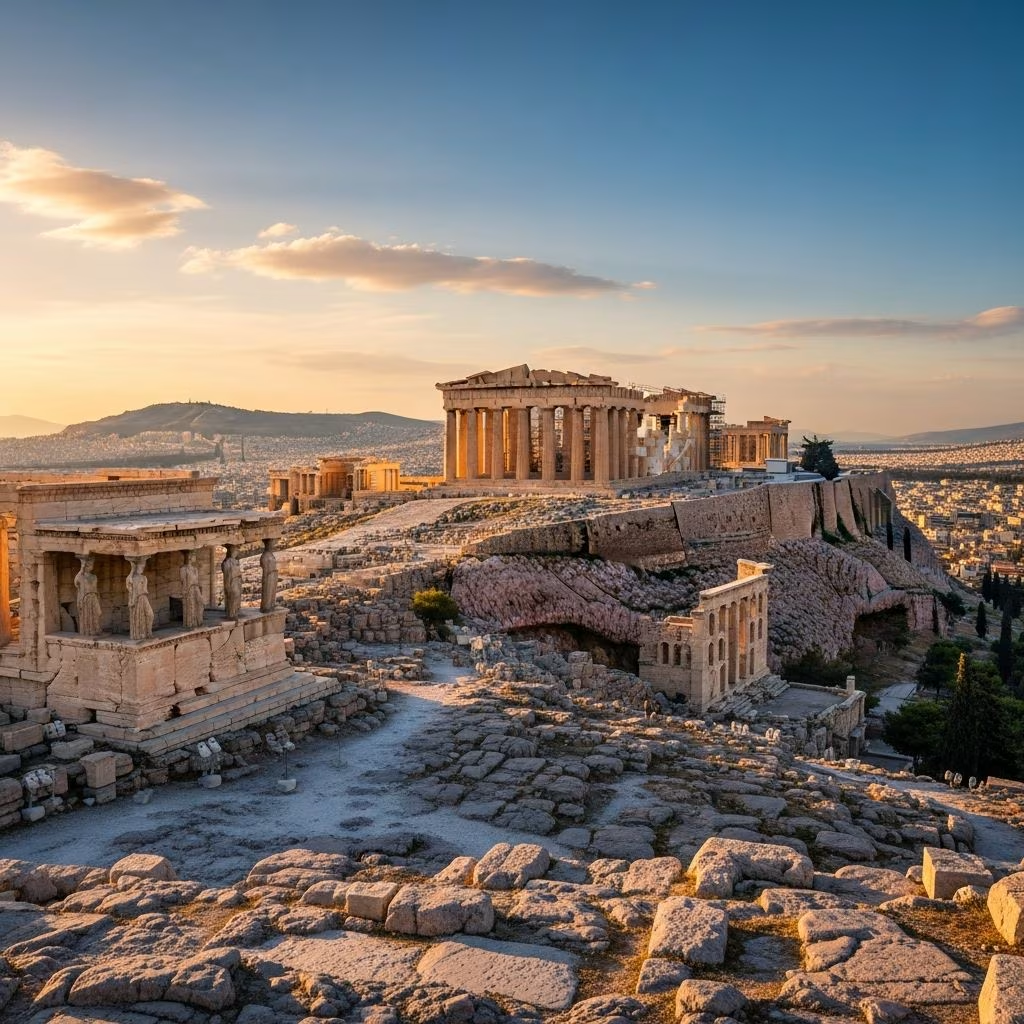
The Acropolis encompasses far more than the internationally recognized Parthenon, though this temple remains the site’s most photographed structure. Understanding the distinct architectural and historical significance of each monument enriches your physical experience considerably.
The Parthenon dominates the skyline as the temple dedicated to Athena Parthenos, constructed between 447 and 432 BCE as the artistic and theological centerpiece of ancient Athens. Its mathematical precision, optical refinements, and sculptural program represent the apotheosis of classical architecture. Despite appearing to embody perfect geometric regularity, the Parthenon incorporates subtle curvatures and dimensional adjustments designed to counteract optical illusions—a sophisticated architectural principle largely imperceptible to casual observers.
The Erechtheion occupies the northern plateau as an architectural anomaly compared to the Parthenon’s classical symmetry. This irregular temple accommodates multiple religious functions simultaneously, housing shrines to different deities within its asymmetrical plan. The iconic Porch of the Maidens, supported by sculptural female figures serving as architectural columns, represents one of antiquity’s most recognizable artistic achievements.
The Temple of Athena Nike manifests as a diminutive yet elegantly proportioned structure positioned at the southwestern edge of the site. Dedicated to the goddess of victory, this temple exemplifies the refined proportions characteristic of classical architecture scaled to intimate dimensions.
The Odeon of Herodes Atticus functions as the architectural gateway encountered immediately upon entry, a Roman-period theater constructed in 161 CE featuring marble seating and a distinctive checkerboard stage floor. Modern renovations enable this venue to host contemporary performances, creating a living bridge between ancient and contemporary cultural traditions.
Independent exploration without interpretive guidance significantly diminishes your understanding of the site’s historical and architectural significance. Audio guides provide essential context explaining architectural innovations, historical narratives, and religious functions that transform scattered ruins into comprehensible narratives of ancient Athenian civilization.
Options include purchased audio guide equipment at the entrance, inclusion within skip-the-line ticket packages, or digital downloads accessible via smartphone before arrival. The investment in such interpretive tools facilitates genuine learning rather than mere monument observation, enabling you to grasp the sophisticated theological concepts, civic functions, and aesthetic principles embedded within these structures.
| Visit Category | Recommended Duration | Suitable For | Typical Route Structure |
|---|---|---|---|
| Abbreviated Survey | 1.5–2 hours | Time-constrained visitors prioritizing highlights | Primary entrance → Parthenon → Erechtheion → Herodes Atticus Theatre → Exit |
| Comprehensive Experience | 3–4 hours | Most first-time visitors seeking balanced immersion | Primary entrance → All major monuments → Theatre of Dionysus → Plaka neighborhood descent |
| Intensive Exploration | 6+ hours | History enthusiasts and archaeological researchers | Complete circuit including south slope temples, ancient agora integration, museum coordination |
A comprehensive three to four-hour visit enables thorough engagement with primary monuments while maintaining reasonable physical exertion levels. This timeframe accommodates detailed observation, interpretive consultation, and contemplative absorption without exhaustion-induced diminishing returns that extend visits beyond eight hours.
The Acropolis Museum, situated approximately ten minutes’ walking distance from the primary site entrance, warrants dedicated time following your archaeological exploration. Museum exhibits frequently reference ruins you have just observed, creating meaningful contextual connections impossible to appreciate without prior site familiarity. Sculptures, architectural fragments, and artifact collections assume far greater significance when you have witnessed the original contexts and proportions.
The Acropolis features uneven stone pathways, often steep grades, and minimal shade. Durable, broken-in walking footwear with secure ankle support proves essential. Light, breathable clothing with sun protection layers accommodates temperature fluctuations and extended outdoor exposure. Sunscreen and hydration containers represent non-negotiable preparatory items.
Photography for personal use is permitted throughout the site. Professional photography equipment or commercial shooting requires advance permits. Tripods and large format cameras may face limitations during peak hours when pathway congestion demands unrestricted movement.
The northeastern elevator installation and concrete peripheral pathway substantially improve accessibility compared to historical conditions. However, terrain irregularities persist throughout the site. Visitors with significant mobility limitations should contact site administration in advance to coordinate specific assistance arrangements.
Exclusive private tours during early morning (7:00-9:00 AM) and late evening (8:00-10:00 PM) hours accommodate small groups (up to five people) at substantial premium pricing. These specialized tours provide extraordinary photographic opportunities and minimal competitor presence.
The Ancient Agora, situated at the Acropolis’ base, functions as the civic and commercial center complementing the religious functions of the plateau monuments. A comprehensive half-day visit typically incorporates both sites sequentially, descending from the Acropolis through neighborhoods to agora exploration.
Multiple transportation modalities connect central Athens to the Acropolis. The Metro system’s “Akropoli” station provides direct access to the southeastern entrance and museum proximity. Bus routes serve “Makrigianni” adjacent to the southeastern entrance, while the central “Syntagma” station enables pedestrian navigation through historic districts to the western entrance. Taxi services and walking from central accommodation areas remain viable options for independent travelers preferring flexible timing without scheduling constraints.
Pre-visit familiarity with classical Greek history, democratic philosophical traditions, and architectural innovations significantly enhances experiential depth. Understanding the Acropolis not merely as tourist destination but as the physical manifestation of ancient Athenian civic aspiration transforms observation into meaningful cultural engagement. The monuments represent not historical artifacts existing in temporal isolation but tangible expressions of philosophical, religious, and aesthetic values that continue informing Western civilization’s foundational principles.
