

 Travel Essentials
 Travel Essentials

Explore how exploding road networks in Africa's tropical forests threaten biodiversity hotspots, fragment habitats, and boost hunting, drawing from scientific studies on Congo Basin and Nigeria projects.
 Travel Essentials
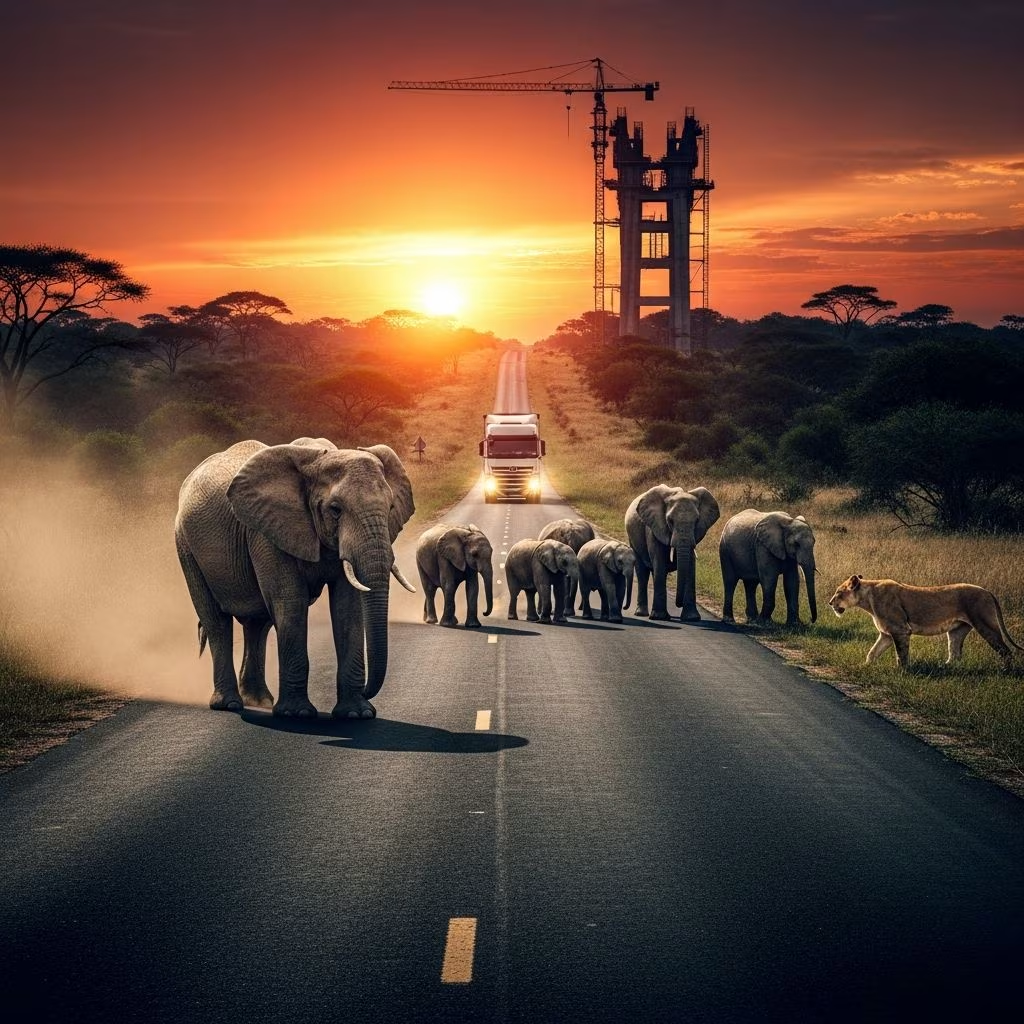
Africa’s lush tropical forests, home to unparalleled biodiversity, face an unprecedented assault from rapid infrastructure development. Vast road networks and highways, designed to spur economic growth, are carving through pristine habitats, fragmenting ecosystems, and opening floodgates to exploitation. This expansion, often dubbed an “infrastructure tsunami,” could irreversibly alter the continent’s ecological balance, affecting everything from endangered primates to ancient forest giants.
Sub-Saharan Africa is witnessing a boom in transportation projects, with 33 major development corridors planned or underway. These routes promise to connect remote regions, facilitating trade and resource extraction. However, their environmental cost is staggering: they threaten to bisect or degrade approximately one-third of all protected areas in the region. Notably, 23 corridors remain in early planning stages, posing the greatest risk as they slice through high-priority sites like World Heritage areas and Ramsar wetlands, totaling over 3,600 kilometers of protected habitat.
In the greater Congo Basin, a global biodiversity hotspot, new roads are proliferating at an alarming rate. These projects grant unprecedented access to previously untouched areas, amplifying threats like logging, poaching, and land conversion. Without proactive land-use planning, this surge could diminish forest cover and wildlife populations irreversibly.
Roads act as impenetrable barriers, disrupting animal movements and gene flow. Large mammals, such as forest elephants (Loxodonta africana cyclotis) and lowland gorillas (Gorilla gorilla gorilla), avoid roadsides due to noise, traffic, and human presence. Studies in Gabon’s rainforests reveal that ungulates like duikers and sitatungas (Tragelaphus spekei gratus) show pronounced road avoidance, with effects intensifying where hunting pressure is high.
Fragmentation reduces habitat connectivity, shrinking viable population sizes and increasing extinction risks. In protected areas, this effect compounds, as roads erode buffer zones meant to shield core habitats. Predictive models from analogous systems, such as tiger populations in Nepal’s Chitwan National Park, forecast severe declines: existing roads alone could kill 46 tigers over 20 years through vehicle collisions and prey depletion, slashing adult populations by 39%.
| Species Group | Road Impact Observed | Key Locations |
|---|---|---|
| Large Ungulates (e.g., elephants, duikers) | Strong avoidance, population depression | Central African rainforests |
| Primates (e.g., gorillas, monkeys) | Variable; gorillas highly affected | Gabon concessions |
| Carnivores | Reduced near roads | Tropical forests |
| Small Mammals (e.g., rodents, pangolins) | Increased in disturbed areas | Outside protected zones |
This table summarizes mammal responses to roads, highlighting how impacts vary by body size and hunting intensity.
Improved roads lower barriers to hunters, enabling deeper penetration into forests. In southern Gabon, mammal abundances plummet near roads outside concessions, where unregulated hunting thrives. Duikers and other ungulates suffer most, with road avoidance magnifying under moderate hunting—a pattern likely replicated across Central Africa.
Nigeria’s proposed Cross River Superhighway exemplifies this danger. Routed through the nation’s last major rainforest tract and alongside Cross River National Park, it endangers 20% of global butterfly species and endemic flora. With 90% of Nigeria’s rainforests already lost, this highway could catalyze the demise of remaining stands, boosting bushmeat trade and timber poaching.
Cross River State harbors Nigeria’s vital forest remnants, including a REDD+ pilot site. The superhighway, intended for economic linkage, skirts the park’s edge—a proposed World Heritage site. Critics argue its path invites disaster, fragmenting habitats and inviting exploitation. Rerouting emerges as a critical mitigation, yet political and developmental pressures persist.
Internationally, similar concerns shadow projects like China’s Belt and Road Initiative (BRI), which funds African infrastructure but risks biodiversity in Eurasia and Africa. Proactive environmental impact assessments are urged to balance growth with conservation.
These factors interplay, creating feedback loops that amplify damage. For instance, prey depletion near roads starves predators, mirroring tiger declines where mammal abundances drop with road proximity.
To avert catastrophe, African nations need robust frameworks. Key strategies include:
Capacity building in Equatorial Africa is vital, fostering local expertise for sustainable decisions. International funding, like from development banks, should tie aid to eco-standards.
Insights from Asia underscore urgency. In Sumatra and China, tiger habitats shrink near roads due to avoidance and poaching. Applying agent-based models to African contexts could forecast outcomes, guiding policies. For elephants and gorillas, early intervention is key—once populations crash, recovery spans decades.
Africa’s forests store vast carbon, buffering climate change. Their loss would spike emissions, hitting the continent hardest despite low contributions. Sustainable infrastructure offers a dual win: connectivity without collapse.
About one-third, with planned corridors posing the highest risks to priority sites.
They cause avoidance behaviors, fragment habitats, and boost hunting, depressing populations of elephants, gorillas, and ungulates.
Yes, through careful planning, wildlife passages, and green tech, balancing growth with biodiversity.
It endangers Nigeria’s remaining rainforests and a key national park, risking endemic species and global biodiversity.
Roads increase access, intensifying pressure and altering community structures even at moderate levels.
