

 Travel Essentials
 Travel Essentials

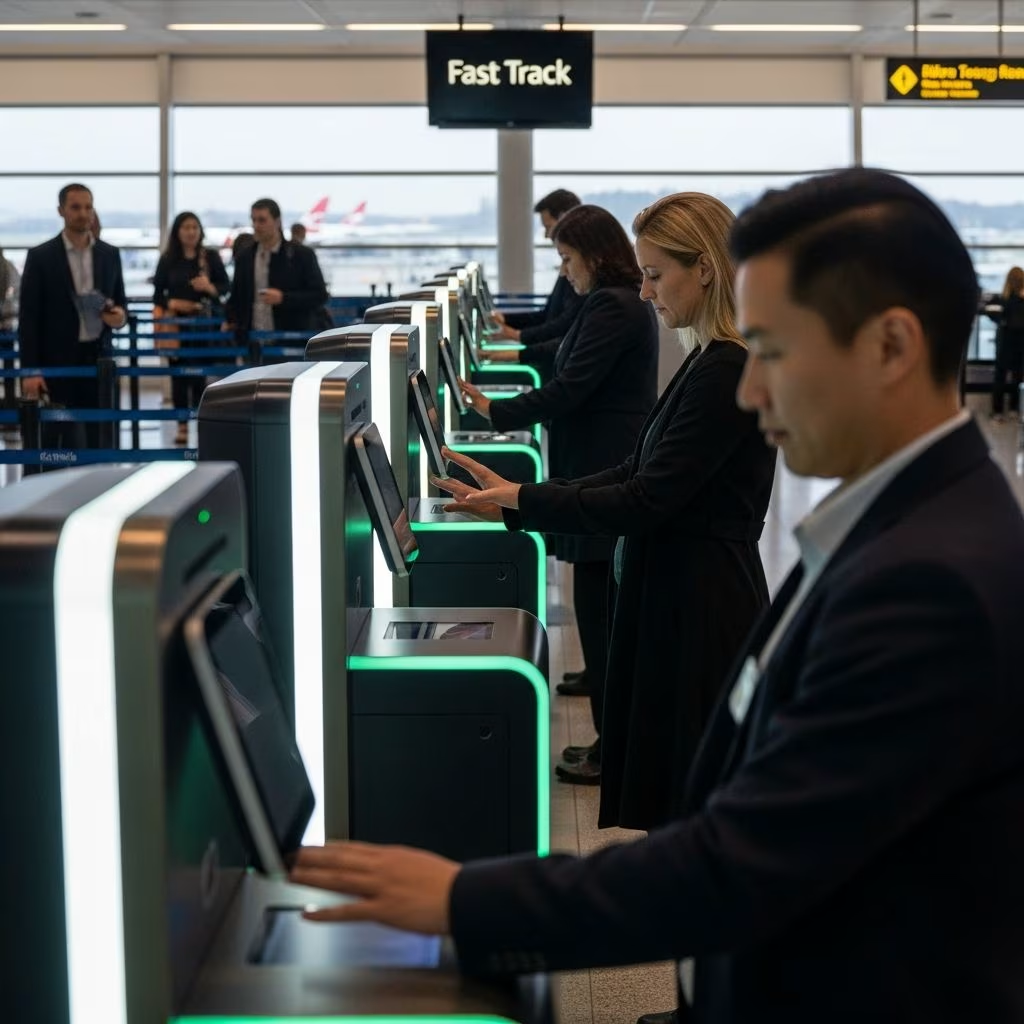
Discover how biometric identity verification systems revolutionize airport security, offering expedited screening through fingerprint and iris recognition technology.
 Travel Essentials
Air travel has undergone significant transformations over the past two decades, particularly in how airports manage security screening. What once required manual identity verification by trained agents has evolved into sophisticated automated systems powered by biometric technology. These innovations represent a fundamental shift in how travelers move through airports, replacing traditional time-consuming processes with technology-driven solutions that prioritize both efficiency and security.
The integration of biometric systems into airport security reflects broader industry efforts to balance two competing demands: maintaining rigorous security protocols while minimizing delays that frustrate millions of travelers annually. Modern airports recognize that enhanced efficiency doesn’t compromise safety—in fact, streamlined processes often improve overall security by reducing congestion and human error in verification procedures.
Biometric verification systems utilize unique physical characteristics to confirm traveler identity without requiring manual document inspection. These systems capture and analyze distinctive biological markers that belong exclusively to each individual, creating a nearly impossible-to-duplicate identification method. The technology operates through sophisticated scanning equipment positioned at designated security checkpoints, where trained ambassadors guide travelers through the verification process.
The primary biometric identifiers used in airport security include:
Each of these methods offers distinct advantages for airport environments. Fingerprint technology provides rapid verification while maintaining accuracy rates exceeding 99.9%. Iris scanning offers exceptional security due to the extreme uniqueness of iris patterns, which remain consistent throughout an individual’s lifetime. Facial recognition systems operate at distance, allowing verification without direct contact with scanning equipment, a feature particularly valuable in post-pandemic airport operations.
The operational workflow for biometric verification differs significantly from traditional security processes. Rather than waiting in a standard queue for a Transportation Security Administration agent to manually examine identification documents, travelers using biometric systems proceed to dedicated verification lanes where automated scanning occurs. Upon arrival at a biometric pod, a security ambassador initiates the verification sequence by requesting the traveler position their finger on the scanner or look directly at the iris camera.
The verification typically completes within seconds. The system compares the scanned biometric data against the traveler’s enrolled profile stored in the secure database. Upon successful verification, the ambassador clears the traveler to proceed directly to the physical screening area, effectively bypassing the identity verification queue entirely. This streamlined approach eliminates the need for travelers to remove identification from wallets or bags, reducing friction points and accelerating the overall process.
Importantly, travelers utilizing biometric systems still must complete standard physical security screening. The biometric technology specifically accelerates the identity verification component—typically the longest and most labor-intensive portion of security procedures. After identity confirmation, travelers proceed to the conventional screening stations where they remove shoes, place laptops in bins, and undergo metal detection and baggage screening as required.
The biometric expedited security landscape includes multiple distinct programs, each addressing different aspects of airport screening. Understanding the differences helps travelers select services aligned with their travel patterns and security preferences.
| Program Aspect | Biometric Identity Verification | Traditional PreCheck Alternative |
|---|---|---|
| Primary Function | Eliminates ID verification queue through biometric scanning | Provides expedited physical screening with relaxed clothing/baggage requirements |
| Operator | Private commercial company | U.S. Transportation Security Administration (government) |
| Annual Cost | $189-$209 per year | $78-$85 per five-year period |
| Airport Coverage | Available at 50+ airports nationwide | Operational at 200+ airports |
| Additional Venues | Select sports stadiums and entertainment venues | Primarily airport-focused |
| Verification Method | Fingerprint, iris, or facial biometric scanning | Background check and identity document review |
The distinction between these programs represents a fundamental difference in how they accelerate travel. Biometric systems focus exclusively on the identity verification stage, while traditional PreCheck programs streamline the physical screening portion. Savvy frequent travelers often utilize both services simultaneously, creating the optimal pathway through airport security procedures.
Participating in biometric airport security requires completing a straightforward enrollment procedure. The process begins with an online application submitted through the program’s official website, where applicants provide biographical information and respond to initial verification questions. This digital submission establishes an account and initiates background verification procedures.
Following online approval, applicants must visit a designated biometric enrollment location, typically situated at major airport terminals. During the in-person appointment, security personnel verify identity documentation such as valid passports or driver’s licenses. The ambassador then guides the applicant through biometric capture, systematically recording fingerprints, iris patterns, and facial imagery. This comprehensive biometric profile becomes permanently associated with the traveler’s account and stored in secure databases maintained with stringent privacy protections.
Eligibility requirements generally include United States citizenship or lawful permanent resident status, minimum age requirements (typically 18 years), and passage of background verification procedures. The entire enrollment typically completes within a single visit, though some applicants may require additional verification steps if background checks reveal unusual circumstances.
Biometric data collection and storage involve sophisticated security protocols that exceed standard data protection measures. Systems utilized in airport environments meet rigorous federal security standards established by the National Institute of Standards and Technology. These frameworks mandate encryption requirements, access controls, and audit procedures designed to prevent unauthorized data disclosure.
The Department of Homeland Security has formally designated biometric airport security technology as Qualified Anti-Terrorism Technology, acknowledging its security effectiveness and operational integrity. This designation reflects extensive government evaluation and represents formal recognition of the technology’s value to national security infrastructure.
Biometric data possesses inherent security advantages compared to traditional identification documents. Unlike passwords that can be forgotten or identification cards that can be lost or stolen, biometric markers remain unique and unchangeable throughout an individual’s lifetime. The mathematical probability of two individuals sharing identical fingerprints or iris patterns approaches zero, making spoofing or identity fraud virtually impossible through these systems.
Biometric airport security programs offer flexible membership configurations accommodating individual travelers and family groups. Standard individual memberships provide annual access to biometric verification lanes at participating airports and venues. For families traveling together, programs offer economical options allowing multiple household members to share a single account rather than purchasing separate memberships.
Family additions typically cost substantially less than independent memberships—approximately 60-70% of the full membership fee. This pricing structure recognizes that multi-member families receive proportionally greater value from the service while benefiting the program through increased utilization. Some programs extend complimentary enrollment to dependent children under 18, allowing youth family members to utilize biometric verification without purchasing separate memberships, requiring only parental account holders to complete formal enrollment.
These flexible membership options make biometric airport security services accessible to families across various income levels and travel frequencies. Families that travel together frequently find the cumulative time savings throughout the year justify the annual membership investment.
The advantages of biometric airport security extend across diverse traveler demographics, though benefits vary based on travel frequency and airport usage patterns. Business travelers who navigate airports dozens of times annually accumulate substantial time savings across the year. For a commuter flying between two cities weekly, eliminating 10-15 minutes from each airport visit translates to hours saved annually—time that can be redirected toward productive work or family commitments.
Leisure travelers taking multiple annual vacations benefit from reduced stress and improved travel experiences. The ability to expeditiously proceed through security allows travelers to arrive at airports with less time pressure, reducing anxiety associated with flight departures. Families traveling with young children particularly appreciate streamlined security processes that minimize disruption and waiting periods for restless youngsters.
International travelers increasingly recognize biometric systems as valuable investments. While standard airport security processes create unpredictable delays that complicate flight connections and tight itineraries, biometric verification provides reliable, rapid processing. Travelers connecting through hub airports appreciate the guaranteed expedited verification when circumstances demand maximum efficiency.
Airport biometric security continues evolving beyond traditional fingerprint and iris scanning. Facial recognition technology has emerged as a significant innovation, offering touchless verification that captures identity information from photographs taken during the verification process. This advancement eliminates the need for travelers to place fingers on scanning surfaces—a feature with obvious hygiene benefits in crowded airport environments.
Advanced facial recognition systems map distinctive facial geometry, measuring distances between key facial features to create unique numerical profiles. These systems operate rapidly, often completing verification within the time required for a traveler to look toward the camera. Integration of multiple biometric identifiers—combining facial recognition with backup fingerprint or iris scanning—creates redundant verification systems that maintain accuracy while accommodating travelers with visual impairments or fingerprint irregularities.
No, biometric systems specifically accelerate the identity verification portion of security procedures. Travelers still undergo conventional physical screening including metal detection, baggage scanning, and body imaging. The time savings result from bypassing the identity verification queue, not from reduced security rigor.
Yes, absolutely. Combining biometric identity verification with traditional PreCheck programs creates optimal security efficiency. Travelers first utilize biometric scanning to bypass ID verification, then proceed to PreCheck screening lanes that offer relaxed clothing requirements and streamlined baggage procedures.
The actual biometric scanning process typically completes within 5-10 seconds. Total time in the biometric lane, including ambassador guidance and verification confirmation, usually ranges from 30 seconds to two minutes depending on system traffic and individual circumstances.
Biometric airport security remains limited to 50+ major airports, primarily hub facilities and high-traffic destinations. Coverage continues expanding, but travelers should verify biometric availability at their departure airport before purchasing memberships.
No, each traveler requires individual biometric enrollment and profile. However, family members can combine their enrollments under a single account for simplified management and billing purposes.
