

 Travel Essentials
 Travel Essentials

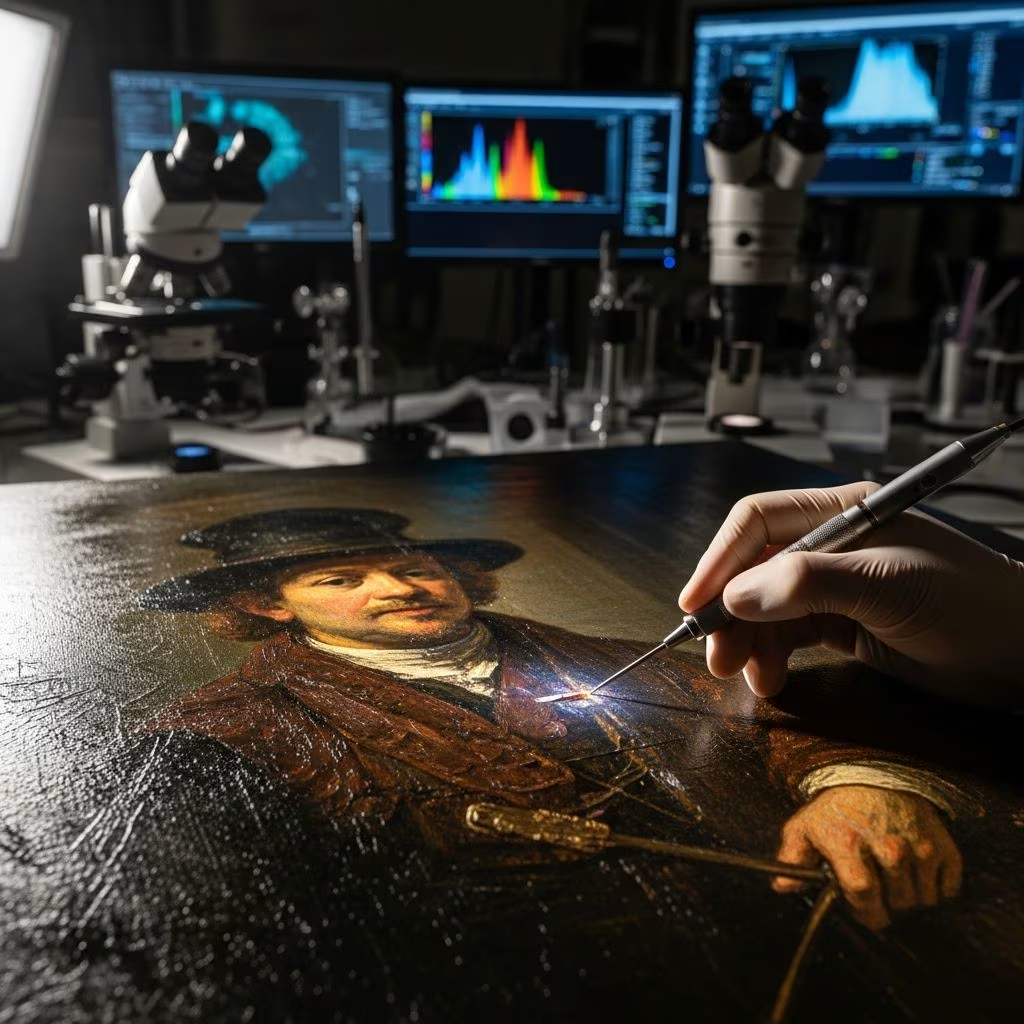
Modern conservation and imaging helped a Pennsylvania museum rediscover that a long-debated painting was an authentic Rembrandt.
 Travel Essentials
In the world of art authentication, few stories capture the drama and intrigue quite like that of a misattributed masterpiece. The tale of how a small museum in eastern Pennsylvania discovered it had possessed an authentic Rembrandt painting all along is a fascinating intersection of art history, scientific innovation, and curatorial perseverance. What began as routine maintenance in 2018 evolved into a groundbreaking revelation that would rewrite the provenance of one of the museum’s most significant holdings.
The Allentown Art Museum acquired Portrait of a Young Woman in 1961, believing they had secured a work by the legendary Dutch Golden Age master Rembrandt van Rijn. The painting, completed in 1632, depicted a young woman adorned in fine fabrics and delicate jewelry, her face displaying the warmth and psychological depth characteristic of Rembrandt’s portraiture. At the time of acquisition, the museum’s assessment appeared sound, and the work took its place among the institution’s treasured holdings.
However, the art world’s confidence in the attribution wavered significantly during the 1970s. The Rembrandt Research Project, a Dutch-led initiative established in 1968 with the explicit mandate to definitively catalog and authenticate the artist’s body of work, undertook a comprehensive examination of disputed paintings. Their rigorous analysis led them to a controversial conclusion: Portrait of a Young Woman was not painted by Rembrandt himself, but rather by one of the many talented assistants who worked within his prolific studio. This deattribution represented a significant blow to the Allentown Art Museum’s collection, effectively downgrading the work from an authentic master painting to a studio production.
The difficulty in authenticating Old Master paintings stems from several interconnected factors that have challenged scholars for centuries:
The Rembrandt Research Project’s deattribution reflected the honest uncertainty that plagued the field. Without access to modern scientific analysis tools, scholars relied primarily on stylistic analysis, historical records, and visual examination—methods that, while valuable, could not conclusively answer every question about disputed works.
In 2018, nearly fifty years after its deattribution, the Allentown Art Museum made the decision to send Portrait of a Young Woman to conservators for routine maintenance and cleaning. This seemingly straightforward decision would set in motion a series of discoveries that would transform the painting’s status and our understanding of conservation science.
During the initial conservation assessment, specialists recognized that the painting’s surface had accumulated significant alterations over its nearly 400-year existence. Layers of old varnish, previous restoration attempts, and accumulated grime had created a veil over the original composition. Modern conservation practice calls for careful removal of these layers to restore visibility to the artist’s actual brushwork and pigment choices—a delicate process requiring both artistic sensitivity and scientific precision.
What distinguished this conservation project from countless others was the application of cutting-edge diagnostic technologies that had never previously been deployed on this particular painting. The research team employed a sophisticated arsenal of scientific tools:
| Technology | Function | Insights Revealed |
|---|---|---|
| Infrared Reflectography | Captures light reflected from beneath surface layers to visualize underdrawings and compositional changes | Exposed Rembrandt’s preliminary sketches and corrections, demonstrating the master’s creative process |
| Scanning Electron Microscopy | Magnifies paint samples to examine pigment composition and application patterns at microscopic levels | Confirmed the use of materials and techniques consistent with Rembrandt’s known practices |
| Cross-Section Evaluation | Analyzes tiny paint samples in cross-section to study layering sequences and paint composition | Demonstrated paint layer characteristics matching authentic Rembrandt works rather than studio productions |
These technologies, collectively representing the frontier of art conservation science, allowed researchers to metaphorically peer into the painting’s past. They could observe Rembrandt’s deliberate brushstrokes beneath the accumulated layers, witness his characteristic corrections and revisions, and analyze the precise materials he employed. Each discovery added another thread to the tapestry of evidence supporting the original attribution.
As conservators progressed with their work, removing layers of accumulated varnish and old retouchings, a clear picture emerged. The brushwork visible beneath the surface layers exhibited the confident, assured quality characteristic of Rembrandt’s mature period. The handling of light and shadow, the modeling of the young woman’s face, and the delicate rendering of her clothing and jewelry all demonstrated the hand of a master craftsman operating at the height of his abilities.
Furthermore, analysis revealed that this was not a hastily executed work or a collaborative piece partially completed by an assistant. Instead, evidence suggested that Rembrandt had painted the entire work himself, from initial conception through final execution. The painting’s physicality—its construction, materials, and technique—aligned precisely with what scholars understood about Rembrandt’s working methods during the 1630s.
Historical speculation had long suggested that Portrait of a Young Woman depicted Rembrandt’s sister, a romantic notion that added personal narrative to the work. However, modern art historical analysis has provided a more nuanced interpretation. The painting likely represents what scholars term a “tronie”—a character study rather than a formal portrait of a specific, identifiable individual.
Tronies occupied a distinctive position in seventeenth-century Dutch art. While models posed for these works, they were conceptualized as representations of character types or archetypal figures rather than commissioned portraits of patrons seeking to preserve their likeness for posterity. The existence of multiple portraits featuring the same model, rendered by Rembrandt and his studio in varying degrees of finish, suggests that the artist may have used this particular young woman as a model for instructional purposes—painting her as an exemplar that he could reference while teaching his students the complexities of facial rendering and the subtleties of light manipulation.
Following the completion of conservation work and the accumulation of compelling evidence supporting the original attribution, the Allentown Art Museum organized a comprehensive exhibition titled Rembrandt Revealed. Opening in January 2021, this exhibition presented the restored painting alongside detailed explanations of the authentication process, allowing visitors to understand both the artwork and the scientific methodology that had restored its proper attribution.
The exhibition achieved multiple objectives simultaneously. It celebrated the museum’s acquisition and the successful restoration of an authentic Old Master work. It educated the public about the complexities inherent in art authentication and the legitimate uncertainties that scholars must navigate. Most importantly, it demonstrated how modern conservation science could resolve questions that had seemed settled decades earlier, suggesting that other disputed attributions might warrant re-examination using contemporary techniques unavailable to previous generations of scholars.
The Rembrandt case carries significant implications for the broader field of art history and museum curation. It demonstrates that attribution decisions, while made by respected authorities, are not immutable. As technology advances, new evidence can emerge that challenges previous scholarly consensus. This suggests humility in approaching attribution questions and openness to revisiting established conclusions when compelling new evidence surfaces.
For collectors, institutions, and scholars, the message is clear: works downgraded through deattribution deserve periodic re-examination. The expense of modern conservation and imaging technology may seem substantial, but the potential reward—identifying an authentic masterpiece—can justify the investment. Furthermore, the story underscores the value of rigorous conservation work that goes beyond simple cleaning and repair to include comprehensive scientific analysis.
How is it possible that a painting could be incorrectly deattributed? The Rembrandt Research Project made their determination based on the best evidence available in the 1970s. Without access to modern imaging and analysis techniques, they relied on stylistic assessment and historical analysis. Their conclusion was not unreasonable given the information available at that time.
What makes this discovery particularly significant? The discovery demonstrates that scientific methodology can resolve longstanding art historical questions. It also affirms the value of conservation science as a discipline capable of revealing truths obscured by time and deterioration.
Are other museum collections likely to contain similarly misattributed works? Yes, absolutely. Many Old Master paintings remain in disputed attribution categories. This case provides a model for how systematic scientific examination could potentially resolve other questions.
How does the financial value of the painting change following re-authentication? Authenticated Rembrandt paintings command substantially higher market values than works attributed to his studio. However, the Allentown Art Museum is a public institution dedicated to preservation and public access, so the painting’s primary value lies in its cultural and historical significance to the community rather than its market worth.
