

 Travel Essentials
 Travel Essentials

Explore Amber Fort's rich history, stunning architecture, and cultural significance. Learn about its construction, design elements, and what makes this UNESCO World Heritage Site a must-visit destination.
 Travel Essentials
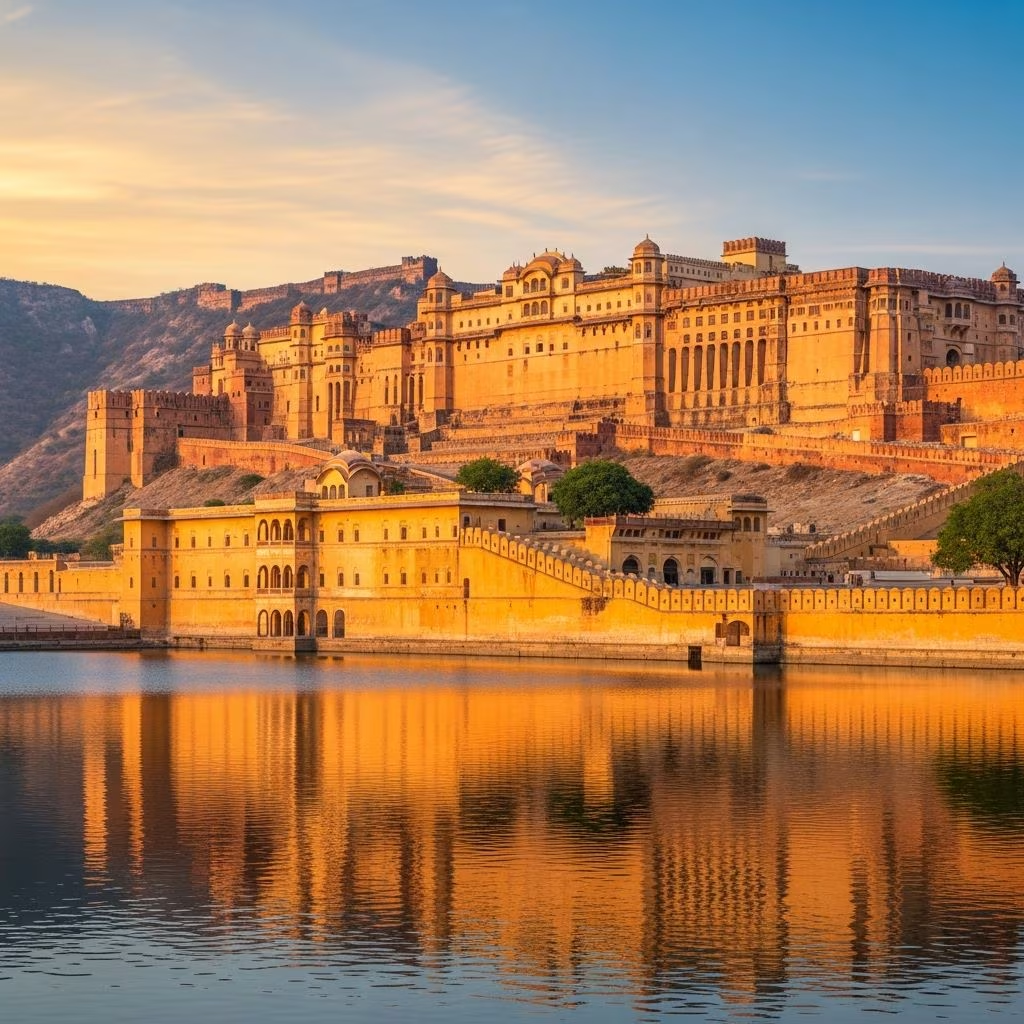
Nestled within the rugged Aravalli Hills approximately 11 kilometers from Jaipur, Amber Fort represents one of India’s most remarkable architectural achievements. This magnificent structure, also known as Amer Fort, stands as a living chronicle of Rajasthan’s royal heritage, combining the aesthetic sensibilities of Rajput tradition with the refined elegance of Mughal design. The fortress has captivated visitors and scholars alike for centuries, drawing admiration not merely for its imposing physical presence but for the sophisticated engineering and artistic vision embedded within its structures.
The current incarnation of Amber Fort emerged in 1592 under the patronage of Raja Man Singh I, a trusted military commander of the Mughal emperor Akbar. However, the site’s significance predates this construction considerably. The region had been inhabited and fortified since the 11th century by the Kachhwaha clan, who ruled the territory known as Dhundar. Previous fortifications, built between 1290 and 1310 under the supervision of Rajdev, established defensive walls and structures that would later inform the design of the present fort.
Raja Man Singh’s ambitious project took approximately 25 years to complete and utilized red sandstone as the primary building material. The construction coincided with an era of vigorous territorial expansion throughout Rajasthan, and the fort served multiple strategic purposes: it functioned as the royal residence of the Maharajas and their families, a defensive stronghold against potential invaders, and a symbol of dynastic power and prestige.
Subsequent rulers enhanced and modified the fort substantially. Jai Singh I undertook significant expansions during the early 1600s, while his descendant Sawai Jai Singh II continued refinements until 1727, when the Kachhwaha capital relocated to the newly established city of Jaipur. Despite these transitions and the inevitable weathering of centuries, the fort has persisted through conflicts, climate, and cultural transformations, earning its designation as a UNESCO World Heritage Site in 2013.
Amber Fort exemplifies a remarkable architectural dialogue between two powerful traditions. The structure showcases how Rajput architectural principles—emphasizing fortress functionality, defensive capabilities, and Hindu aesthetic conventions—merged seamlessly with Mughal design elements, introducing Persian influences, sophisticated geometric patterns, and ornamental refinement.
The fort’s layout reflects this synthesis through its interconnected palatial spaces, courtyards, temples, and gardens arranged in a carefully planned configuration. The massive ramparts, designed with military precision, feature parapets positioned specifically for archers to defend against attackers. Yet within these fortifications lie ornate chambers adorned with precious stone inlays, delicately painted ceilings, and intricate carved surfaces that speak to refined artistic sensibilities.
The fort’s position on a hilltop commanding views over Maota Lake provided both strategic advantage and aesthetic drama. The massive gateways—including the renowned Suraj Pol (Sun Gate), Chand Pol (Moon Gate), Singh Pol (Lion Gate), and Ganesh Pol—feature architectural innovations designed to thwart invasion attempts. The pointed arches of these entrances were engineered to withstand cannon fire, while the gates themselves, constructed from substantial timber reinforced with iron rods, resisted penetration by war elephants.
The rampart system demonstrates sophisticated understanding of defensive geometry, with protective barriers strategically positioned to maximize visibility and protect defenders from counterattack. The narrow, winding passageways connecting various sections of the fort served both practical and defensive purposes, allowing defenders to control access while complicating any assault strategy.
Beyond its formidable exterior, Amber Fort contains interior spaces of extraordinary beauty and functional sophistication. The palace comprises multiple interconnected structures, each serving specific ceremonial, residential, or administrative functions.
Two particularly significant halls exemplify the fort’s ceremonial importance. The Diwan-e-Aam, or Hall of Public Audience, accommodated the king during formal address to common subjects and petitioners. This spacious structure featured 27 porches, each mounted with intricately carved elephant-shaped capitals, with galleries positioned above to accommodate observers. The architectural design allowed for both visual accessibility and acoustic properties that would carry the ruler’s pronouncements throughout the chamber.
The Diwan-e-Khas, or Hall of Private Audience, served a contrasting function, hosting confidential meetings between the ruler and trusted advisors, foreign dignitaries, and military commanders. This more intimate space combined ornamental elegance with secure isolation, reflecting the dual nature of royal authority requiring both public performance and private deliberation.
Among the fort’s most celebrated features stands the Sheesh Mahal, or Mirror Palace, renowned throughout the subcontinent for its magnificent interior decoration. This chamber features walls and ceilings embedded with thousands of small mirrors and precious gemstones, creating a kaleidoscopic effect when illuminated by candlelight or sunlight. The innovative use of reflective surfaces served both aesthetic and practical purposes—the mirrors amplified limited light sources, while the crystalline surfaces created an atmosphere of ethereal beauty befitting royal ceremonies and celebrations.
The fort incorporates multiple temples reflecting the Hindu devotional traditions of its Rajput founders. Adjacent to the Ganesh Gate stands a temple dedicated to Sheila Devi, the goddess associated with the Chaitanya cult. This temple was presented to Raja Man Singh following his military victory over the Raja of Jessore in Bengal during 1604, linking religious devotion to dynastic military achievement and territorial expansion.
The integration of religious structures within the fortified complex reflects the Rajput conception of kingship, which combined secular authority with spiritual legitimacy. These sacred spaces provided venues for daily worship and major festivals, reinforcing the ruler’s role as protector and sustainer of cosmic and social order.
The fort contains a structure designated as a pavilion, specifically configured as the meeting place for royal women, reflecting the gender-segregated court practices of medieval Rajasthan. This space represents an important aspect of palace architecture—the provision of secure, private environments for female members of the royal household while maintaining their connection to courtly life and ceremonial participation.
The fort showcases exceptional craftsmanship across multiple media and techniques. Intricate marble and semi-precious stone inlays cover interior surfaces, demonstrating sophisticated knowledge of geometric and botanical design principles. The painted ceilings display complex artistic compositions, their pigments and techniques revealing the chemical and aesthetic knowledge of artisans working in the 16th and 17th centuries.
The carved stone elements—from capitals adorned with elephant motifs to delicate latticework screens known as jali—represent hours of painstaking labor by master craftspeople. These decorative elements simultaneously served practical purposes: latticework screens, while aesthetically refined, allowed ventilation and visibility while maintaining privacy for female observers of public proceedings.
Amber Fort’s historical importance extends beyond its architectural achievements. For centuries, it served as the capital of the Kachhwaha state, functioning as the administrative and residential center of one of Rajasthan’s most powerful dynasties. The fort’s establishment under Raja Man Singh I coincided with a period of significant territorial consolidation and artistic development throughout the region.
The fort’s existence influenced broader patterns of urban development and economic activity. Markets and roads developed around the fortress, facilitating trade and commerce. Materials, particularly timber imported from Maharashtra, moved through regional trading networks, stimulating economic exchange between Rajputana and the Deccan states. The fort thus represented not merely a military and residential structure but also an economic engine driving regional commerce and cultural exchange.
After India’s independence and subsequent decolonization, Amber Fort initially received less scholarly and popular attention than it deserved, overshadowed by broader historical narratives and development priorities. However, in recent decades, recognition of the fort’s architectural and historical significance has intensified. Its designation as a UNESCO World Heritage Site in 2013 acknowledged its importance as a universal cultural artifact and prioritized its preservation for future generations.
Contemporary conservation efforts address the challenges posed by environmental weathering, visitor impact, and structural aging. These initiatives balance public access with protective measures, recognizing that the fort’s value encompasses both its role as a living historical document and its function as an educational and tourism resource.
The fort attracts visitors from across the globe seeking to experience Rajasthan’s architectural heritage and understand India’s royal traditions. The journey through the fort’s passages, courtyards, and chambers offers multiple layers of understanding—architectural appreciation, historical insight, and aesthetic experience combine to create a comprehensive encounter with India’s past.
| Architectural Aspect | Rajput Characteristics | Mughal Influence |
|---|---|---|
| Structural Focus | Defensive fortifications, massive walls, strategic positioning | Palatial elegance, refined chambers, ornamental design |
| Decorative Elements | Stone carvings, elephant motifs, Hindu iconography | Precious stone inlays, geometric patterns, calligraphy |
| Spatial Organization | Interconnected courtyards, enclosed passages | Symmetrical arrangements, formal gardens |
| Religious Integration | Hindu temples, sacred spaces for worship | Persian aesthetic principles, refined ornamentation |
Raja Man Singh I initiated construction in 1592, with the project requiring approximately 25 years for completion. Subsequent rulers made significant additions and modifications through the early 1700s.
Sawai Jai Singh II relocated the capital to Jaipur in 1727, establishing a new city designed according to contemporary urban planning principles. This transition reflected changing strategic considerations and Jai Singh’s vision for a more systematically planned capital.
The fort synthesizes Rajput military architecture with Mughal palatial design, creating a unique hybrid reflecting Hindu, Mughal, and Persian influences.
Yes, the fort operates as a museum and historical site, welcoming visitors daily. Its UNESCO World Heritage designation has enhanced preservation efforts while maintaining public access.
The Mirror Palace’s embedded mirrors and gemstones create reflective surfaces that multiply light sources, producing an ethereal, shimmering atmosphere unparalleled in Indian palace architecture.
Amber Fort stands as a remarkable testament to the ambitions, artistic sensibilities, and strategic acumen of Rajasthan’s medieval rulers. Its construction, spanning centuries of refinement and expansion, produced a structure that transcends simple categorization as merely defensive, residential, or ceremonial. Instead, it represents an integrated vision where military necessity, administrative function, religious devotion, and artistic expression merged into a cohesive whole.
The fort’s significance extends beyond its historical moments or individual architectural features. It embodies patterns of cultural synthesis, demonstrating how different traditions—Rajput and Mughal, Hindu and Persian—could be integrated into forms of extraordinary beauty and functionality. For contemporary visitors and scholars, the fort offers ongoing lessons in adaptive architecture, sustainable design principles embedded within historical structures, and the enduring appeal of human creative achievement.
