

 Travel Essentials
 Travel Essentials

Discover China's network of ancient city walls that protected its major urban centers. Learn about their construction, historical significance, and which ones remain accessible today.
 Travel Essentials
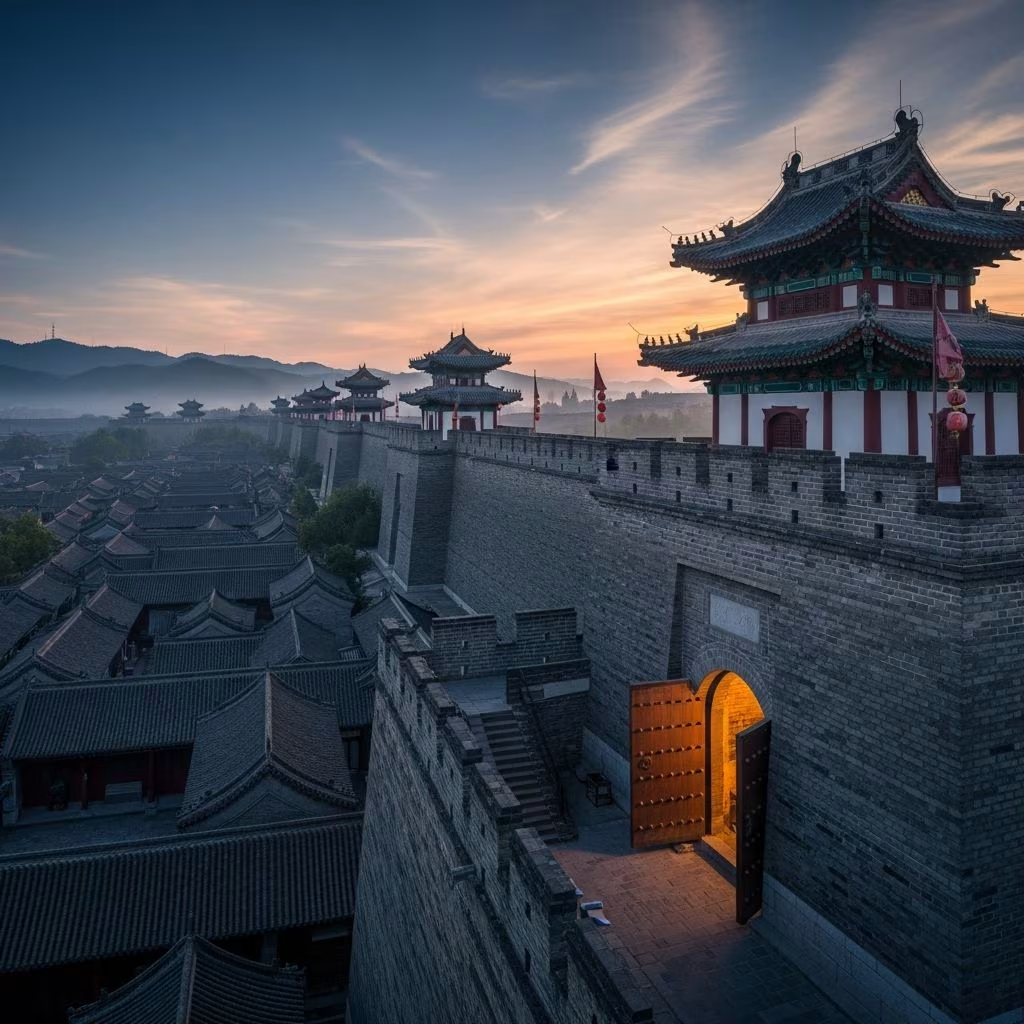
While China is globally recognized for its iconic Great Wall snaking across northern territories, the nation possesses a far more diverse and intimate collection of defensive architecture embedded within its historical cities. These urban fortifications served as critical protective barriers for civilian populations and administrative centers throughout centuries of dynastic rule. Rather than being isolated relics, these walled cities functioned as living communities where thousands of residents conducted daily commerce, governance, and cultural activities within their fortified boundaries.
The extensive history of Chinese wall construction reflects the country’s tumultuous past, marked by constant military threats, territorial disputes, and the need for organized urban defense. Military architects developed sophisticated methods to construct walls capable of withstanding both conventional siege warfare and the emergence of cannon-based military technology. These engineering achievements represent not merely defensive necessities but also statements of imperial authority and markers of urban prestige.
Chinese fortification techniques underwent significant transformation as building technologies advanced and military threats evolved. Early urban walls relied primarily on tamped earth construction, a labor-intensive method that involved compressing layers of soil into solid barriers. This technique, while effective for its era, possessed inherent vulnerabilities to erosion, weather damage, and sustained military assault.
The transition from earthen construction to brick and stone represented a watershed moment in Chinese architectural development. The Ming dynasty (1368-1644) pioneered more sophisticated construction methodologies that incorporated multiple material layers and reinforcement techniques. The foundation often consisted of stone bases, supporting structures made from glutinous rice extract mixed with lime and earth, and exterior surfaces of precisely fitted brick work. This multi-layered approach created walls of exceptional durability that could withstand centuries of environmental exposure and military pressure.
The Qing dynasty (1644-1911) inherited and refined these Ming innovations, implementing regular maintenance cycles and strategic renovations to preserve existing fortifications. Imperial records document systematic restoration efforts undertaken at specific intervals, demonstrating organized approaches to infrastructure preservation rather than haphazard repairs in response to emergencies.
Beyond simple barrier walls, Chinese city fortifications incorporated sophisticated defensive infrastructure designed to maximize strategic advantage. Corner towers and gate structures served dual purposes, providing elevated vantage points for surveillance while accommodating artillery emplacements. As military technology evolved to include cannon-based weaponry, engineers adapted wall designs to incorporate cannon positioning platforms and reinforced sections capable of withstanding artillery impact.
Water defense mechanisms represented another innovation in urban fortification design. Cities constructed impressive moats surrounding their walls, creating additional obstacles for attacking forces while serving practical functions in water management and irrigation. The psychological effect of expansive water barriers should not be underestimated—these visual demonstrations of defensive sophistication conveyed messages of imperial power to both potential attackers and the urban populace.
Interior construction methods employed locally-available materials adapted to regional geological conditions. Workers packed irregular rocks and rammed yellow soil between structural layers, creating walls of remarkable strength. Archaeological evidence reveals that wall maintenance records existed for individual sections, permitting targeted restoration efforts rather than wholesale reconstruction.
Xi’an maintains China’s most comprehensively preserved city wall system, standing as one of the world’s largest remaining ancient defense complexes. Built during the early Ming period under Emperor Zhu Yuanzhang’s direction, the rectangular fortification demonstrates architectural sophistication through its carefully engineered base composition and strategic gate placement. The wall’s construction employed advanced techniques including earth bases, lime reinforcement, and glutinous rice extract binding agents that contributed to exceptional structural integrity.
Visitors can traverse substantial portions of the wall, experiencing firsthand the engineering scale that protected this major imperial administrative center. The preserved sections offer panoramic perspectives of the modern city beyond, creating temporal contrasts that underscore the wall’s historical significance within Xi’an’s urban landscape.
Nanjing presents particularly compelling evidence of ambitious imperial defensive projects. Historical records indicate initial wall construction dating back approximately 2,500 years, yet the walls visitors encounter today represent Emperor Zhu Yuanzhang’s extensive reconstruction and reinforcement campaign during the Ming dynasty. This ambitious undertaking required 21 years to complete and necessitated conscripting approximately 200,000 laborers, reflecting the enormous resource investment considered necessary to protect the imperial capital.
The original red-rock construction remains partially visible in western sections of the city, providing archaeological evidence of construction techniques employed centuries ago. Modern preservation efforts have restored substantial portions, with approximately 25 kilometers of wall remaining accessible today. The distinctive feature of inscribed bricks—where construction workers inscribed their names or identifying marks on individual bricks—appears unique to Nanjing’s walls among all Chinese urban fortifications, creating an unintended historical record of the construction workforce.
Pingyao represents China’s most comprehensively preserved ancient walled town, maintaining its medieval character despite centuries of potential deterioration. The walls originated as tamped earth construction, a technique visible in specific preserved sections that demonstrate historical building methods. Brick reinforcement and upgrades occurred around 1370, at the commencement of Ming dynasty rule, systematically strengthening the original fortification.
The distinctive turtle-shaped design incorporated symbolic and strategic elements, with major towers positioned at cardinal points representing the creature’s head and tail. The northern and southern gate towers dominated the architectural composition, while smaller tower structures on eastern and western sides completed the symbolic representation. Walking circuits along the walls span approximately three kilometers from the northern to southern gates, providing elevated perspective of the urban environment below while revealing detailed views of the impressive surrounding moat.
Xingcheng City Wall preserves distinctive evidence of Ming dynasty military culture and strategic thinking. Historical documentation records completion in 1430, with substantial restoration undertaken in 1624 that returned the structure to original specifications regarding size, layout, and structural arrangement. Despite experiencing ammunition bombardment, warfare damage, natural disasters, and political upheavals throughout subsequent centuries, the wall avoided substantial structural compromise.
The fortification extends approximately 35 kilometers in total length, though roughly 25 kilometers remain preserved today. The Qing dynasty undertook three major maintenance restoration cycles in 1779, 1817, and 1848, demonstrating sustained commitment to preservation across extended time periods. The wall’s cannon emplacements positioned at corner junctures effectively resisted powerful Jin army sieges, validating the defensive engineering principles employed in its construction.
Southern China’s defensive architecture receives representation through Linhai’s city wall, which stretches six kilometers along the city’s western perimeter. Construction commenced during the Eastern Jin dynasty (317-420) and underwent substantial expansion during the Sui and Tang dynasties (581-907). After extended periods of deterioration and neglect, comprehensive restoration undertaken in the 1990s returned the structure to public accessibility and contemporary functionality.
| City Wall | Primary Construction Period | Primary Materials | Current Preservation Status |
|---|---|---|---|
| Xi’an | Ming Dynasty (1368-1644) | Stone base, earth, lime, glutinous rice extract, brick | Most complete ancient city wall |
| Nanjing | Ming Dynasty (1368-1644) | Red-rock structure, inscribed brick | 25 km preserved with four original gates |
| Pingyao | 1370 onwards (Ming) | Original tamped earth, upgraded to brick | Best-preserved walled town |
| Xingcheng | 1430 (Ming) | Brick with irregular rock and yellow soil infill | 25 km preserved of 35 km total |
| Linhai | Eastern Jin (317-420) | Regional materials, multiple dynasty expansions | 6 km accessible after 1990s restoration |
These urban fortifications transcend their original military functions to become repositories of historical knowledge and cultural identity. The inscribed bricks of Nanjing preserve names of individual workers, creating unique documentation of social history often absent from imperial records. The spatial organization of walled cities reveals urban planning principles employed by ancient administrators, including market placement, residential organization, and ceremonial space arrangement.
These walls function as material evidence of ancient China’s organizational capabilities, administrative sophistication, and technological achievements. They demonstrate how empires mobilized vast labor forces, coordinated complex construction projects across extended time periods, and maintained organizational systems capable of preserving critical infrastructure through centuries of political transformation and military conflict.
Contemporary travelers can experience these historical structures through various access points and preservation initiatives. Xi’an’s wall permits pedestrian circulation along extended sections, offering physical engagement with historical architecture while providing modern safety infrastructure. Pingyao maintains tourist accommodations within the walled boundaries, permitting visitors to experience residential settings within historical urban cores.
Preservation challenges persist as expanding modern cities encroach upon historical fortifications. Some sections have undergone reconstruction using contemporary materials and techniques, raising scholarly questions about authenticity and historical accuracy. Archaeological surveys reveal that substantial portions of historical city walls remain beneath contemporary urban development, detectable through satellite imagery and specialized survey techniques.
Nanjing possesses the earliest documented wall construction, with evidence suggesting initial fortification dating back approximately 2,500 years. However, the preserved walls visitors encounter today represent Ming dynasty reconstruction and expansion undertaken by Emperor Zhu Yuanzhang.
Yes, major preserved city walls including Xi’an, Pingyao, and portions of Nanjing permit pedestrian access. Walking circuits offer perspectives of both interior urban spaces and exterior landscapes, though specific accessibility varies by location and maintenance status.
Early walls employed tamped earth techniques. Ming and Qing fortifications incorporated stone foundations, brick exteriors, and sophisticated binding agents including lime and glutinous rice extract. Interior spaces were packed with irregular rocks and rammed yellow soil.
Nanjing’s Ming reconstruction required approximately 200,000 conscripted laborers over 21 years, illustrating the massive scale of imperial construction projects and the significant social disruption involved in wall construction.
No—these fortifications serve exclusively historical, cultural, and tourism functions in contemporary China. Modern military defense strategies rendered traditional city wall architecture obsolete during the twentieth century.
Chinese governmental authorities and international heritage organizations recognize these fortifications as irreplaceable historical resources requiring active preservation. UNESCO designation of certain wall sections acknowledges their global cultural significance. However, tension persists between urban modernization imperatives and heritage preservation objectives, particularly in rapidly expanding metropolitan areas.
Restoration efforts balance historical accuracy with practical functionality and contemporary safety standards. Some renovation projects employ traditional materials and techniques, while others incorporate modern reinforcement methods invisible to casual observation. Ongoing archaeological research continues revealing construction techniques, historical chronologies, and evidence of ancient urban organization patterns.
These enduring city walls represent tangible connections to China’s complex and multifaceted history. Beyond their architectural sophistication, they embody stories of human labor, administrative ambition, technological innovation, and cultural identity persisting across centuries of dynamic change. As contemporary society embraces accelerating urbanization and technological transformation, these ancient fortifications remind us of fundamental human imperatives for security, community organization, and lasting cultural expression through monumental architecture.
