

 Travel Essentials
 Travel Essentials

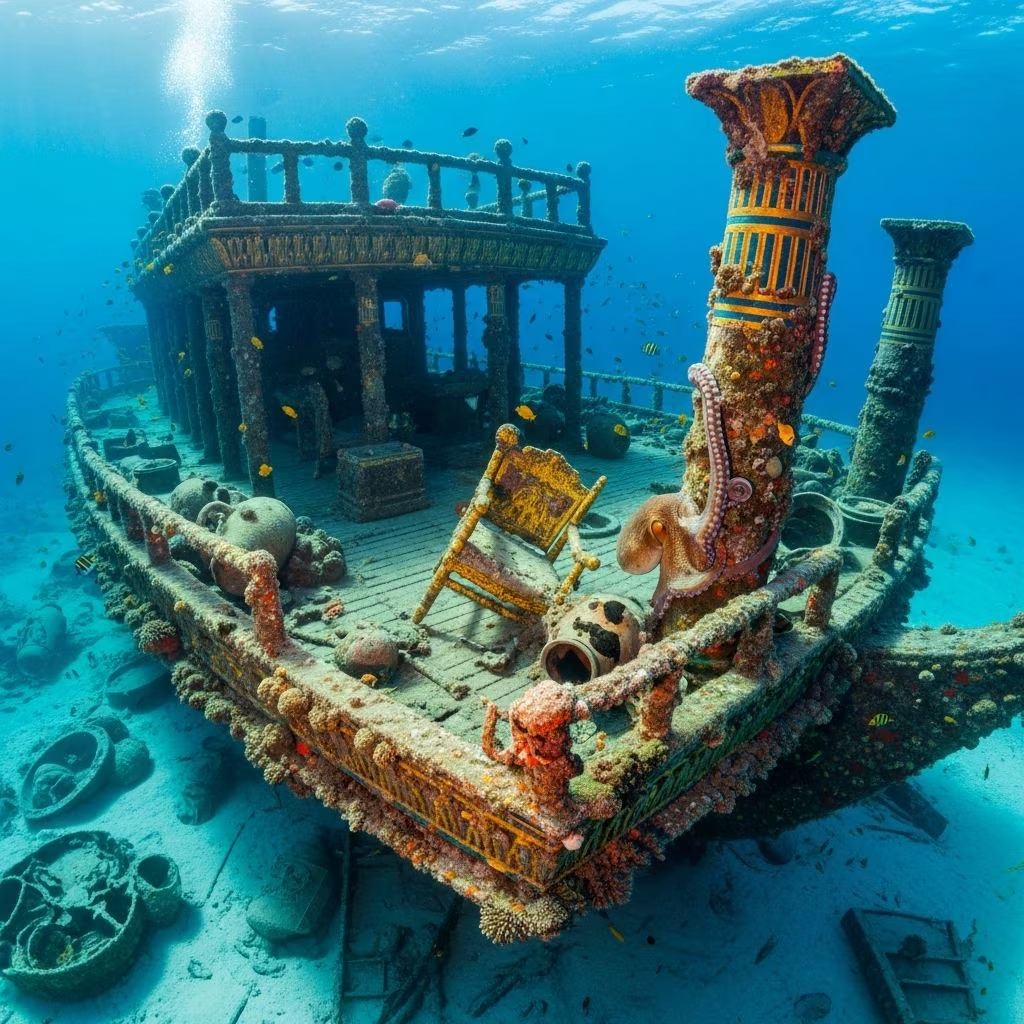
Underwater explorers reveal the first physical remains of an ancient Egyptian pleasure barge, a 115-foot thalamegos from the 1st century CE, submerged off Alexandria with Greek graffiti hinting at royal connections.
 Travel Essentials
A groundbreaking underwater discovery off the coast of Alexandria has brought to light the remnants of a rare ancient Egyptian pleasure barge known as a thalamegos. This 2,000-year-old vessel, measuring nearly 115 feet in length, represents the first archaeological evidence of such a craft, previously known only through historical texts and artistic depictions.
In the submerged ruins of Portus Magnus, the ancient royal harbor of Alexandria, a team led by renowned French underwater archaeologist Franck Goddio stumbled upon massive wooden timbers during routine excavations. Initially mistaken for parts of multiple ships, these 28-meter-long beams revealed themselves as components of a single, extraordinary barge approximately 35 meters long and 7 meters wide.
The site lies near the now-submerged island of Antirhodos, once home to opulent palaces and temples, including those associated with Cleopatra VII. Earthquakes and rising sea levels over centuries have buried this area under sediment and water, preserving the wreck remarkably well despite its age.
The thalamegos stood out for its unique architecture tailored for luxury and leisure. Its flat-bottomed hull and rounded stern made it ideal for calm, sheltered waters like the Nile River and coastal lagoons, rather than open seas. Unlike typical cargo or warships, this barge prioritized comfort with a spacious central pavilion likely adorned with lavish decorations for elite passengers.
Propulsion came solely from oars, potentially manned by up to 20 rowers, allowing for graceful, controlled cruises. The preserved structure spans 92 feet, showcasing robust timber construction that withstood millennia underwater.
| Feature | Description | Historical Comparison |
|---|---|---|
| Length | ~115 feet (35m) | Larger than Strabo’s descriptions (29-25 BCE) |
| Width | ~23 feet (7m) | Wide for pavilion stability |
| Hull Type | Flat-bottom, rounded stern | Suited for rivers/canals |
| Propulsion | Oars only (20 rowers) | No sails for leisure control |
Among the most intriguing finds are Greek inscriptions carved into the central timber, dated to the first half of the 1st century CE. These graffiti, still under analysis, strongly suggest the barge’s construction in Alexandria, a Hellenistic hub blending Greek and Egyptian cultures.
Such markings were common among shipbuilders and crew, offering personal glimpses into daily life. They reinforce the vessel’s Ptolemaic-era origins, a time when Greek influence dominated Egypt under rulers like the Ptolemies.
The wreck’s location in Portus Magnus places it amid the ruins of Cleopatra’s palace complex, fueling speculation about royal ties. Greek historian Strabo documented similar thalamegos barges used by the Ptolemies for leisure along the Nile, including Cleopatra’s famed cruise with Julius Caesar in 47 BCE.
Franck Goddio hypothesizes the barge may have sunk around 50 CE during the destruction of the nearby Temple of Isis on Antirhodos. This event, possibly linked to Roman interventions, could have doomed the vessel amid chaos.
Beyond pleasure cruises, thalamegoi served ceremonial roles. Goddio proposes a ritual function, potentially tied to the Isis cult’s navigatio iside processions. In these, a decorated Navigium vessel symbolized Isis’s solar barque, parading in naval ceremonies.
If connected to the Temple of Isis, this barge might have embodied divine maritime power, blending leisure with spirituality in Ptolemaic society.
The discovery credits the Institut Européen d’Archéologie Sous-Marine (IEASM), directed by Franck Goddio since 1986. Goddio’s decades of work in Alexandria’s bays have yielded treasures like temple ruins and statues, making this thalamegos a pinnacle achievement.
His team’s meticulous dredging preserved delicate timbers, enabling detailed study. This find validates ancient accounts, bridging textual history with tangible artifacts.
Underwater sites like Portus Magnus face threats from pollution, tourism, and climate change. Rising seas and acidity erode wood rapidly, underscoring the urgency of Goddio’s missions.
Conservation involves stabilizing timbers, analyzing wood species, and 3D mapping. Future tech like advanced sonar could reveal more wrecks in the area.
This thalamegos rewrites understandings of ancient Egyptian naval tech. Previously, evidence was limited to Strabo’s writings and mosaics; now, physical proof confirms large-scale luxury barges existed.
It illuminates Ptolemaic engineering prowess, cultural fusion, and elite lifestyles, enriching narratives of Alexandria as a cosmopolitan powerhouse.
Though not definitively Cleopatra’s, the barge’s era and location evoke her thalamegos cruises. These vessels symbolized power, hosting dignitaries and rituals that shaped history.
Proximity to her palace ruins suggests it served similar high-society functions, perhaps ferrying nobles during Isis festivals.
IEASM plans further dives to explore the site’s full extent. Analyzing graffiti content, wood dating, and pavilion remnants could pinpoint builders and owners.
Collaborations with Egyptian authorities aim for museum displays, educating global audiences on this Hellenistic-Egyptian marvel.
A thalamegos was an ancient Egyptian luxury barge for pleasure and ceremonies, featuring a central cabin and oar propulsion.
In the submerged Portus Magnus harbor off Alexandria, near Antirhodos Island.
Dated to the 1st century CE via Greek graffiti, around 2,000 years old.
Franck Goddio and the IEASM team.
Not confirmed, but its location near her palace suggests possible royal use.
