

 Travel Essentials
 Travel Essentials

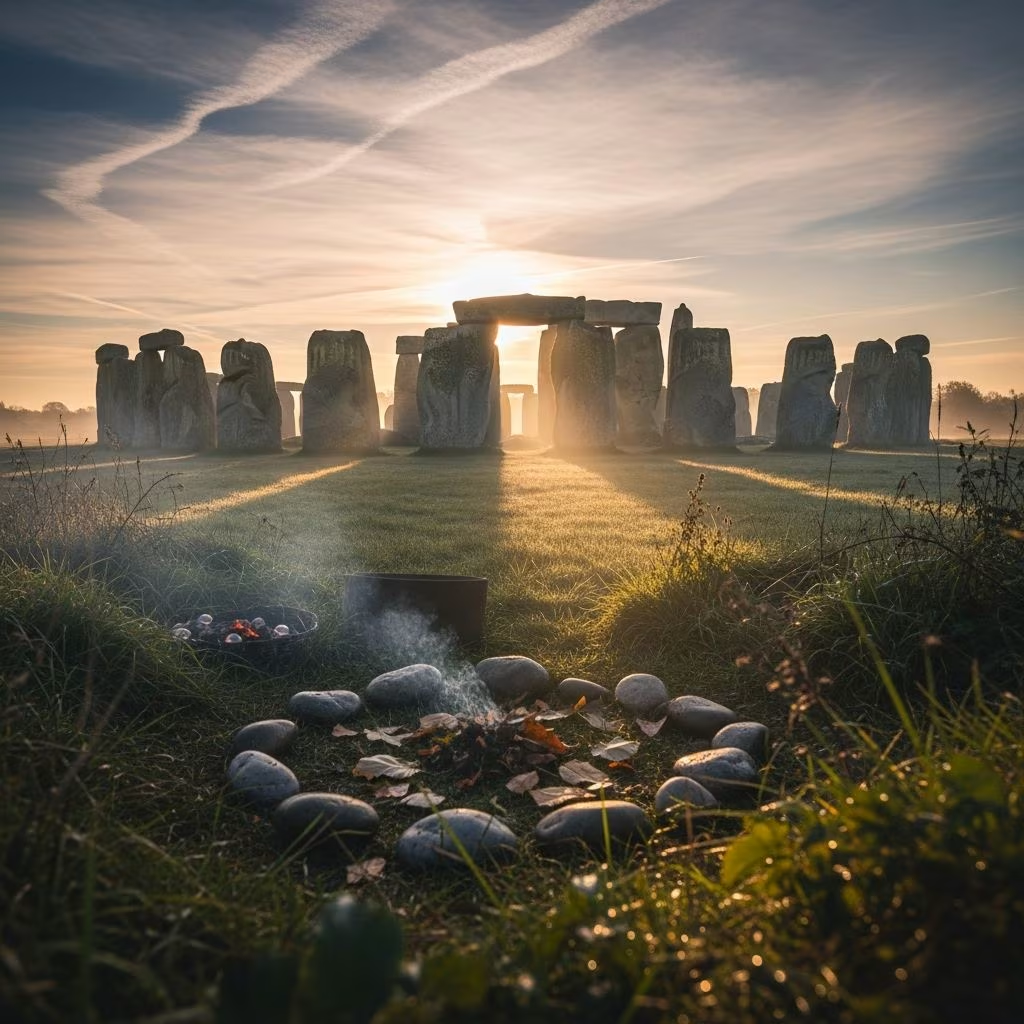
Uncover the hidden world of ancient pagan festivals from Greece to Rome, Celtic lands to Japan, revealing how these sacred rituals influenced modern celebrations.
 Travel Essentials
Throughout human history, cultures across the globe have marked significant moments with elaborate ceremonies and ritual gatherings. Before modern religions standardized spiritual practices, societies developed their own unique festivals tied to agricultural cycles, celestial events, and divine mythology. Many of these ancient observances have faded into obscurity, yet their echoes remain embedded in contemporary celebrations. By examining these lesser-known pagan ceremonies, we gain insight into the spiritual beliefs, social structures, and seasonal awareness of civilizations long past.
Among the most enigmatic religious practices of antiquity were the mystery cults that thrived throughout ancient Greece. These secretive societies attracted devotees from across the Mediterranean world, with participants bound by sacred oaths to conceal the nature of their rituals. The most prominent of these was centered in Eleusis, a town situated approximately 30 kilometers west of Athens that became a major pilgrimage destination for over two millennia.
The Eleusinian traditions, believed to have originated from Mycenaean customs dating back to 1,500 BCE, centered on agricultural cycles and the mythological narrative of Demeter and Persephone. According to legend, Persephone was abducted by Hades to the underworld, creating a separation that influenced the changing of seasons. The festival reenacted this cosmic drama, with initiates participating in elaborate ceremonies designed to ensure fertile harvests and spiritual transformation.
What made these ceremonies particularly distinctive was the consumption of a ritualistic beverage called kykeon, which participants from all social strata—both men and women, rich and poor—were invited to drink as part of the initiation process. Contemporary scholarly investigation suggests these ceremonies may have incorporated psychoactive substances, representing one of history’s earliest documented instances of ritual drug use within religious contexts. For over two thousand years, seekers traveled the sacred road to Eleusis, hoping to experience the spiritual transformation promised by the mysteries.
The Roman civilization developed its own calendar of sacred festivals, many of which have become obscured by their later Christian adaptations. One particularly interesting observance was Lupercalia, celebrated annually on February 15th within the city of Rome. This fertility festival involved ritualistic elements including animal sacrifices and a distinctive practice wherein participants would run naked through designated streets while being ceremonially struck with strips of flayed animal hide. Many historians now propose that Valentine’s Day, despite its association with Christian martyr Saint Valentine, may actually derive from this ancient Roman celebration.
Another Roman festival deserving attention is the celebration honoring Anna Perenna, observed around March 15th in antiquity. This goddess, whose origins remain somewhat mysterious, was variously associated with lunar cycles or Etruscan mother deities. Significantly, her festival date corresponded to what had originally been designated as the first day of the Roman calendar year, linking her veneration to the cyclical renewal of time itself.
Celtic societies, distributed across Ireland, Scotland, Wales, and continental Europe, developed their own sophisticated system of seasonal observances tied intimately to pastoral and agricultural activities. Among these was Imbolc, also known as Imbolg, celebrated during the opening days of February (approximately February 1-2). This festival marked the midpoint between the winter solstice and the spring equinox, representing a symbolic transition from dormancy to awakening as livestock began birthing offspring.
The Celtic calendar divided the year at specific astronomical moments, with each festival carrying profound spiritual significance. These observances were not merely recreational gatherings but represented critical moments when the boundary between the natural and supernatural worlds was believed to grow thin. Modern practitioners of neopaganism continue maintaining these traditions, demonstrating the enduring appeal of Celtic seasonal observances.
The continuity between ancient pagan practices and modern celebrations demonstrates how deeply embedded these traditions remain within global culture. Modern paganism encompasses diverse spiritual paths, yet many contemporary practitioners organize their ritual year around the Wheel of the Year—a seasonal calendar featuring eight major festivals (called Sabbats) aligned with solar events and cross-quarter days. These observances include well-established festivals such as Beltane, Samhain, and Yule, though reconstructionists also work to recover older systems based on Hellenistic, Norse, Slavic, and other traditions.
The ancient Germanic peoples, inhabiting Scandinavia, Iceland, and Anglo-Saxon England, marked their year through seasonal festivals and ritual offerings dedicated to their pantheon of gods and ancestral spirits. Similarly, Slavic pagan traditions across Eastern Europe incorporated agricultural cycles and veneration of regional deities such as Perun, Veles, and Mokosh, with modern practitioners attempting to reconstruct these systems from historical fragments and oral tradition.
The transformation of ancient pagan celebrations into modern holidays illustrates how cultural practices evolve while maintaining their essential character. Winter solstice celebrations, observed by Anglo-Saxon and Celtic populations as Yule before the spread of Christianity, featured distinctive rituals including the lighting of a ceremonial log in the family hearth and the decoration of dwellings with seasonal greenery such as mistletoe and holly. These practices directly influenced Christmas traditions observed centuries later, demonstrating the remarkable persistence of cultural memory.
In Scotland, the New Year’s Eve festival of Hogmanay represents a syncretic blend of Celtic Samhain traditions and Viking winter solstice celebrations, reflecting the complex cultural exchanges that occurred during medieval periods. The festival fills Edinburgh and other Scottish cities with celebratory crowds, yet most modern participants remain unaware of the profound historical layers underlying their observance.
The Japanese archipelago developed distinctive festival traditions that, while influenced by Buddhist and Shinto practices, maintain elements of pre-Buddhist seasonal observances. The Saidai-ji Eyo Hadaka Matsuri, held in Okayama and celebrated at numerous other locations throughout Japan, represents a particularly striking example of ritual community participation. This festival, with origins tracing back over five centuries, draws up to 10,000 participants who compete for sacred wooden sticks believed to confer good fortune for the entire year. Participants wear minimal clothing—typically only a fundoshi loincloth—during the competition, suggesting deep historical roots in purification and blessing rituals.
Beyond the well-documented festivals of Greece and Rome, Europe harbored numerous obscure ritual traditions. Hungary’s Busójárás festival in the town of Mohács combines pagan ritual elements with folk traditions and elaborate masquerade to ceremonially banish the final days of winter. The festival features participants wearing frightening masks and reenacting a sixteenth-century historical battle, with masked revelers arriving by rowboat and processing through streets in horse-drawn carriages. This event also serves to celebrate the region’s Croatian minority heritage, demonstrating how ancient ritual forms adapt to encompass contemporary cultural identity.
What unites these diverse festival traditions across geographical and temporal boundaries is their common function within human societies. Whether marking astronomical events, celebrating successful harvests, or invoking divine protection, these ceremonies fulfilled essential psychological and social needs. They provided communities with structured opportunities for collective spiritual expression, reinforced social bonds through shared participation, and offered frameworks for understanding humanity’s relationship to natural cycles and divine forces.
The persistence of pagan festival traditions—whether maintained by direct cultural continuity or revived through modern reconstruction—indicates that these ancient practices address fundamental human needs that remain relevant across centuries. Seasonal observance, communal gathering, and ritual performance continue to provide meaning and connection in contemporary society, even as their ancient religious contexts have transformed or disappeared.
Pagan festivals typically predated organized monotheistic religions and were organized around natural cycles, agricultural seasons, and polytheistic mythologies. They often involved community participation, ritualistic purification, and direct engagement with perceived supernatural forces.
The expansion of Christianity across Europe and the Mediterranean world led to the suppression or adaptation of pagan practices. Many festivals were either banned, incorporated into Christian observances, or simply abandoned as cultural memories faded across generations.
Modern practitioners attempt to reconstruct ancient traditions using historical records, archaeological evidence, and surviving folklore. However, complete authenticity remains impossible, as much knowledge of ancient practices was lost or intentionally concealed.
Lupercalia influenced Valentine’s Day, Yule shaped Christmas traditions, Samhain became Halloween, and various solstice celebrations influenced New Year’s observances. Many other connections exist between ancient and modern practices.
Modern festivals in Japan, Hungary, and other regions maintain traditional practices. Additionally, neopagan communities in many countries organize seasonal celebrations based on reconstructed ancient calendars.
The study of obscure pagan festivals reveals that human societies have consistently organized themselves around sacred time and communal ritual. From the mystery cults of ancient Greece to the seasonal observances of Celtic and Germanic peoples, from Roman purification ceremonies to Japanese blessing rituals, cultures worldwide developed sophisticated systems for marking sacred moments. While the religious contexts of these practices have transformed or disappeared, the underlying human impulse toward seasonal celebration and communal gathering persists.
Understanding these ancient festivals provides not merely historical interest but illuminates how spiritual and cultural practices transmit across generations, adapt to changing circumstances, and continue shaping contemporary society. Even as modern civilization has become increasingly disconnected from natural cycles and seasonal rhythms, the echoes of these ancient observances remain audible in contemporary celebrations, demonstrating the enduring power of ritual tradition to connect human communities across vast stretches of time.
