

 Travel Essentials
 Travel Essentials

Explore the best ancient ruins in Turkey, including Ephesus, Göbeklitepe, and more. Uncover millennia of history amid stunning landscapes and well-preserved structures.
 Travel Essentials
Turkey stands as a treasure trove of ancient history, bridging continents and eras with its unparalleled archaeological sites. From the dawn of civilization at Göbeklitepe to the grandeur of Roman Ephesus, these ruins offer a vivid glimpse into humanity’s past. This guide highlights the most remarkable destinations, detailing their historical context, key features, and practical visiting advice to help you plan an unforgettable trip.
Turkey’s ancient sites extend back to the Neolithic period, challenging traditional views of human development. These early settlements reveal sophisticated societies long before written history.
Nestled in southeastern Turkey, Göbeklitepe dates to approximately 9600 BCE, predating Stonehenge by millennia. This UNESCO World Heritage site features massive T-shaped pillars arranged in circles, many adorned with intricate carvings of animals and abstract symbols. Archaeologists believe it served as a ceremonial center, suggesting complex religious practices among hunter-gatherers.
Located in central Anatolia, Çatalhöyük flourished around 7500-5700 BCE. This densely packed settlement housed up to 8,000 people in mud-brick homes accessed via rooftops, lacking streets. Wall paintings and figurines depict daily life, rituals, and possibly early religious beliefs.
Excavations continue to uncover burials beneath floors and evidence of advanced agriculture, painting a picture of one of the earliest urban experiments.
The Hittites, a powerful empire from 1600-1178 BCE, left behind fortified cities showcasing advanced engineering and monumental architecture.
Hattuşa, near modern Boğazkale, served as the Hittite capital with massive walls spanning 8 kilometers, featuring lion gates and sphinx portals. The site includes over 100 rock-cut reliefs at Yazılıkaya, a sacred open-air sanctuary.
| Feature | Description | Period |
|---|---|---|
| City Walls | Postern gates and towers for defense | 14th century BCE |
| Yazılıkaya Sanctuary | Deities carved into rock faces | 13th century BCE |
| Great Temple | Dedicated to storm god Tarhunna | 13th century BCE |
Explore the site’s vast scale, which once supported 15,000-30,000 inhabitants.
Turkey’s western regions boast impeccably preserved Greco-Roman cities, reflecting the height of classical civilization.
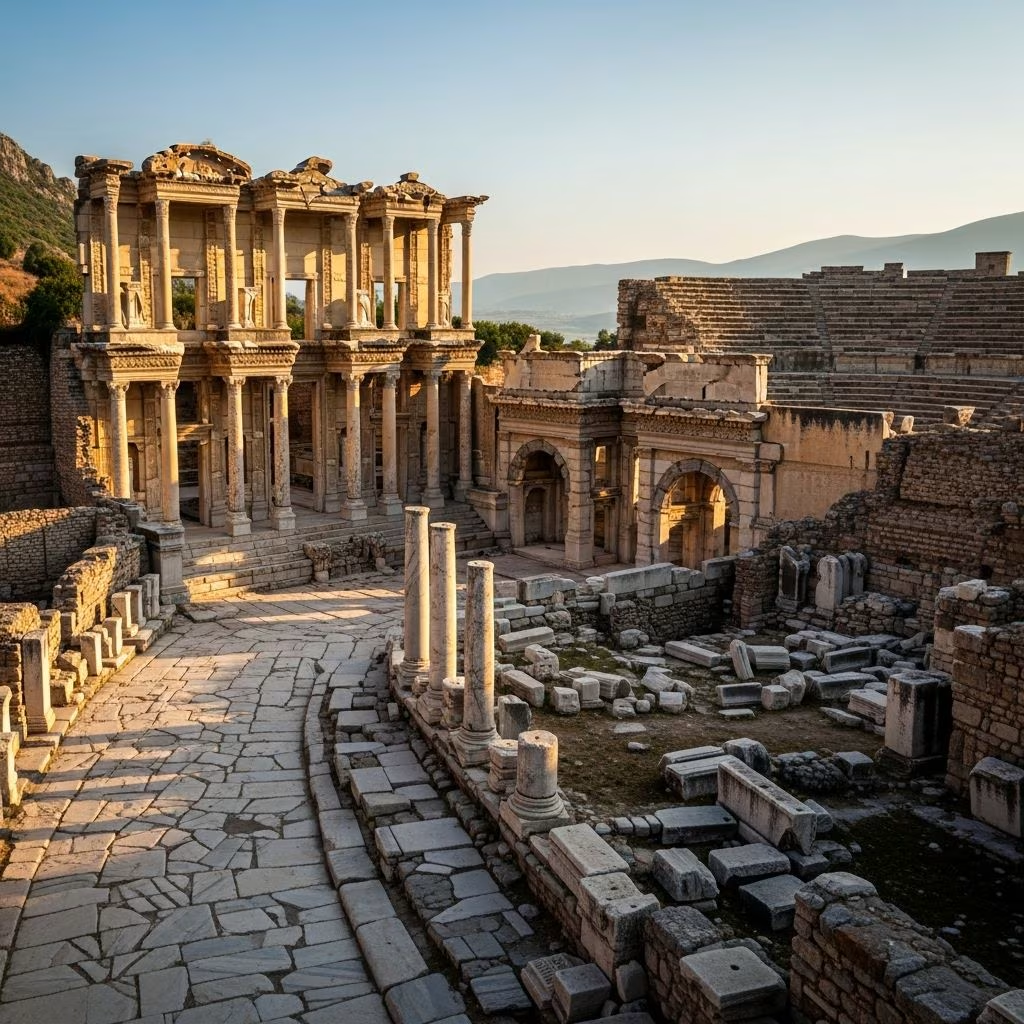
Ephesus, near Selçuk, was a bustling port city with a population nearing 250,000 in Roman times. Highlights include the Library of Celsus (capacity 12,000 scrolls), the grand Theatre seating 25,000, and terraced houses with mosaics and frescoes.
Once home to the Temple of Artemis—one of the Seven Wonders—its marble streets and Curetes Way evoke imperial splendor. Combine with a visit to the nearby House of the Virgin Mary for added intrigue.
Perched above Bergama, Pergamon’s acropolis features a steep theater (10,000 seats), the Temple of Trajan, and the famed Altar of Zeus (now in Berlin). Known for its medical school under Galen, it was a center of Hellenistic culture.
The cable car ascent offers panoramic views, enhancing the dramatic setting.
In the Aydın province, Aphrodisias thrived as a marble quarrying and sculpture hub from the 1st century BCE. The Tetrapylon gateway, 30,000-seat stadium, and Temple of Aphrodite stand out, with the onsite museum displaying exquisite statues.
Its rural location amid fertile valleys provides a serene contrast to busier sites.
High in the Taurus Mountains, Sagalassos features the restored Antonine Nymphaeum fountain, theaters, and agoras. Spanning Hellenistic to Byzantine eras, it illustrates continuous habitation and engineering prowess.
Turkey’s southern coast hides picturesque ruins amid turquoise waters and pine forests.
Olympos, in Antalya’s Tekirova area, blends Roman ruins with a stunning beach. Pirate haven turned Roman town, it boasts sarcophagi, basilica, and theater amid cedar groves.
Stay in nearby treehouses for an immersive experience; the site’s accessibility via a riverside path adds charm.
Overlooking travertine terraces, Hierapolis offers a necropolis, Pluto Gate (thermal fumes), and well-preserved theater. Founded in 190 BCE, its healing springs attracted Romans.
The site’s dual UNESCO status (natural and cultural) makes it uniquely spectacular.
These Ionian sites form a triad: Priene’s hillside grid layout, Miletus’ grand theater, and Didyma’s colossal Temple of Apollo with its oracle.
Compact and less crowded, they’re ideal for a day trip from Kuşadası or Bodrum.
Turkey invests heavily in restoration, like Sagalassos’ fountains. Visitors should stick to paths, avoid touching artifacts, and support local guides to aid conservation.
Göbeklitepe, dating to 9600 BCE, holds that distinction as the earliest known monumental architecture.
Absolutely—allow 4-6 hours for the main site, plus time for the museum and Basilica of St. John.
Yes, like Priene-Miletus-Didyma (2-3 hours each) or Aphrodisias with nearby Denizli.
Large sites like Ephesus offer partial access; rugged ones like Sagalassos are challenging.
Comfortable shoes, layers for altitude changes, snacks, and a hat for sun protection.
