

 Travel Essentials
 Travel Essentials

Explore Angkor Wat's rich history from Khmer Empire origins, stunning architecture, cultural significance, and practical visitor guide including best times, tickets, and preservation efforts.
 Travel Essentials
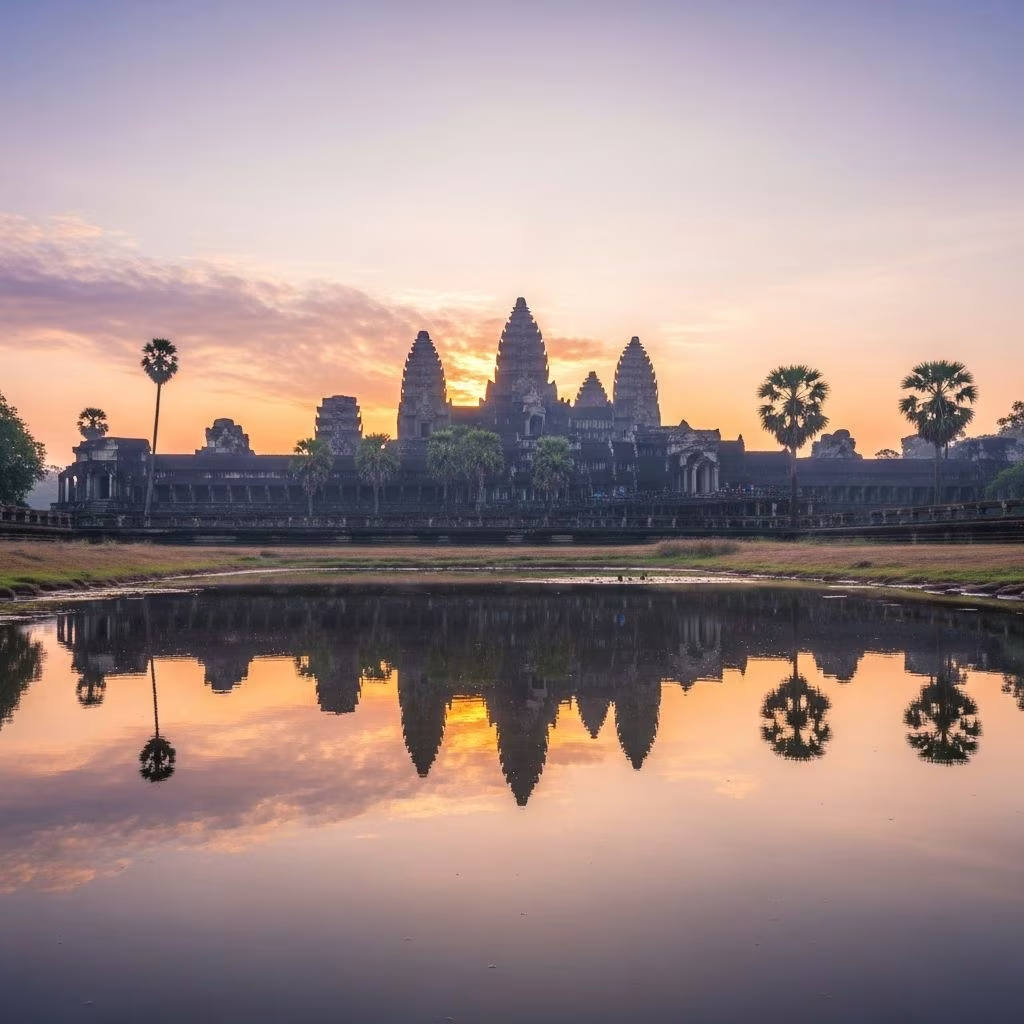
Angkor Wat stands as the pinnacle of ancient Khmer architecture, a sprawling temple complex constructed in the early 12th century that symbolizes Cambodia’s golden age.Spanning over 400 acres, it remains the largest religious monument on Earth and serves as the centerpiece of the Angkor Archaeological Park, a UNESCO World Heritage site since 1992. Dedicated initially to the Hindu god Vishnu, this masterpiece draws millions of visitors annually, blending profound historical depth with breathtaking artistry.
In the heart of what was once the thriving Khmer Empire, King Suryavarman II commissioned Angkor Wat around 1113–1150 as both a state temple and his funerary mausoleum. This devout Hindu ruler oversaw the mobilization of approximately 50,000 workers, including many slaves, who toiled for nearly three decades to realize his vision amid the dense jungles near modern-day Siem Reap. The empire, which flourished from the 9th to 15th centuries, controlled vast territories across Southeast Asia, with Angkor as its pulsating capital—a metropolis of temples, reservoirs, and canals supporting over a million inhabitants.
The temple’s construction marked the zenith of Khmer ingenuity, reflecting a society advanced in hydraulics, urban planning, and monumental stonework. Unlike later structures, Angkor Wat uniquely faces westward, possibly symbolizing the king’s journey to the afterlife or a deliberate architectural choice to greet the setting sun. By Suryavarman II’s death, likely before completion, the site had transformed the landscape into a cosmic replica of Mount Meru, the mythical home of the gods in Hindu cosmology.
Angkor Wat’s design embodies the Khmer ‘temple-mountain’ style, with five lotus-bud towers soaring skyward, the central one reaching 213 feet (65 meters). Encircled by a 550-yard-wide moat and three concentric galleries, the complex features intricate bas-reliefs covering nearly 4,000 feet of walls. These carvings depict epic Hindu tales from the Mahabharata and Ramayana, alongside scenes of Suryavarman II’s battles and daily Khmer life, showcasing over 1,800 graceful apsara dancers.
| Feature | Description | Significance |
|---|---|---|
| Central Towers | Five corbelled spires mimicking Mount Meru | Represents the Hindu-Buddhist universe’s sacred peak |
| Bas-Reliefs | 12,000+ square meters of carvings | Illustrates mythology, history, and cosmology |
| Moat and Galleries | 1.5 km perimeter waterway and libraries | Symbolizes cosmic ocean; functional for rituals |
| Apsara Statues | 1,800+ celestial nymph figures | Embodiment of beauty and divine dance |
Masterful sandstone quarrying and laterite foundations highlight engineering prowess without mortar, relying on precise interlocking stones that have endured earthquakes and monsoons. The site’s hydraulic network, including vast barays (reservoirs), sustained agriculture in this tropical climate, underscoring the Khmer’s mastery over water management.
Angkor Wat’s religious journey mirrors Cambodia’s spiritual shifts. Originally a Vishnu temple, it faced devastation in 1177 when Cham invaders from modern Vietnam sacked Angkor, prompting King Jayavarman VII (r. 1181–1220) to convert the empire to Mahayana Buddhism. He repurposed the site, replacing Hindu icons with Buddha images and erecting nearby Angkor Thom with its iconic Bayon temple featuring 216 enigmatic faces.
By the 13th–14th centuries, Theravada Buddhism dominated, and Angkor Wat became a monastic center. The Khmer Empire declined amid Thai Ayutthaya invasions, culminating in 1431 when Angkor was abandoned, its population halved and survivors fleeing south to Phnom Penh. Yet, the temple never fully vanished; locals maintained rituals, and royalty returned for pilgrimages into the 16th century.
European awareness dawned with 16th-century Portuguese missionaries, but the modern revival began in 1860 when French explorer Henri Mouhot documented the ‘lost city’ in travelogues, likening it to ancient wonders. France established a Cambodian protectorate in 1863, funding restorations and infrastructure that opened the site to tourists.
Independence in 1953 under King Norodom Sihanouk allowed continued French-Khmer excavations until the 1970s civil war and Khmer Rouge atrocities halted work. Revived in the late 1980s, international efforts by France, Japan, India, and others employ advanced techniques like laser scanning for conservation. UNESCO’s 1992 inscription spurred the Angkor Archaeological Park’s management, balancing tourism with protection against overvisitation, erosion, and looting. Today, sustainable practices limit daily visitors and fund community projects.
Located 6 km north of Siem Reap, Angkor Wat welcomes over 2 million visitors yearly, peaking November–March during dry season. Entry requires a 1–7 day pass (US$37–62), granting access to the 400 km² park including Ta Prohm’s tree-entwined ruins and Preah Khan.
Start at the western causeway for the classic view, then wander galleries clockwise. Combine with sunset at Pre Rup or Phnom Bakheng. Stay ethical: stick to paths, support local economies via homestays.
Angkor Wat pulses with life as Cambodia’s spiritual epicenter. Monks in saffron robes chant dawn prayers, while apsara dances revive ancient traditions during festivals like Khmer New Year (April). As the sole temple on a national flag, it embodies national pride, featured in currency and anthems. Visitors witness live blessings and markets selling silk scarves echoing bas-relief motifs.
The site’s legacy influences contemporary Khmer art, dance, and identity, fostering resilience post-Khmer Rouge. Community-led initiatives train youth in restoration, ensuring generational stewardship.
Health & Safety: Vaccinations advised; malaria low but use repellent. Hydrate amid 35°C heat.
Constructed circa 1113–1150, it’s nearly 900 years old.
Yes, as a Buddhist temple with daily worship.
Main tower closed for preservation; others accessible.
Shoulders and knees covered out of respect.
No—3 days ideal for main sites.
Beyond stone and symmetry, Angkor Wat whispers tales of empire, faith, and human ambition. Its endurance through conquests, abandonment, and revival cements its status as Southeast Asia’s crowning jewel, inviting all to ponder eternity amid its eternal spires.
