

 Travel Essentials
 Travel Essentials

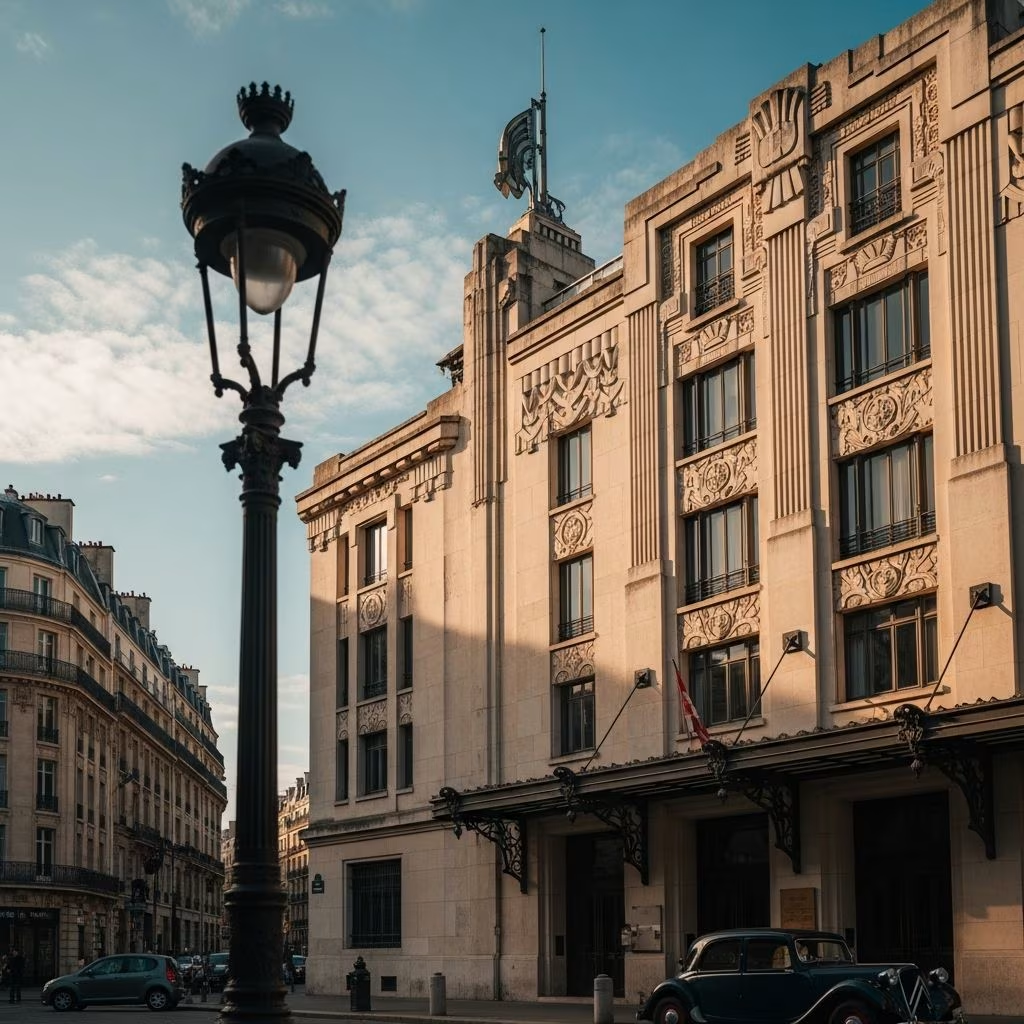
Navigate Paris's Art Deco heritage through its most stunning buildings, from theaters to residential complexes that defined 1920s modernity.
 Travel Essentials
The streets of Paris stand as an open museum of twentieth-century design innovation, with the Art Deco movement representing one of the most transformative architectural periods in the city’s history. Emerging during the 1910s and flourishing through the 1930s, this aesthetic revolutionized how Parisians conceived of urban space, blending functionalism with ornamental sophistication. The movement reached its zenith following the 1925 International Exhibition of Modern Decorative and Industrial Arts, an event that cemented Paris’s position as the global epicenter of contemporary design thought. Today, wandering through the city’s neighborhoods reveals an impressive collection of buildings that showcase the geometric precision, luxurious materials, and forward-thinking philosophy that defined this influential era.
The Art Deco phenomenon represented a decisive departure from the organic, nature-inspired forms that characterized the preceding Art Nouveau movement. Where Art Nouveau emphasized curves, flowing lines, and botanical motifs, Art Deco asserted geometric rigor, symmetrical composition, and industrial materials as expressions of modern society. This stylistic transition reflected broader cultural shifts—the confidence of the post-World War I period, the technological advances reshaping daily life, and society’s fascination with speed, efficiency, and progress.
The 1925 Exposition Internationale des Arts Décoratifs et Industriels Modernes served as the defining moment for this aesthetic movement. Held between the Grand Palais and the Invalides, this landmark exhibition brought together artists, designers, and architects from across Europe and beyond to celebrate contemporary creative achievement. The exposition showcased not merely decorative objects but an entire philosophical framework—a vision of how modern people should live, work, and find beauty in their urban environment. The exhibition’s success transformed Art Deco from an avant-garde experiment into a widely adopted architectural language that would shape Parisian development for the next fifteen years.
Art Deco’s visual vocabulary comprised several distinctive elements that remain immediately recognizable to contemporary observers. Bold geometric forms replaced the sinuous curves of earlier movements, with architects favoring symmetrical arrangements, stepped profiles, and clean horizontal or vertical lines. The style embraced technological innovation through the use of modern materials—reinforced concrete, steel, glass, and aluminum—that earlier architectural traditions had rarely employed for aesthetic purposes.
Color played a crucial role in Art Deco composition. Rather than the subtle earth tones favored by classical architecture, Art Deco designers deployed vibrant hues, striking contrasts, and decorative elements like mosaic tiles and sculptural reliefs. These ornamental features—sunburst patterns, chevrons, stylized flora and fauna, and geometric abstractions—served to enliven surfaces while maintaining overall compositional harmony. This balance between restraint and exuberance distinguished Art Deco from more extreme modernist movements that rejected all decoration as superfluous.
The Théâtre des Champs-Élysées stands as one of the earliest and most significant Art Deco structures in Paris. Inaugurated in 1913 on the elegant Avenue Montaigne, this visionary creation by Auguste Perret embodied revolutionary architectural thinking. Perret’s design pioneered the sophisticated use of reinforced concrete, a material that most architects of the period still considered primarily utilitarian. Rather than hiding this industrial material behind traditional facades, Perret elevated concrete through rigorous proportional systems and subtle ornamental details, demonstrating that modern materials could convey elegance and cultural significance.
The theater’s clean lines, generous fenestration, and harmonious proportions established aesthetic principles that would influence Art Deco development throughout the decade. Perret’s achievement lay in reconciling modernism’s functional demands with the human desire for beauty and refinement—a balance that would define successful Art Deco architecture across Paris.
The Molitor Building represents Art Deco’s application to residential and recreational architecture. Designed by architects Robert Mallet-Stevens and Marcel Perret, this structure exemplifies how geometric principles and contemporary materials could create spaces of extraordinary elegance and functionality. The building’s rigorously symmetrical facades, expansive windows that flood interiors with natural light, and sophisticated use of concrete and glass reflect an architectural philosophy that prioritized both aesthetic refinement and practical livability.
The Molitor’s fame extended beyond its architectural credentials—its swimming pool became an iconic Parisian destination, symbolizing the leisured modern lifestyle that Art Deco promised. The building demonstrates how architectural innovation could integrate multiple functions (residential, recreational, social) while maintaining unified aesthetic vision.
The 16th arrondissement emerged as a primary laboratory for Art Deco experimentation following its annexation to Paris. The district’s spacious vacant lands and affluent resident base created conditions favorable for ambitious architectural projects. This neighborhood contains extraordinary concentrations of Art Deco and transitional Art Nouveau structures, offering architectural historians and enthusiasts unparalleled opportunities for comparative study.
Key Landmarks in the 16th:
Economic challenges of the interwar years profoundly influenced Art Deco’s material vocabulary. As financial pressures mounted, architects adapted their designs to incorporate less prestigious materials alongside traditional stone. Concrete, brick, and iron became compositional elements rather than inferior substitutes, demonstrating architectural resourcefulness and creative problem-solving. At numbers 44 and 50 Rue de l’Assomption, twin Art Deco structures showcase this material eclecticism through combinations of sandstone, concrete, iron, and brick, adorned with fruit baskets, wrought-iron spirals, and sculptural pediments.
Understanding Art Deco requires appreciation of its complex relationship with Art Nouveau. The earlier movement, championed by architects like Hector Guimard, emphasized organic forms, intricate ironwork, and the romantic potential of industrial materials. The celebrated Hôtel Deron-Levent (8 Villa de la Réunion) exemplifies Guimard’s sophisticated approach, featuring double facades with extraordinarily fine wrought ironwork and magnificently sculpted stone window surrounds.
Art Deco did not simply reject these achievements but rather redirected design energy toward geometric abstraction and mechanical precision. The transition proved gradual rather than abrupt—many buildings of the 1910s and early 1920s incorporated both movements’ aesthetic vocabularies. Architects and patrons gradually embraced Art Deco’s streamlined forms as they perceived them as more authentically representative of contemporary technological civilization.
Geometry provided Art Deco’s fundamental organizational principle. Unlike Art Nouveau’s reliance on irregular curves derived from natural observation, Art Deco employed strict geometric systems—circles, triangles, chevrons, and stepped forms—as primary design generators. These geometric elements appeared not merely as decorative details but as structural organizing systems determining facade composition, window placement, and ornamental schemes. This mathematical approach reflected contemporary fascination with rationality, science, and industrial production methods.
Art Deco architects recognized light as a critical design medium. Extensive fenestration, glass bricks, translucent materials, and carefully calculated proportions allowed natural light to penetrate deep into building interiors. The Cité de l’Argentine (galerie Argentine), designed by Henri Sauvage and Charles Sarrazin between 1904 and 1907, demonstrates this principle through its succession of glass roofs—one fishbone-patterned, one rectilinear—distributing soft zenithal illumination throughout the shopping galerie. This emphasis on light accessibility reflected modernist beliefs about hygiene, psychological well-being, and democratic access to natural benefits.
Several visionary architects emerged as dominant figures in Parisian Art Deco development. Henri Sauvage distinguished himself through multiple significant commissions, including the Studio Building, the Majorelle Building (constructed for furniture designer Louis Majorelle), and the innovative apartment complex at 26 rue Vavin. Auguste Perret pioneered reinforced concrete’s aesthetic potential through the Théâtre des Champs-Élysées. Robert Mallet-Stevens and Marcel Perret collaborated on the Molitor Building, while Michel Roux-Spitz developed stripped modernist approaches balancing industrial efficiency with human-scaled proportions.
These architects, along with contemporaries like Louis-Hippolyte Boileau and Jean Boucher, constituted an international design community sharing common aspirations toward reconciling modern materials and production methods with aesthetic refinement and cultural meaning.
While architectural achievement dominated the Art Deco movement, related artistic disciplines flourished simultaneously. Designers René Lalique, known for innovative glasswork; Cartier, the prestigious jewelry house; and Tamara de Lempicka, whose paintings captured Art Deco’s geometric sensibilities in figural composition, all contributed to a comprehensive aesthetic ecosystem. Fashion designer Paul Poiret championed streamlined silhouettes and geometric ornament in textile design. Photographer and artist Man Ray employed geometric abstraction and contemporary materials in groundbreaking visual experiments. This cross-disciplinary creative ferment ensured Art Deco’s pervasive influence throughout Parisian culture and design practices.
Today, Paris’s Art Deco heritage represents an invaluable cultural resource and architectural archive. Many buildings have undergone thoughtful restoration, while others remain privately occupied, their facades continuing to delight contemporary observers. Walking through neighborhoods like the 16th arrondissement provides unmediated encounters with this architectural legacy, allowing visitors to examine design details, material combinations, and spatial arrangements that revolutionary architects developed nearly a century ago.
Contemporary architectural discourse increasingly recognizes Art Deco’s sophisticated balance between modernist principles and humanistic concerns. Rather than viewing Art Deco as kitsch or mere decoration obscuring functionalist purity, contemporary architects appreciate its successful integration of beauty, utility, and technological innovation—a reconciliation that remains relevant to contemporary design challenges.
Visitors seeking concentrated Art Deco immersion should prioritize the 16th arrondissement, where numerous landmarks cluster within walkable distances. The Avenue Montaigne corridor, encompassing the Théâtre des Champs-Élysées and nearby structures, offers quintessential examples. The Left Bank’s Lutetia hotel and adjacent districts contain additional significant specimens. Department stores, though beyond the scope of this architectural survey, often incorporate Art Deco elements in their facades and interior spaces.
Architectural guidebooks and specialized tours provide contextual information, historical backgrounds, and technical analysis enriching casual observation. Photography opportunities abound, as Art Deco’s bold geometric forms and ornamental details photograph dramatically in varying light conditions.
