

 Travel Essentials
 Travel Essentials

Discover how astronaut candidates train for spaceflight through rigorous selection, survival drills, simulators, and mission prep at NASA and beyond.
 Travel Essentials
Astronaut training transforms highly qualified candidates into elite space explorers capable of handling the extreme challenges of spaceflight. This multi-phase process, primarily conducted at NASA’s Johnson Space Center in Houston, Texas, spans up to two years of intensive preparation before candidates earn their astronaut wings.
Becoming an astronaut candidate begins with a fiercely competitive selection process. NASA receives thousands of applications—over 8,000 in the 2024 cycle alone—and selects only a handful, such as the 10 candidates from that year. Candidates must hold a master’s degree in a STEM field, have at least three years of related professional experience, or log 1,000 hours of pilot-in-command time in jet aircraft.
The Astronaut Selection Board rigorously evaluates qualifications, inviting top applicants for interviews at Johnson Space Center. About half of interviewees return for second rounds, from which the final group emerges. Diverse backgrounds, including test pilots, engineers, medical professionals, and geologists, enrich the corps, now comprising around 240 members, including 130 international partners.
Newly selected astronaut candidates, or “AsCans,” dive into a two-year “boot camp” blending classroom learning with hands-on drills. They master shuttle and space station systems, orbital dynamics, navigation, materials processing, and sciences like geology, meteorology, oceanography, astronomy, and physics.
Training emphasizes both technical and survival skills. Candidates learn land and sea survival techniques, scuba diving for underwater simulations, space suit operations, and weightlessness basics. Pilot candidates train on T-38 jet trainers to hone aviation proficiency.
International collaboration requires language training, particularly Russian for ISS operations, alongside cultural and professional development. This phase ensures AsCans grasp aerospace acronyms, space system engineering, medicine, robotics, and piloting fundamentals.
| Training Module | Description | Duration/Focus |
|---|---|---|
| Systems & Sciences | Shuttle/ISS ops, orbital mechanics, Earth sciences | Core classroom phase |
| Survival Skills | Land/sea survival, scuba, space suits | Practical field exercises |
| Flight Readiness | T-38 jets (pilots), robotics intro | Hands-on aviation |
| Language/Culture | Russian, international protocols | 16+ months for some |
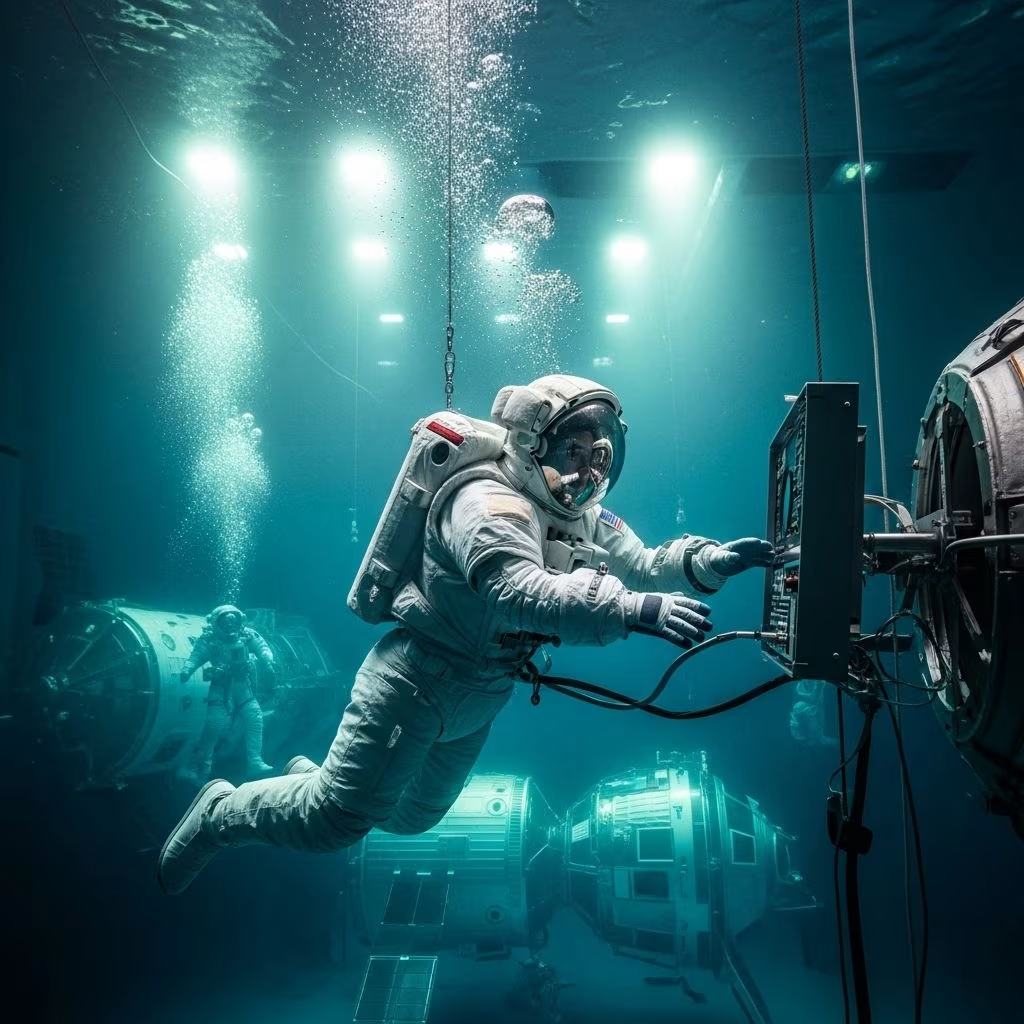
Progressing to advanced training, candidates use state-of-the-art facilities to replicate space conditions. The Neutral Buoyancy Laboratory (NBL)—the world’s largest indoor pool at the Sonny Carter Training Facility—immerses trainees in mock spacewalks. Weighted to neutral buoyancy, candidates practice extravehicular activities (EVAs) for hours in full suits.
Virtual Reality Laboratories provide computer-generated microgravity environments for spacewalk and robotic arm rehearsals. Fixed-base simulators train rendezvous and payload operations, while functional space station mockups teach station navigation and procedures.
ESA astronauts at the European Astronaut Centre follow a similar 16-month basic block, covering spacefaring nations’ programs, laws, and policies before advancing. Russian cosmonauts at Star City undergo two years of general training, including Soyuz/ISS systems and survival, followed by specialization.
China’s program at the Astronaut Center features high-fidelity Shenzhou trainers, Neutral Buoyancy Facilities, and vacuum chambers for EVA prep.
About three months pre-launch, intensive mission training begins. Candidates receive flight assignments, grouped as pilots (who command and fly) or mission specialists (flight engineers handling experiments).
Integrated simulations test mission rules, procedures, and crew-flight controller interactions alongside planning. Crew medical officer training equips them for in-flight health issues. AsCans log 300+ hours in simulators, mastering robotics, experiments, and contingencies.
For cosmonauts, crew training spans 1.5 years on vehicle ops, ISS details, and English. Upon completion, candidates are designated full astronauts or cosmonauts, eligible for assignment.
While NASA leads, international programs mirror this rigor. Russia’s Yury Gagarin Centre delivers phased training: two years general (classes, survival, exams), one year group (Soyuz/ISS specialization), and 1.5 years crew-specific.
ESA’s European Astronaut Centre offers orientation on global agencies and uncrewed programs. China’s 10-month mission phase uses Beijing facilities for Shenzhou and environmental simulations.
Over 50 international explorers have trained at Johnson, fostering global cooperation essential for ISS and future missions.
NASA’s Johnson Space Center hosts world-class venues:
These tools ensure realistic preparation, from zero-gravity maneuvers to emergency responses.
Training demands psychological agility for isolation, high-stakes decisions, and microgravity effects. Water survival underscores adaptability, as candidates practice post-splashdown scenarios. Rehabilitation and proficiency maintenance follow, sustaining skills post-mission.
Typically two years of basic and advanced training, plus 3-10 months mission-specific prep.
The Neutral Buoyancy Laboratory, a massive pool simulating weightlessness.
Yes, mission specialists focus on science and operations without piloting requirements.
Yes, over 130 have trained at Johnson Space Center.
Rigorous exams, survival drills, scuba, and jet flights test endurance.
As Artemis and commercial missions advance, training evolves with lunar/Mars focus, enhanced VR, and AI simulations. Yet core elements—rigor, teamwork, resilience—remain timeless.
