

 Travel Essentials
 Travel Essentials

Discover Atlanta's groundbreaking linear arboretum spanning 12+ miles of the Beltline corridor, featuring over 9,000 plants and 369 species.
 Travel Essentials
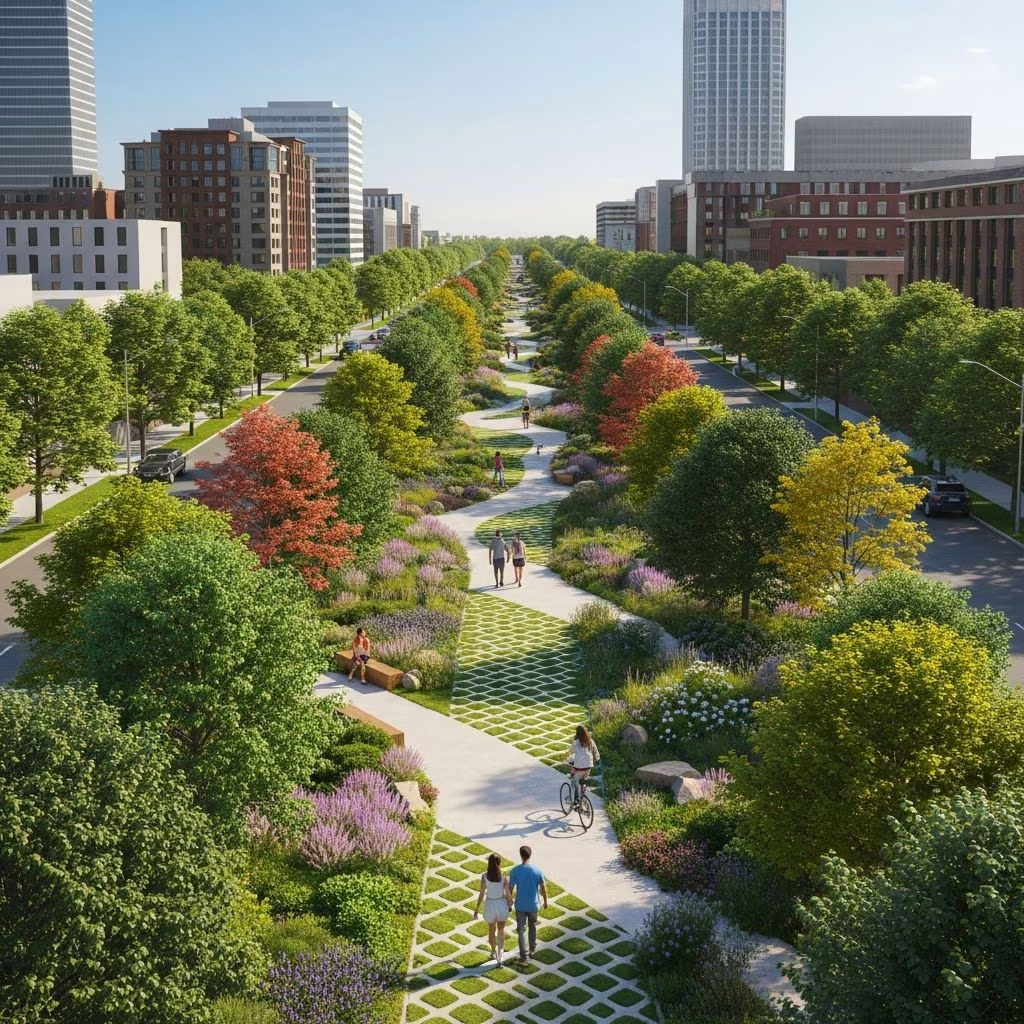
When abandoned railroad corridors are reimagined as thriving green spaces, cities transform. Atlanta’s Beltline project exemplifies this transformation through its pioneering linear arboretum, an innovative approach to urban forestry that stretches across multiple neighborhoods and redefines how metropolitan areas can cultivate natural beauty and ecological resilience. This botanical marvel represents a convergence of urban planning, environmental stewardship, and community engagement that offers visitors an extraordinary experience while advancing sustainability on an urban scale.
Unlike traditional arboreta confined within fixed boundaries, a linear arboretum extends along a continuous corridor, creating a dynamic pathway through multiple ecosystems and communities. This distinctive format fundamentally changes how residents and visitors interact with botanical collections and nature education. The Atlanta Beltline Arboretum represents this concept at unprecedented scale, having achieved official recognition as the world’s longest linear arboretum. The design philosophy emphasizes accessibility and integration with urban infrastructure, transforming what was once industrial land into a living laboratory for sustainable horticulture and ecological restoration.
An arboretum, in its traditional definition, functions as a specialized botanical garden dedicated to the cultivation, study, and display of trees for research, education, and public enjoyment. The Atlanta iteration expands this mandate by incorporating grasslands, wildflowers, and native shrubs alongside diverse tree species, creating a more comprehensive representation of regional ecosystems than conventional tree collections.
The arboretum currently spans more than 12 miles of the completed Beltline trail, with plans to extend to 16.7 miles by summer 2026 as construction progresses toward the full 22-mile loop completion targeted for 2030. This expansion trajectory demonstrates sustained commitment to integrating botanical excellence throughout the entire corridor. The current installation encompasses approximately 60 to 85 acres of curated botanical space, with projections indicating growth to over 100 acres upon project completion.
The magnitude of this undertaking becomes evident when examining the plant inventory. Trees Atlanta, the nonprofit organization managing the arboretum in partnership with the City of Atlanta and the Atlanta Beltline, Inc., has already planted over 700,000 plants along the path. The collection now includes more than 9,000 individually cataloged trees and shrubs representing 369 distinct species and cultivars, alongside tens of thousands of native grasses and herbaceous plants filling the meadow areas.
The journey from abandoned railway infrastructure to thriving botanical destination reflects a dramatic ecological transformation. Prior to redevelopment, invasive species like kudzu dominated the corridor. Today, this invasive vegetation has been replaced with 650 different species and cultivars of woody plants, fundamentally altering the ecological character of the landscape.
This conversion represents more than aesthetic improvement; it constitutes genuine ecological restoration. The native plant focus creates habitat corridors for wildlife, including birds, butterflies, and other pollinators that depend on appropriate vegetation for survival and reproduction. By emphasizing southeastern native species, the arboretum restores ecological relationships disrupted by decades of industrial use and urban development.
The arboretum’s plant selection follows a deliberate ecological philosophy prioritizing species naturally adapted to Georgia and southeastern U.S. climates. This native plant emphasis provides multiple environmental advantages beyond simple aesthetics. Grace Manning, the Beltline’s Arboretum Manager, emphasizes that native plants require significantly less water, reduce emissions, and minimize gas fumes that long-term maintenance would otherwise necessitate.
Native plant landscaping fundamentally reimagines urban maintenance practices. By working with adapted species rather than against regional climate patterns, the arboretum demonstrates sustainable land management at scale. This approach reduces dependence on irrigation systems, chemical inputs, and resource-intensive maintenance protocols—practical advantages that extend far beyond the immediate site.
The diverse plant palette ensures seasonal interest throughout the year, with different species providing visual appeal and ecological value during spring blooms, summer foliage, autumn color, and winter architecture. This temporal dimension transforms the arboretum into a dynamic environment that reveals different characteristics with changing seasons, encouraging repeat visits and deepening connections between visitors and botanical diversity.
Recognition of the arboretum’s educational potential has driven creation of specialized learning spaces throughout the corridor. Trees Atlanta has funded and installed multiple educational installations that provide trail users with experiences typically unavailable in urban settings. These interventions transform the arboretum from a passive recreational space into an active learning environment.
Docent-led tours offer guided exploration of the arboretum’s botanical wonders, fresh air experiences, and stunning city views, allowing visitors to understand plant relationships, ecological principles, and horticultural practices through expert interpretation. These guided experiences democratize botanical knowledge, making specialized information accessible to diverse audiences regardless of prior plant science experience.
Specialized garden installations serve focused educational missions. A butterfly garden represents one such intervention, concentrating plants that specifically support pollinators—particularly butterflies—in dedicated spaces designed for observation and learning. These targeted installations teach visitors about plant-pollinator relationships, ecological interdependence, and the role of specific plant selections in supporting wildlife populations.
The arboretum functions as a gateless, free public garden accessible to all community members without entrance fees or administrative barriers. This democratic approach to botanical access ensures that horticultural education and nature experiences remain available to residents regardless of economic status. The approximately 2 million annual trail users represent an unprecedented audience for botanical education and environmental messaging.
The arboretum connects 45 neighborhoods throughout Atlanta, serving as a unifying green infrastructure that links disparate communities while providing neighborhood-specific plantings that reflect local character and ecological conditions. This neighborhood integration transforms the arboretum from a destination attraction into daily infrastructure that residents encounter during commutes, recreation, and community movement.
The Beltline corridor links directly to more than 400 acres of parks and 24.6 miles of trails (combining mainline and connector paths), creating an extensive connected greenspace network described as an “emerald necklace” encircling the urban center. This connectivity multiplies the environmental and recreational benefits beyond the arboretum itself.
The arboretum’s achievement as the world’s longest linear arboretum represents a significant distinction in botanical and horticultural communities. Beyond this record, Trees Atlanta maintains Level II accreditation from ArbNet, an international network comprising more than 900 arboreta. This accreditation confirms compliance with professional standards for collection development, maintenance, research, and public programming, validating the arboretum’s credentials as a serious botanical institution rather than merely a recreational corridor.
The Atlanta Beltline Arboretum demonstrates how rapid urban growth can accommodate—and indeed strengthen—climate-friendly, healthy community development. Rather than viewing green infrastructure as secondary to urban priorities, the project positions botanical excellence as central to urban livability, mental health, and environmental resilience.
The arboretum serves multiple simultaneous functions: ecological restoration, education, recreation, air quality improvement, stormwater management, urban heat island mitigation, and community connectivity. This multifunctionality exemplifies sophisticated urban design that addresses contemporary environmental challenges while enhancing quality of life.
No. The Atlanta Beltline Arboretum operates as a free, open-to-all public garden. No entrance fees or registration requirements apply, making botanical education and nature experiences universally accessible.
Currently, the arboretum spans approximately 12 to 13 miles of the completed Beltline trail. The full 22-mile loop is projected to reach completion by 2030, with expansion to 16.7 miles anticipated by summer 2026.
Yes. Trees Atlanta offers docent-led tours that provide expert botanical guidance, plant identification, and ecological education throughout the arboretum corridor.
The collection includes over 9,000 cataloged plants representing 369 species and cultivars, with emphasis on native southeastern species. Visitors will observe diverse trees, woody shrubs, native grasses, wildflowers, and specialized plantings in themed gardens.
The Beltline’s flat, paved surface accommodates various accessibility needs. Visitors can explore sections matching their fitness level and time availability, with multiple entry and exit points throughout the corridor.
As the Atlanta Beltline Arboretum continues expanding toward its 22-mile completion, it establishes templates for urban forestry and botanical education that other cities can adapt and replicate. The project demonstrates that urban growth need not conflict with environmental stewardship, ecological restoration, and community access to nature. Rather, intentional design can integrate these priorities seamlessly into urban infrastructure.
The arboretum’s evolution from industrial corridor to world-renowned botanical destination represents a transformative approach to urban reimagining. By recognizing the potential of abandoned infrastructure, committing sustained resources to plant cultivation and maintenance, and designing experiences that serve educational and recreational functions simultaneously, Atlanta has created a model for twenty-first-century urbanism that prioritizes ecological resilience, community wellbeing, and botanical excellence.
