

 Travel Essentials
 Travel Essentials

Explore essential Atlanta sites tied to MLK Jr., from his birthplace to memorials, offering deep insights into his life and the Civil Rights Movement.
 Travel Essentials
Atlanta stands as a living testament to Dr. Martin Luther King Jr.’s transformative role in the Civil Rights Movement. This southern city preserves numerous landmarks associated with his life, work, and vision for a just society. Spanning roughly 35 acres, the core area features sites where King was born, raised, preached, and now rests eternally. These locations draw hundreds of thousands of visitors annually, providing immersive experiences into the struggles against segregation and the power of nonviolent resistance.
Dr. King’s roots in Atlanta shaped his lifelong commitment to equality. Born in 1929 amid Jim Crow laws, he grew up witnessing systemic racism firsthand. His family’s home, church, and community influenced his philosophy, blending Christian teachings with influences from Gandhi and others. In 1980, these sites gained federal protection as a National Historic Site, later elevated to a National Historical Park in 2018. Today, they offer free access to exhibits, tours, and serene reflection spaces, making history accessible to all.
Your first stop should be the Martin Luther King Jr. National Historical Park Visitor Center. Located at the park’s entrance, this modern facility orients visitors with interactive displays. The flagship exhibit, often highlighting themes of courage amid oppression, uses multimedia to depict the era’s racial violence and King’s responses. Secure tickets here for guided tours of his birth home, as spots fill quickly. Open daily from 9 a.m. to 5 p.m., except major holidays, it’s the hub for maps, schedules, and ranger programs.
A modest two-story house at 501 Auburn Avenue captures the essence of King’s early years. Here, from 1929 to 1941, he lived with his parents, siblings, and grandparents. Restored to its 1930s appearance, the home features period furnishings, family photos, and stories of daily life under segregation. Ranger-led tours, limited to 15 people, run from 10 a.m. to 4 p.m. Note: As of recent updates, the site is under renovation through late 2025, but virtual presentations continue at Fire Station No. 6. This preserved space evokes the foundation of a global leader.
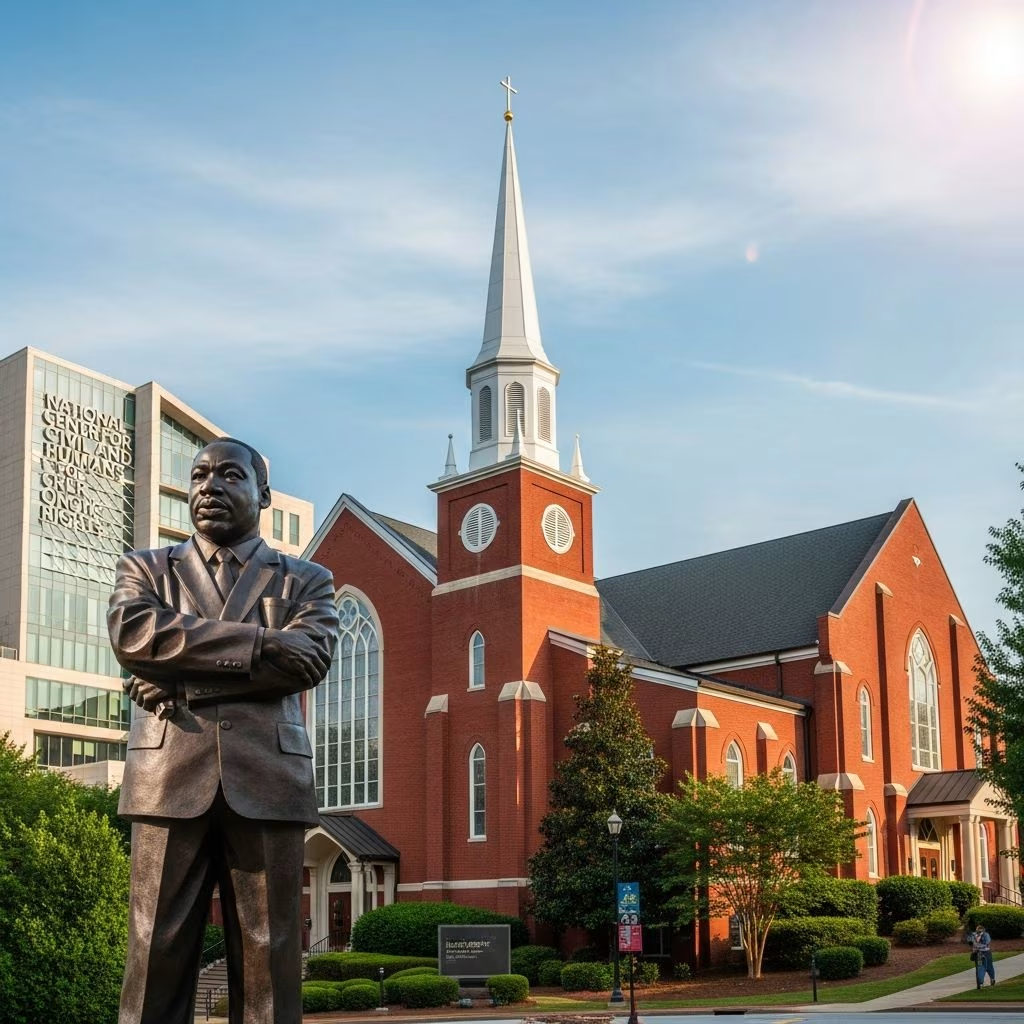
Ebenezer Baptist Church, at 407 Auburn Avenue, was the spiritual anchor for the King family. King’s father and grandfather pastored here, and young Martin was baptized in its waters. Returning in 1960 as co-pastor, he delivered powerful sermons from the pulpit until his assassination. Visitors enter the 1960s sanctuary to hear audio recordings of his speeches echoing through the pews. Exhibits detail the church’s role in civil rights organizing. Open daily 9 a.m. to 5 p.m., with ranger talks enhancing the experience.
Adjacent to Ebenezer lies the poignant memorial where Dr. King and Coretta Scott King rest. Their white marble crypts float in a serene reflecting pool, illuminated by an eternal flame symbolizing undying hope. Designed in 1970, this site draws quiet reflection on their shared sacrifices. Surrounding paths feature quotes from King’s speeches, inviting contemplation of his dream.
The “I Have a Dream” World Peace Rose Garden blooms with over 1,000 roses representing global unity. Dedicated to King’s vision, it includes a fountain and the towering “Behold” Monument, a bronze sculpture unveiled in 2020. Interpretive panels link the garden to nonviolent icons like Gandhi and Rosa Parks. Perfect for photos and peaceful walks, it’s accessible year-round.
Fire Station No. 6, at 39 Boulevard NE, served as one of the first desegregated stations in the South during the 1950s. Now a temporary visitor center during renovations, it houses exhibits on integration efforts and park history. Volunteers staff it variably from 9 a.m. to 5 p.m.. Nearby, The King Center, founded by Coretta in 1968, offers Freedom Hall with artifacts, a bookstore, and resources on nonviolence. It features Gandhi’s statue and walks tracing civil rights footsteps.
Atlanta’s MLK sites cluster along Auburn Avenue, easily walkable in 2-3 hours, though full exploration takes a day. Free entry applies park-wide, but birth home tours require tickets. Parking is available on John Wesley Dobbs Avenue; public transit via MARTA buses (#3, #99) or Atlanta Streetcar connects seamlessly.
| Site | Hours | Key Features | Accessibility |
|---|---|---|---|
| Visitor Center | 9am-5pm daily | Exhibits, tour tickets | Fully accessible |
| Birth Home | 10am-4pm tours | Ranger-guided | Limited during reno |
| Ebenezer Church | 9am-5pm daily | Sermons, exhibits | Wheelchair ramps |
| Memorial | Always open | Crypts, flame | Paved paths |
| Rose Garden | Always open | Roses, monument | Garden trails |
Combine with nearby attractions like the Robert W. Woodruff Library’s MLK Collection for deeper research. Stay hydrated in Georgia heat and wear comfortable shoes for the promenade.
Beyond tourism, these landmarks educate on ongoing justice struggles. Annual events, like MLK Day observances, draw crowds for marches and programs. The park’s 850,000 yearly visitors reflect global resonance. Exhibits evolve, incorporating recent scholarship on King’s global influences and Coretta’s activism.
Yes, all National Historical Park components are free, including tours.
Spring for roses or weekdays to avoid crowds. Closed Thanksgiving, Christmas, New Year’s.
Ranger-led birth home tours and church talks run daily; check the calendar at the visitor center.
Yes, MARTA #3 bus from Five Points or Streetcar directly to grounds.
Under renovation until Nov 2025; presentations available at Fire Station No. 6.
2-4 hours for essentials; full day with King Center and library.
Visiting these sites isn’t just sightseeing—it’s a call to reflect on progress and persistent challenges. Atlanta’s MLK landmarks bridge past injustices to future aspirations, ensuring Dr. King’s voice endures.
