

 Travel Essentials
 Travel Essentials

Rare mid-flight births turn airplanes into delivery rooms, revealing the medical, legal, and crew challenges behind these extraordinary events.
 Travel Essentials
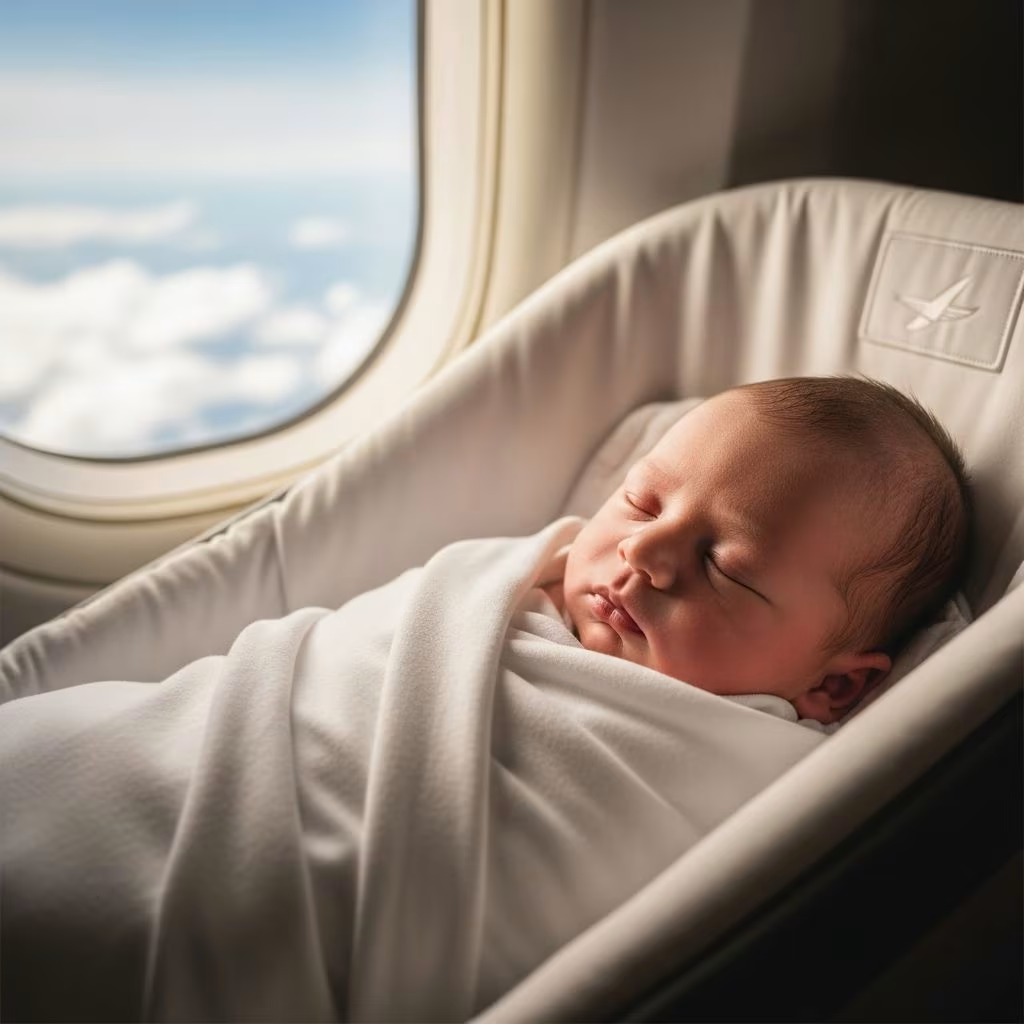
Commercial aviation occasionally witnesses one of life’s most profound miracles: the birth of a child at cruising altitude. These rare events blend high-stakes medical emergencies with the confined environment of an aircraft cabin, testing the limits of crew training and passenger goodwill. Over the decades, fewer than 100 such incidents have been documented on scheduled flights, highlighting their exceptional nature.
In-flight deliveries represent a tiny fraction of global air travel. A comprehensive study reviewing aviation history from 1929 to 2018 identified just 74 births across 73 commercial flights, with 71 newborns surviving the ordeal. These occurrences demand immediate, coordinated action in a setting far from conventional medical facilities.
Factors contributing to such events include premature labor, unexpected complications in late-term pregnancies, and the stresses of long-haul travel. Despite airline policies discouraging travel in the final weeks of pregnancy, emergencies can strike without warning, turning a routine flight into a delivery room at 30,000 feet.
One recent case involved a Caribbean Airlines flight from Kingston, Jamaica, to New York’s John F. Kennedy International Airport on April 4, 2026. A passenger went into labor mid-journey, giving birth successfully en route. The airline confirmed the medical event, noting that upon landing, both mother and newborn received prompt care from ground medical personnel. Details on the exact location at the time of birth remain unconfirmed, fueling discussions on the child’s legal status.
Another compelling account features Kendra Rhoden, a Connecticut resident flying American Airlines from New York to the Dominican Republic. At seven months pregnant—six weeks early—Rhoden’s water broke while she slept. Alerted by her sister, flight attendants summoned onboard nurses who assisted in delivering her son, named Skylan in tribute to his unique arrival. The birth certificate lists the place of birth as “in the air,” affirming his U.S. citizenship. After landing, both were hospitalized briefly before returning home safely. American Airlines praised the crew and medical volunteers for their swift response.
These narratives underscore a pattern: passengers often include family members or medical professionals who step up, while cabin crew orchestrate the response under pressure.
Airline staff undergo rigorous training for medical emergencies, including births. Protocols involve clearing space, providing sterile supplies, and communicating with air traffic control for priority landing if needed. In Rhoden’s case, nurses improvised with available materials, demonstrating the value of passenger expertise.
Caribbean Airlines’ handling of their incident exemplifies standard procedure: post-delivery care coordination and handover to authorities. Crews also manage passenger anxiety, maintaining calm amid chaos.
The question of nationality for skyborn infants hinges on location at birth. U.S. law grants citizenship via jus soli—right of the soil—under the 14th Amendment, extending to airspace within 12 nautical miles of the coastline. Immigration experts like Juan Carlos Rivera emphasize that precise flight data, such as GPS coordinates, proves territorial boundaries.
Proving this requires airline logs documenting latitude and longitude. Parents must report the birth to authorities for certificates and passports, a process affirmed by legal precedent over a century old. In ambiguous cases, like the Caribbean Airlines flight, unresolved coordinates complicate claims.
| Scenario | Citizenship Eligibility | Proof Required |
|---|---|---|
| Born in U.S. airspace (<12nm coast) | Automatic U.S. citizen | Flight GPS logs |
| Born over international waters | Mother’s nationality | Birth records |
| Ambiguous location | Case-by-case review | Legal documentation |
Neonates born mid-flight face hypoxia risks from cabin pressure equivalent to 8,000 feet elevation. Yet, survival stands high at over 95% per historical data. Immediate neonatal care focuses on warming, oxygenation, and resuscitation if needed.
For mothers, postpartum hemorrhage and infection risks elevate without full sterile conditions. Post-landing hospital transfers are critical. The Mayo Clinic advises healthy pregnancies can fly until 36 weeks, but complications warrant ground travel.
Carriers enforce gestational limits: most bar travel after 36 weeks domestically, 32-35 weeks internationally, requiring doctor’s notes beyond 28 weeks. Violations occur, as in Rhoden’s case, but airlines prioritize safety.
Some mandate liability waivers; others refuse boarding. These rules balance passenger rights with operational risks.
Aviation birth lore includes a 1929 first on a commercial flight and notable cases like a 2020s TikTok-viral American Airlines delivery. Air traffic control recordings from New York-bound flights capture tense coordinations.
Over 90 years, patterns show higher incidences on transatlantic or Caribbean routes, linking to demographics and travel patterns.
Only if delivered in U.S. territorial airspace (within 12 nautical miles of coast). Proof via flight data is essential.
Comprehensive medical drills cover deliveries, using onboard emergency kits and volunteer coordination.
Yes, up to 36 weeks for healthy cases per Mayo Clinic, but airlines restrict beyond 32-36 weeks.
Extremely rare; under 100 total from 1929-2018 across global flights.
Crew stabilizes patients; pilots expedite landing; EMS meets the aircraft.
Pregnant passengers should consult physicians pre-flight, carry medical summaries, and opt for direct routes. Airlines continue refining protocols, ensuring these miracles end happily.
These stories celebrate human resilience, from crew heroism to medical improvisation, proving life’s unpredictability even miles above earth.
