

 Travel Essentials
 Travel Essentials

Explore Beacon Hill's cobblestone streets, Federal-style homes, State House, and cultural trails in this comprehensive guide to Boston's elegant historic district.
 Travel Essentials
Beacon Hill stands as one of Boston’s most treasured neighborhoods, blending colonial history with timeless elegance. This compact area, perched atop a prominent rise, captivates with its narrow lanes, brick sidewalks, and preserved architecture from the late 18th and early 19th centuries. Home to the Massachusetts State House and adjacent to Boston Common, it offers a perfect fusion of cultural landmarks, residential charm, and modern amenities.
Beacon Hill’s story begins in the 17th century when the hill served practical purposes for the early settlement. In 1634, a signal beacon was placed at its summit to alert residents of potential invasions, giving the area its enduring name. The southwestern slopes were used for military drills and grazing livestock, while the north slope attracted sailors and soldiers, rendering it less desirable for residential development.
Transformation accelerated in the late 18th century. Beacon Street emerged in 1708 from an old cow path leading to Boston Common. By 1787, architect Charles Bulfinch designed the Massachusetts State House on land once owned by John Hancock, selected for its elevated position overlooking the city. Construction finished in 1798, marking a pivotal shift toward upscale residential growth.
The Mount Vernon Proprietors, formed around 1795, spearheaded development by acquiring nearly 19 acres west of the State House. This early land company filled in parts of the hill and built elegant homes in Federal and Greek Revival styles, drawing architects like Asher Benjamin, Solomon Willard, and Alexander Parris. Harrison Gray Otis House, designed by Bulfinch in 1796, exemplifies this era and now serves as Historic New England’s headquarters.
By the 19th century, Beacon Hill became a hub for wealth and influence. Apartment buildings appeared later, and adaptive reuse turned stables into lofts. The neighborhood’s African American community flourished pre-Civil War, with abolitionists and activists residing here. Women’s contributions shone through writers, artists, and pioneers in medicine and suffrage.
In 1955, Massachusetts established the Historic Beacon Hill District—the state’s first—to safeguard its architecture amid urban renewal. Expansions occurred in 1958, 1963, 1975, and as recently as 2024, ensuring preservation through efforts like the Beacon Hill Civic Association.
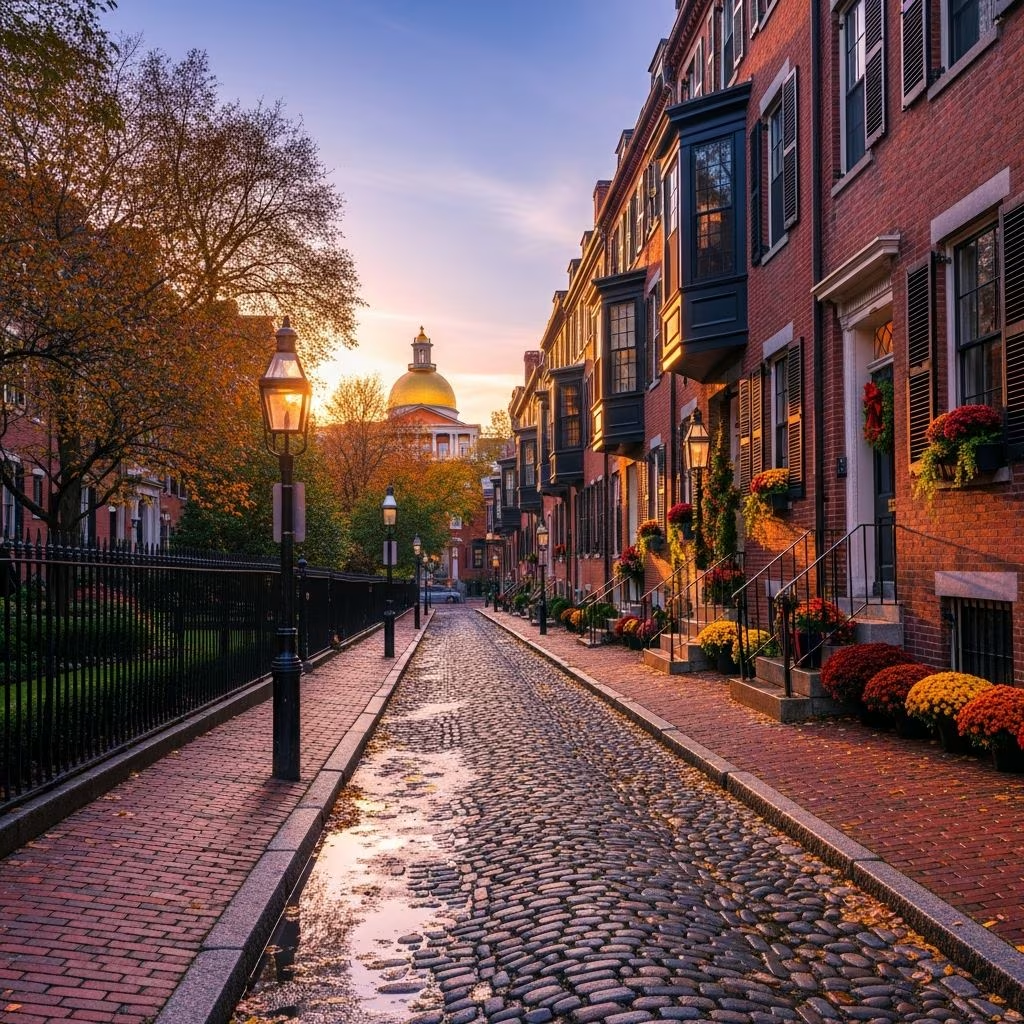
Beacon Hill’s visual allure lies in its Federal-style rowhouses, gas lamps, and wrought-iron details. Narrow, steep streets—some cobblestoned—wind past brick facades adorned with flower boxes and ornate doorways. The neighborhood spans about one-sixth of a square mile, fostering an intimate scale.
Acorn Street reigns as the most photographed spot, its cobblestones and symmetrical brick homes evoking a postcard from 1800. Photographers flock here for the play of light on shadowed alleys.
Louisburg Square offers an exclusive enclave with a central garden ringed by grand 19th-century mansions. Wrought-iron fences and lush plantings enhance its private, affluent vibe.
The Nichols House Museum, built in 1804 and renovated in 1830 by Bulfinch, provides tours of Brahmin life through original furnishings owned by landscape artist Rose Standish Nichols.
Beacon Hill brims with sites tied to American history. The Massachusetts State House, with its iconic gold dome (originally wooden, then copper-plated by Paul Revere’s firm in 1802), anchors the neighborhood. Free guided tours reveal government functions and artifacts like George Washington’s library collections at the adjacent Boston Athenaeum.
| Landmark | Key Features | Historical Note |
|---|---|---|
| Massachusetts State House | Gold dome, Federal architecture | Completed 1798 by Charles Bulfinch |
| Nichols House Museum | 1804 townhouse, original furnishings | Home of Rose Standish Nichols |
| Charles Street Meeting House | 1807 Baptist church | Hosted Frederick Douglass, Harriet Tubman speeches |
| African Meeting House | Oldest in U.S., part of Black Heritage Trail | Center for abolitionism and education |
The Black Heritage Trail parallels Beacon Hill paths, highlighting the African Meeting House—America’s oldest—and Abiel Smith School, the nation’s first black public school building.
Boston Athenaeum boasts rare books, including George Washington’s private library and volumes from England’s King William III. Freedom Trail starts at nearby Boston Common, weaving through 16 revolutionary sites.
A self-guided walk reveals the neighborhood’s essence. Begin at Boston Common, proceed to the State House, then descend to Acorn Street for photos. Continue to Louisburg Square, loop via Charles Street for shopping, and end at the Esplanade overlooking the Charles River.
Allow 2-3 hours; wear comfortable shoes for uneven paths. Best times: early morning or late afternoon for soft light and fewer crowds.
Along Beacon Hill’s western edge, Charles Street pulses with life. Antique shops, boutiques, and galleries mix with cafes, bakeries, and eateries. Specialty stores offer gourmet groceries, artisanal goods, and vintage finds.
Dining ranges from cozy pubs to upscale bistros. Try historic spots near the Charles Street Meeting House or modern gems with outdoor seating. The street’s vibrancy contrasts the quiet residential lanes, making it ideal for a post-walk refresh.
Getting There: Walk from downtown Boston (10-15 minutes from Park Street T station) or use the T (Red or Green Lines). Limited parking; public transit recommended.
Best Seasons: Spring and fall for mild weather and blooming window boxes; summer for events, winter for festive lights.
Accessibility: Cobblestones challenge wheelchairs; some sites offer tours or elevators.
Events: Join house tours, holiday strolls, or Black Heritage Trail walks via local organizations.
Beacon Hill’s allure endures through preservation and community stewardship, offering a living museum amid Boston’s bustle.
Beacon Hill is renowned for its historic Federal-style rowhouses, gaslit cobblestone streets, and landmarks like the Massachusetts State House and Acorn Street.
Yes, it’s one of Boston’s safest, most walkable neighborhoods, patrolled and residential.
2-4 hours for highlights; add time for museums or dining.
It’s a high-demand, expensive area with preserved historic homes and luxury condos.
Acorn Street, especially at golden hour.
