

 Travel Essentials
 Travel Essentials

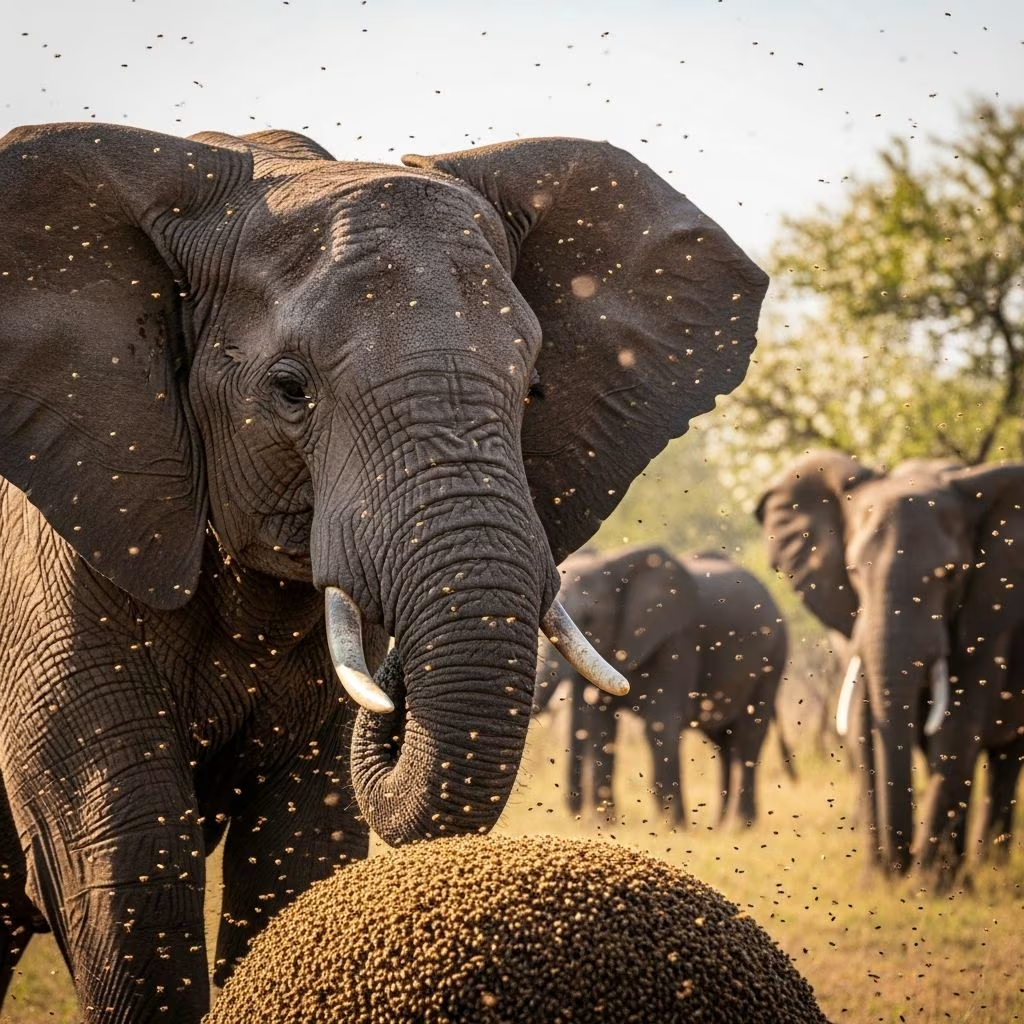
Beehive fences deter elephants from farmlands up to 86% during peak seasons, reducing conflicts while providing honey income and pollination for farmers.
 Travel Essentials
In regions where expanding human settlements encroach on ancient wildlife corridors, clashes between farmers and elephants have escalated, threatening both human livelihoods and endangered species. An ingenious, low-cost solution—beehive fences—capitalizes on elephants’ deep-seated aversion to bees, creating a living barrier that protects crops while generating additional income through honey production.
As populations boom and habitats fragment, elephants increasingly raid farmlands for nutrient-rich crops, leading to substantial economic losses and retaliatory killings. In Kenya alone, thousands of elephant approaches to farms occur annually during harvest seasons, exacerbating tensions in rural communities. Traditional deterrents like thorn bushes or electric fences often fail due to high maintenance costs or elephant adaptability.
Beehive fences address this by mimicking nature’s own defense mechanisms. Elephants, despite their thick hides, dread bee stings in vulnerable spots such as eyes, trunks, and mouths, prompting rapid retreats upon detecting buzzing hives. This instinctive response has been quantified in rigorous field trials, proving the method’s reliability.
Constructed from simple materials—wooden posts spaced 10 meters apart, connected by wire, with beehives suspended every 10 meters—these fences span farm perimeters, typically 500-1000 meters long. When an elephant brushes against the wire, hives vibrate, releasing swarms of African honeybees (Apis mellifera scutellata), whose aggressive defense triggers the animal’s flight.
Beyond deterrence, hives pollinate crops, enhancing yields, and yield 10-20 kg of honey per hive annually, sold for supplemental income.
A landmark study spanning 2014-2020 monitored 3,027 elephant approaches at Kenyan farms equipped with beehive fences. Results showed an 86.3% deterrence rate during peak crop seasons (November-January), dropping to 76% overall, including drought periods. Led by Dr. Lucy King of the University of Oxford and Save the Elephants, the research appeared in Conservation Science and Practice.
| Period | Elephant Approaches | Deterrence Rate |
|---|---|---|
| Peak Seasons (6 seasons) | 3,027 | 86.3% |
| All Seasons (9 years) | 3,999 | 76% |
| Drought-Influenced | Variable | Reduced efficacy |
Earlier pilots, like a 2011 trial in Turkana, Kenya, deterred 13 of 14 raids, yielding 106 kg of honey. Disney researchers confirmed elephants’ acoustic sensitivity to bee sounds via playback experiments.
Pioneered in 2007 by Save the Elephants, Kenya Wildlife Service, and Oxford University, over 14,000 hives now guard 97 sites across Africa and Asia. In Bangladesh, IUCN trains farmers in beekeeping, using hives as repellents for Asian elephants. Butterfly Pavilion extends the model, noting bees as “nature’s peacekeepers”.
Women-led initiatives thrive, with TED speaker Lucy King highlighting empowerment in 60+ sites across 19 countries. Trials in India show promise despite less aggressive Asian bees.
Farmers gain multifaceted advantages:
Ecologically, fences promote coexistence without harming elephants, preserving biodiversity hotspots amid climate pressures.
Despite successes, threats loom: habitat loss from development and prolonged droughts weaken bee colonies, reducing fence efficacy. King warns, “Increased habitat disturbance or more frequent droughts could reduce the effectiveness of this nature-based coexistence method.” Adaptive strategies include drought-resistant hives and habitat restoration.
Scaling requires funding for training and monitoring, but ROI from honey offsets costs within 1-2 years.
| Method | Cost | Effectiveness | Sustainability | Side Benefits |
|---|---|---|---|---|
| Beehive Fences | Low ($1-2/meter) | 76-86% | High (self-sustaining) | Honey income, pollination |
| Electric Fences | High | 70-90% | Medium (power needed) | None |
| Thorn Barriers | Low | 50-60% | Low (elephants breach) | None |
| Chili Fences | Medium | 60-70% | Medium | Spice sales |
Beehives outperform in cost-benefit analyses, blending deterrence with profit.
Yes, they rely on fear, not harm; stings are rare and non-lethal.
50-100 kg/year from 50 hives, worth $300-600.
Trials succeed, though Asian bees are milder; adaptations ongoing.
Restock hives; integrate water sources for resilience.
NGOs like Save the Elephants, governments, and donors.
(Word count: 1678)
