

 Travel Essentials
 Travel Essentials

Explore the legendary Bernina Express and Rhaetian Railway, a 122-kilometer UNESCO World Heritage route featuring breathtaking views, engineering marvels, and unforgettable mountain scenery.
 Travel Essentials
Nestled in the heart of Switzerland’s dramatic Alpine landscape lies one of the world’s most extraordinary railway journeys. The Bernina Express and Rhaetian Railway represent a triumph of human engineering and natural splendor, attracting travelers from across the globe who seek an immersive experience through some of Europe’s most pristine wilderness. This legendary route has earned its place as a UNESCO World Cultural Heritage site, a distinction that reflects both its historical significance and the remarkable landscape it traverses.
Stretching across 122 kilometers from Thusis in Switzerland to Tirano in Italy, this railway corridor passes through 20 towns and incorporates 196 bridges and 55 tunnels into its intricate path through the mountains. The route showcases how human ingenuity has harmonized with nature, creating a transportation corridor that serves as both a practical link between regions and a window into some of Europe’s most breathtaking scenery. The journey takes passengers from Alpine valleys adorned with snow-capped peaks down through temperate zones, offering a vivid illustration of how elevation dramatically transforms landscapes within mere kilometers.
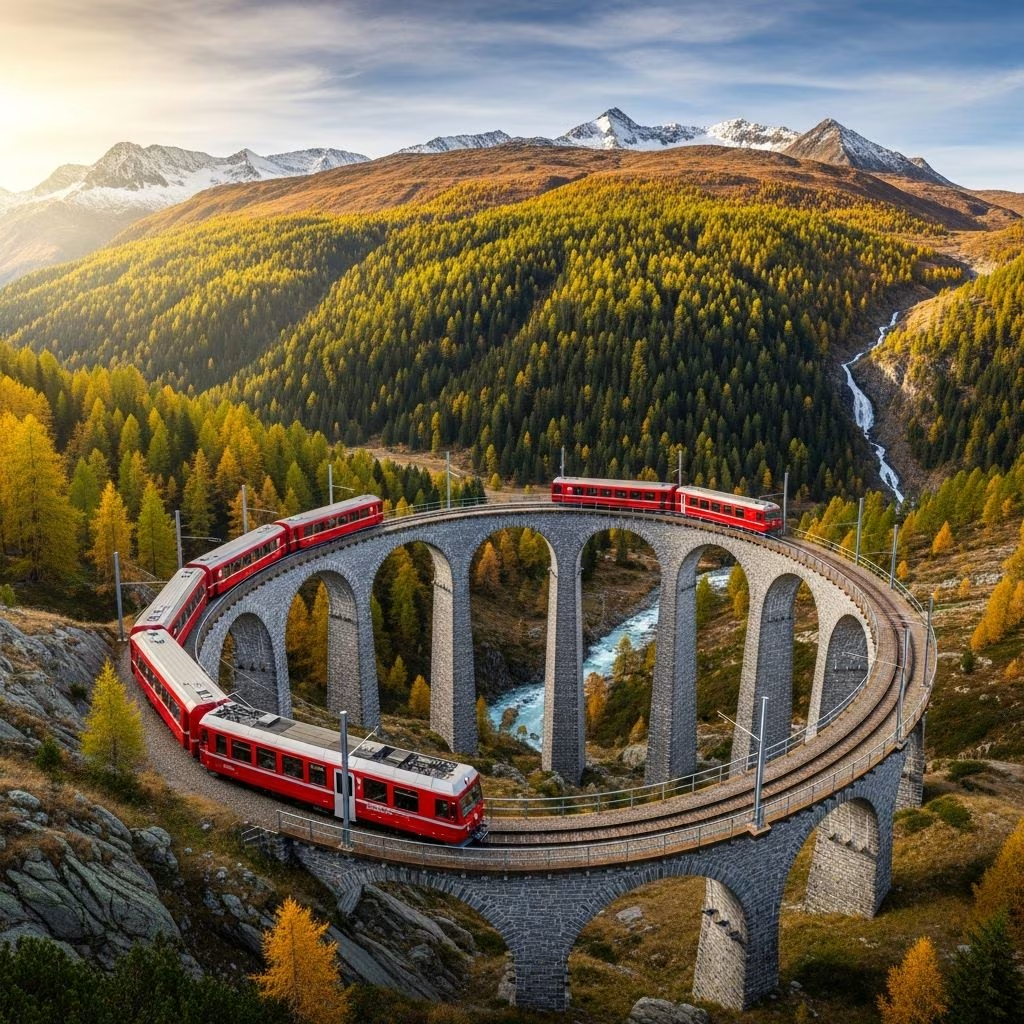
The railway’s engineering accomplishments deserve special recognition. Rather than boring straight through the mountains, the designers of this route created a series of architectural and structural solutions that curve gracefully along the Alpine terrain. The most iconic symbol of this engineering prowess is the Landwasser viaduct, a boldly curved structure that railway enthusiasts worldwide regard as one of the most picturesque segments of any mountain route.
Beyond the famous viaduct, the line incorporates helical tunnels—spiraling passages that allow trains to gain elevation while maintaining manageable grades for locomotives and passengers alike. The most notable of these innovative structures appears near Brusio, where passengers traveling toward Tirano encounter a uniquely exposed helical tunnel that creates a full 360-degree spiral. For most of the journey, these dramatic spirals remain concealed within mountain rock, revealing themselves only through the sensation of gradual ascent. However, the Brusio section offers passengers a rare opportunity to witness the train’s remarkable circular path from outside, making it a photographer’s paradise and a testament to the ingenuity of Victorian-era railway builders.
One of the most impressive feats along this corridor involves the passage over the Bernina Pass, which at 2,253 meters stands as Europe’s highest railway crossing point. What makes this accomplishment particularly remarkable is that the Bernina Express achieves this elevation without the assistance of cogwheel mechanisms—the specialized systems that many steep Alpine railways employ to maintain traction on severe grades.
As the train climbs toward this summit, passengers witness a remarkable ecological transition. The vegetation gradually shifts from dense Alpine forests to sparse mountain meadows, and in winter months, the landscape transforms into a snow-covered wonderland. The ascent itself unfolds gradually, allowing travelers to acclimate to changing altitudes and observe the landscape’s transformation layer by layer. This slow progression offers ample opportunity to photograph the scenery and appreciate the meticulous route planning that makes such a steep climb possible without specialized equipment.
As the train winds through the upper valleys approaching the Bernina Pass, passengers encounter the Morteratsch glacier, a massive natural formation that has shaped the landscape over millennia. The glacier appears almost impossibly close to the railway line, offering visitors a tangible connection to Alpine geography that few other train routes provide. The presence of this glacial system underscores the raw power of natural forces at work in these mountains and provides a sobering perspective on the immense timescales involved in mountain building and erosion.
The views of this glacier, combined with the snow-capped peaks that surround the pass, create a sensory experience that cannot be adequately captured through photography alone. Travelers consistently report that the visual impact of witnessing such grand geological formations from the comfort of a train window provides a unique perspective unavailable from ground-level hiking or driving.
After cresting the Bernina Pass, the route takes a dramatic turn downward, winding through an equally spectacular series of hairpin turns and spiral tunnels as it descends toward Poschiavo and ultimately Tirano. This descent is where the true magic of the route becomes apparent—within the span of just a few hours and kilometers, passengers transition from Alpine tundra to Mediterranean climate zones.
The lower sections of the journey reveal why this corridor earned UNESCO recognition for its cultural landscape significance. The pristine villages encountered along the route maintain traditional architecture and settlement patterns that have persisted for centuries. Stone farmhouses, ancient churches, and carefully maintained vineyards demonstrate how human communities have adapted to and thrived in challenging Alpine and sub-Alpine environments. The landscape itself ranges from ruggedly romantic terrain to primordial-seeming wilderness, creating a visual diversity that appeals to photographers, nature enthusiasts, and cultural travelers alike.
| Aspect | Regional Rhaetian Train | Bernina Express |
|---|---|---|
| Duration | 4 to 4.5 hours | Approximately 4.5 hours |
| Train Changes | Two required changes | Direct service end-to-end |
| Station Stops | Includes request stops | Only scheduled stations |
| Windows | Standard windows | Panoramic windows |
| Cost | More economical | Premium pricing |
| Comfort Level | Functional seating | Spacious seats with air conditioning |
Travelers have two primary options for experiencing this route, each offering distinct advantages. The standard regional Rhaetian Railway operates throughout the day, carrying both tourists and local passengers who rely on the service for legitimate transportation needs. While more economical, this option requires passengers to change trains twice during the full 122-kilometer journey, with minimal waiting periods but periods of disruption nonetheless.
The Bernina Express, by contrast, operates as a dedicated tourist service that maintains continuity throughout the entire route. Passengers enjoy panoramic window arrangements specifically designed to maximize views of the surrounding landscape. The train moves at a deliberate pace that allows extended observation of points of interest, and onboard staff provide knowledgeable commentary about the region’s history, geology, and cultural significance. The air-conditioned compartments, spacious seating arrangements, and amenities ensure a more relaxed experience compared to regional service.
One of the most unique features of this journey involves the spiral tunnels that allow the train to gain elevation while navigating steep terrain. These engineering marvels employ a counterintuitive design where the railway curves back on itself in a complete circle, either within mountain rock or occasionally in open air. Most travelers remain unaware of these spirals while inside tunnels, experiencing them only as periods of gentle turning and forward motion. However, the exposed spiral near Brusio creates an exceptional moment in the journey—passengers can see the train’s progress as it curves upward in a dramatic arc, sometimes catching glimpses of other train cars ahead or behind.
The combination of such technical achievements and visual spectacle explains why railway enthusiasts consistently rank this route among the world’s most remarkable. Photographers in particular value the journey for the opportunity to capture images of the train itself against Alpine backdrops, a possibility that the Brusio spiral tunnel uniquely affords.
The UNESCO World Cultural Heritage designation extends beyond the railway itself to encompass the surrounding landscape and communities. The Albula/Bernina region represents a carefully balanced coexistence between human settlement and natural systems. The villages along the route have maintained traditional building styles, agricultural practices, and cultural traditions that reflect centuries of adaptation to Alpine conditions. Stone construction, slate roofing, and traditional terracing demonstrate sustainable approaches to mountain living that remain relevant today.
The environmental preservation evident in this region stands as a model for how transportation infrastructure and wilderness conservation can coexist. The railway, despite its human-made nature, has become integral to maintaining the viability of communities that might otherwise face economic marginalization due to their remote locations.
Travelers should consider several factors when planning their Bernina Express or Rhaetian Railway experience. The journey takes approximately 4.5 hours regardless of which service option is chosen, making it ideal for a full-day excursion. The route operates year-round, though winter journeys offer dramatically different scenery compared to summer travel. Snow-covered peaks in winter create stark, dramatic vistas, while summer months showcase verdant Alpine meadows and accessible viewpoints for passengers.
The train’s windows present both opportunities and challenges for photography. While the panoramic windows of the Bernina Express are specifically designed for viewing and photography, the glass inevitably creates reflections and glare that may affect image quality. Many experienced travelers recommend simply absorbing the visual experience rather than exclusively focusing on capturing photographs, recognizing that the human eye perceives far more detail and nuance than camera sensors can reliably capture.
The designation recognizes both the exceptional engineering achievements that allowed the railway’s construction through challenging Alpine terrain and the pristine cultural landscape it traverses, including traditional villages, vernacular architecture, and centuries-old settlement patterns.
Yes. The train remains at relatively low altitudes for most travelers, with the highest point being 2,253 meters. Since passengers remain seated throughout the journey, individuals with mobility limitations can typically participate fully. The Bernina Express offers enhanced comfort with air conditioning and spacious seating.
Absolutely. The regional Rhaetian Railway allows passengers to board and exit at various stations, making it possible to experience portions of the journey rather than the complete 122-kilometer route. Many travelers explore specific sections based on time availability or specific points of interest.
Each season offers distinct advantages. Summer provides maximum daylight, verdant landscapes, and fully accessible viewpoints. Winter transforms the scenery with snow and dramatic lighting. Spring and autumn offer temperate conditions with fewer crowds. Winter travel may involve occasional service suspensions due to extreme weather conditions.
The Bernina Express provides dining and beverage services. Regional trains may offer limited refreshment options. Passengers typically carry snacks for regional train journeys and reserve dining cars on the express service.
