

 Travel Essentials
 Travel Essentials

Explore Florence's must-see artworks including David at the Accademia, Botticelli's Birth of Venus at the Uffizi, and the stunning Duomo complex. Practical tips for visiting Italy's art capital.
 Travel Essentials
Florence stands as the epicenter of the Renaissance, a city where artistic genius flourished and transformed Western culture. Home to unparalleled collections of paintings, sculptures, and architecture, it draws millions to witness works by masters like Michelangelo, Botticelli, and Leonardo da Vinci. This guide highlights the indispensable masterpieces, offering insights into their creation, significance, and how to experience them amid crowds.
The Renaissance began in Florence during the 14th to 17th centuries, fueled by wealthy patrons like the Medici family who commissioned works blending classical antiquity with innovative techniques. Perspective, humanism, and realism defined this era, evident in the city’s museums and monuments. Key institutions include the Uffizi Gallery, Galleria dell’Accademia, and the Duomo complex, each housing treasures that narrate humanity’s artistic evolution.
Visitors should prioritize timed tickets to bypass lines, especially during peak seasons. Early mornings or late afternoons offer quieter moments for contemplation. Audio guides or expert-led tours enhance appreciation, revealing layers of history behind each piece.
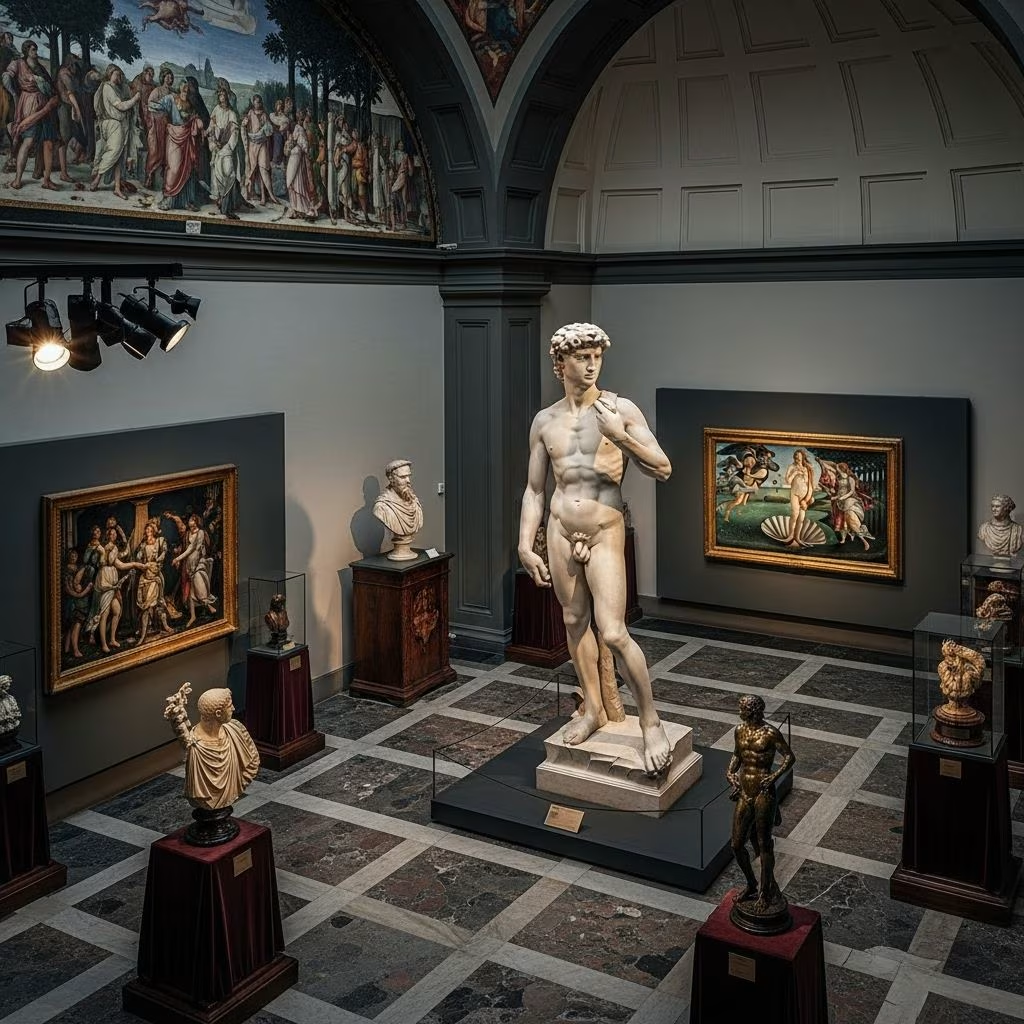
No visit to Florence is complete without encountering Michelangelo Buonarroti’s David, a colossal marble statue at the Galleria dell’Accademia. Carved between 1501 and 1504 from a single block rejected by prior sculptors, this 5.17-meter figure depicts the biblical hero poised before battle, embodying Renaissance ideals of strength, beauty, and intellect.
The statue’s anatomical precision—veined hands, tensed muscles, and intense gaze—captures youthful vigor. Originally destined for Florence’s cathedral, it was relocated to guard Palazzo Vecchio against political threats. Today, protected in a climate-controlled gallery, it remains a pilgrimage site. Allow 15-30 minutes; focus on details like the slingshot over the shoulder symbolizing readiness.
Pro Tip: Book Accademia tickets online (€16 plus €4 fee) and arrive at opening (8:15 AM) to beat crowds. Combine with nearby San Marco Museum for more Michelangelo sketches.
The Uffizi, commissioned by Cosimo I de’ Medici in 1560, evolved from offices into one of the world’s premier art museums. Spanning corridors lined with masterpieces, it showcases the progression from medieval to High Renaissance art.
Sandro Botticelli’s Birth of Venus (c. 1484-1486) mesmerizes with Venus emerging from a shell on windswept waves, symbolizing love’s divine arrival. Nearby, Primavera (c. 1482) weaves allegory through figures like Venus, Mercury, and the Three Graces in an orange grove, celebrating spring’s renewal. These tempera-on-panel works highlight Botticelli’s flowing lines and ethereal grace.
Leonardo da Vinci’s Annunciation (c. 1472-1475) demonstrates early mastery of perspective, with the angel Gabriel greeting Mary amid a lush garden. Raphael’s Madonna of the Goldfinch (1506) portrays tender maternal bonds, while Michelangelo’s Doni Tondo (1506-1508) rounds out sacred scenes with dynamic figures.
Don’t miss Artemisia Gentileschi’s Judith Beheading Holofernes (c. 1620), a visceral Baroque contrast showing female empowerment through dramatic chiaroscuro.
Visiting Essentials:
At Piazza del Duomo, the Cathedral of Santa Maria del Fiore—known as the Duomo—dominates with its polychrome marble facade and Brunelleschi’s engineering marvel dome. Completed in 1436, this feat spanned 114 meters without scaffolding, inspiring global architecture.
Ascend 463 steps to the dome’s lantern for panoramic city views. Inside, Giorgio Vasari’s Last Judgment fresco (1572-1579) covers the interior, echoing Michelangelo’s Sistine Chapel with vivid souls ascending or descending.
Giotto’s Campanile (bell tower) offers 414 steps to similar vistas, plus the dome’s iconic profile. Free cathedral entry belies hour-long lines; prioritize climbs (€20 combo ticket).
The adjacent Baptistery di San Giovanni features golden mosaics of the Last Judgment, dating to the 13th century. Lorenzo Ghiberti’s Gates of Paradise doors (1425-1452), now replicas with originals in the Duomo Museum, depict Old Testament scenes in revolutionary perspective.
The Bargello Museum houses Renaissance sculptures like Donatello’s bronze David and Michelangelo’s Bacchus, offering intimate encounters away from tourist throngs. Entry: €9.
At Basilica di San Lorenzo, the Medici Chapels feature Michelangelo-designed tombs in the New Sacristy (1519-1534), blending architecture and sculpture in somber marble allegory.
This lively square fronts Palazzo Vecchio with a replica David, Cellini’s Perseus, and Loggia dei Lanzi’s ancient Roman copies. It’s a living museum, perfect for people-watching and gelato.
| Day | Morning | Afternoon | Evening |
|---|---|---|---|
| 1 | Accademia (David) | Uffizi Gallery | Piazza della Signoria |
| 2 | Duomo Climb | Bargello & San Lorenzo | Piazzale Michelangelo sunset |
Acquire a Firenze Card (€85, 72 hours) for skip-the-line access to 80+ sites. Stay central near Santa Maria Novella station.
2-4 hours for highlights; full day for immersion. Focus on Renaissance rooms first.
Yes, for Accademia and Uffizi; lines exceed 1-2 hours otherwise.
Absolutely; mornings for Accademia, afternoons for Uffizi with lunch break.
Duomo entry, Piazza della Signoria, Baptistery exterior.
Uffizi and Accademia partially; Duomo climbs not. Check official sites.
Florence’s artworks face threats from tourism, pollution, and floods (1966). Support restoration via museum donations and mindful visits—no flash photography.
