

 Travel Essentials
 Travel Essentials

Discover London's remarkable collection of free museums and galleries featuring masterpieces, historical artifacts, and contemporary art without spending a penny.
 Travel Essentials
London has established itself as one of the world’s foremost cultural capitals, offering visitors an extraordinary opportunity to engage with centuries of human achievement, artistic expression, and scientific discovery. What makes the capital particularly distinctive is its commitment to providing free access to many of its most prestigious institutions. Whether you’re interested in ancient civilizations, contemporary art, natural history, or design innovation, London’s free cultural venues deliver world-class experiences that rival any paid attraction globally.
The tradition of free public access to cultural institutions in London reflects a philosophical commitment to democratizing knowledge and artistic appreciation. Unlike many international cities where museum visits represent a significant expense, London’s major cultural establishments—including national museums and respected galleries—maintain open access to their permanent collections. This approach ensures that financial constraints don’t prevent residents and visitors from engaging with exceptional cultural resources. While special exhibitions and temporary displays may carry charges, the core collections remain accessible to all.
Several premier institutions showcase humanity’s material culture across vast temporal spans. The British Museum stands among the world’s most comprehensive repositories of human civilization, presenting approximately 80,000 objects distributed across 70 galleries. These holdings encompass everything from ancient Egyptian artifacts and Mesopotamian inscriptions to sculptures from classical Greece and contemporary ethnographic materials. The museum’s permanent collection access remains completely unrestricted, allowing visitors to engage directly with objects of profound historical significance without financial barriers.
Similarly, institutions focused on more recent historical periods and specialized domains provide in-depth explorations of particular historical moments and cultural developments. The Museum of London Docklands, for instance, operates nine distinct gallery spaces that chronicle the evolution of London’s maritime heritage and urban development across more than 400 years, all accessible without entry charges.
London’s natural history institutions present remarkable collections that bridge scientific education with public engagement. These venues house specimens, skeletal reconstructions, and interactive displays that illuminate evolutionary processes, biodiversity, and geological phenomena. The ability to encounter these displays without expense ensures that scientific curiosity remains accessible regardless of economic circumstances.
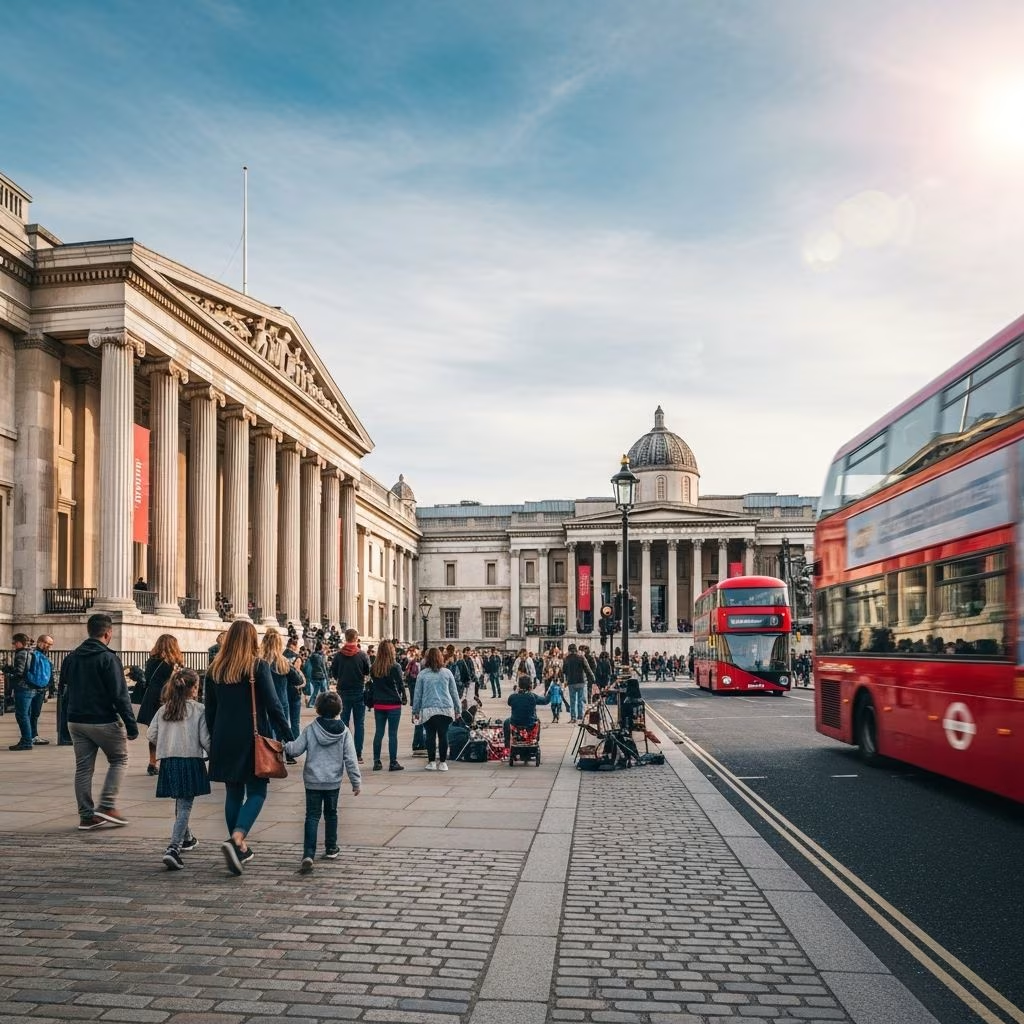
The National Gallery maintains one of the world’s most significant assemblies of European painting, featuring works spanning the medieval period through the twentieth century. The collection encompasses over 2,000 paintings by masters including Leonardo da Vinci, Sandro Botticelli, Caravaggio, and Vincent van Gogh. Visitors encounter artistic innovations across multiple centuries, from the development of perspective in Renaissance Florence to Post-Impressionist experimentation. Located at Trafalgar Square, this institution exemplifies how London positions itself as a venue for artistic pilgrimage without requiring payment for access.
The Victoria and Albert Museum preserves more than 2.3 million objects representing human creative achievement across fashion, jewelry, furniture, photography, and sculpture. This institution approaches art and design broadly, presenting how aesthetic principles manifest across functional and decorative domains. The museum’s approach to collection presentation reveals how artistic sensibilities shape everyday objects and environments. Extended opening hours on certain evenings provide accessibility for visitors with constrained daytime availability.
Tate Modern occupies a converted power station on the Thames’s south bank, establishing itself as London’s premier contemporary art venue. This architectural transformation itself communicates ideas about repurposing, cultural value, and public space. The institution’s Turbine Hall hosts large-scale installations that respond to the building’s monumental character, while galleries throughout showcase painting, photography, performance art, and multimedia works. The café provides views across the river, creating spaces where art engagement intertwines with social experience and urban observation.
Beyond the major national institutions, numerous galleries focus on contemporary artistic experimentation and emerging practitioners. The Whitechapel Gallery presents programming centered on cutting-edge contemporary work, complemented by talks, workshops, and educational events. These venues cultivate artistic dialogue and provide platforms for artists exploring new aesthetic territories. Commercial galleries throughout London also maintain open access, ensuring that artistic innovation circulates widely rather than remaining confined to purchased collections.
The National Portrait Gallery, adjacent to the National Gallery, dedicates itself to portraiture across media, materials, and historical periods. Rather than organizing collections chronologically or by artistic movement, portraiture-focused presentation reveals how visual culture represents identity, power, and historical memory. Free talks conducted throughout the day offer guided interpretation, enhancing visitor engagement with portraiture’s particular communicative strategies.
London houses numerous smaller institutions devoted to specialized domains. The Grant Museum of Zoology presents specimens organized to illuminate evolutionary relationships and biodiversity. The Guildhall Art Gallery, situated within London’s medieval civic center, combines artworks with access to Roman amphitheater ruins, connecting multiple historical layers within a single location. These more modest institutions often receive fewer visitors than major attractions, potentially offering more intimate museum experiences.
The Serpentine Gallery maintains twin facilities overlooking Hyde Park’s water feature, hosting established and emerging contemporary practitioners. During summer months, the venue commissions an architectural pavilion from internationally recognized designers, creating annual cultural events that generate architectural discourse and public participation. These temporary structures combine functionality with artistic experimentation, often becoming Instagram-worthy elements within London’s cultural landscape.
Many London galleries extend beyond interior walls, incorporating outdoor sculpture displays, courtyards, and landscaped environments. The Wallace Collection occupies a historic townhouse, maintaining intimate gallery proportions that contrast with massive contemporary museums. The Serpentine’s bookshop represents one of London’s finest art publishing collections, supporting continued engagement with artistic discourse and visual culture.
Most major institutions maintain consistent daily hours, typically opening between 10:00 and 10:30 AM and closing between 5:00 and 6:00 PM. Certain venues extend evening hours on specific weekdays, sometimes until 9:00 or 10:00 PM, accommodating visitors with workday constraints. Some institutions recommend advance booking during peak tourist seasons, though many operate without reservation systems. Checking specific venue websites before visiting ensures accurate information regarding access requirements and current programming.
While permanent collections remain free, temporary exhibitions often carry separate charges. These curated displays frequently explore specific artists, historical periods, or thematic questions in depth, sometimes justifying expenditure for visitors particularly interested in featured content. Some institutions offer package pricing combining multiple exhibitions, and membership programs provide unlimited exhibition access alongside other benefits.
Many venues offer free talks and guided tours at specified times throughout operating hours. These educator-led experiences enhance visitor understanding, particularly beneficial for visitors unfamiliar with museum conventions or artistic historical contexts. Audio guides or mobile applications provide self-directed interpretation, allowing visitors to engage at personalized paces while accessing expert commentary.
London’s commitment to free cultural access extends beyond economic considerations to inclusive design. Many institutions provide wheelchair access, accessible restrooms, and seating throughout galleries. Certain venues offer programs specifically designed for visitors with particular needs, including sensory-friendly hours, tactile interpretation, and specialized tours for neurodivergent visitors. Contact individual institutions regarding specific accessibility features and accommodations.
London’s free institutions increasingly emphasize decolonization, acquisition ethics, and diverse cultural representation. Collections that historically centered Western European achievement now incorporate materials illuminating African, Asian, Indigenous Australian, and American cultural traditions. This expanded approach reflects contemporary museum practice emphasizing plural perspectives and questioning which narratives institutions traditionally privileged. Visitors encounter ongoing conversations about cultural property, repatriation, and equitable representation within these free spaces.
Most permanent collections accept walk-in visitors without advance booking. However, during peak summer seasons or holidays, some institutions recommend reservations to manage crowd flow. Special exhibitions typically require separate booking with associated fees. Check specific venue websites for current booking policies.
Photography policies vary by institution. Generally, personal photography without flash is permitted in permanent collection galleries, while special exhibitions often restrict photography. Sketching for personal study usually remains unrestricted. Ask staff upon arrival regarding specific policies for your intended activities.
The National Gallery and British Museum warrant full-day visits to engage meaningfully with collections. Smaller specialized institutions like the Grant Museum or Wallace Collection suit visits of two to three hours. Tate Modern’s scale allows flexible engagement from brief visits to extended exploration.
Children enjoy unrestricted access to permanent collections at all free institutions. Many venues provide family programs, activity sheets, and child-friendly interpretation designed to engage younger visitors. Some offer special family tours during weekends and school holidays.
Beyond major attractions, institutions like the Wallace Collection, Guildhall Art Gallery, and specialized museums such as the Anaesthesia Heritage Centre or Alexander Fleming Laboratory Museum attract fewer visitors while offering compelling content. Visiting during weekday mornings typically ensures shorter queues at popular destinations.
London’s exceptional free cultural resources enable extended engagement with art, history, and design across multiple visits. Rather than attempting comprehensive surveys of major institutions, consider thematic approaches selecting venues aligned with particular interests. Alternating between monumental institutions and smaller specialized collections creates varied experiences while managing museum fatigue. The city’s transport network enables efficient movement between geographically distributed venues, allowing visitors to experience multiple institutions within single days.
London’s commitment to free permanent collection access represents a democratic cultural philosophy ensuring that financial resources don’t determine who engages with artistic and historical achievements. This positioning establishes the capital as uniquely accessible for cultural exploration, inviting extended contemplation of human creativity across centuries and continents without economic barriers.
