

 Travel Essentials
 Travel Essentials

Explore Marseille's diverse museum landscape, from ancient civilizations to contemporary art, featuring world-class collections and architectural marvels.
 Travel Essentials
Marseille, France’s bustling port city and gateway to the Mediterranean, has transformed itself into a cultural powerhouse over the past two decades. The city’s museum landscape reflects its rich and complex heritage—spanning from ancient Greek settlements to modern artistic movements. Whether you’re drawn to historical narratives, contemporary visual arts, or natural wonders, Marseille’s institutional collections offer something remarkable for every visitor. This guide navigates the city’s most significant cultural institutions, revealing why they deserve a place on your travel itinerary.
To truly appreciate Marseille’s museums, one must understand the city’s layered history. Founded around 600 BCE by Greek colonists, Marseille became one of the Mediterranean’s most important trading hubs. This multicultural legacy—shaped by Greek, Roman, Provençal, and North African influences—permeates the city’s cultural institutions. Museums here don’t simply display objects; they tell interconnected stories of migration, commerce, artistic exchange, and resilience. The city’s transformation into a modern cultural destination accelerated significantly in the early 21st century, with major institutional renovations and new architectural landmarks reshaping its cultural identity.
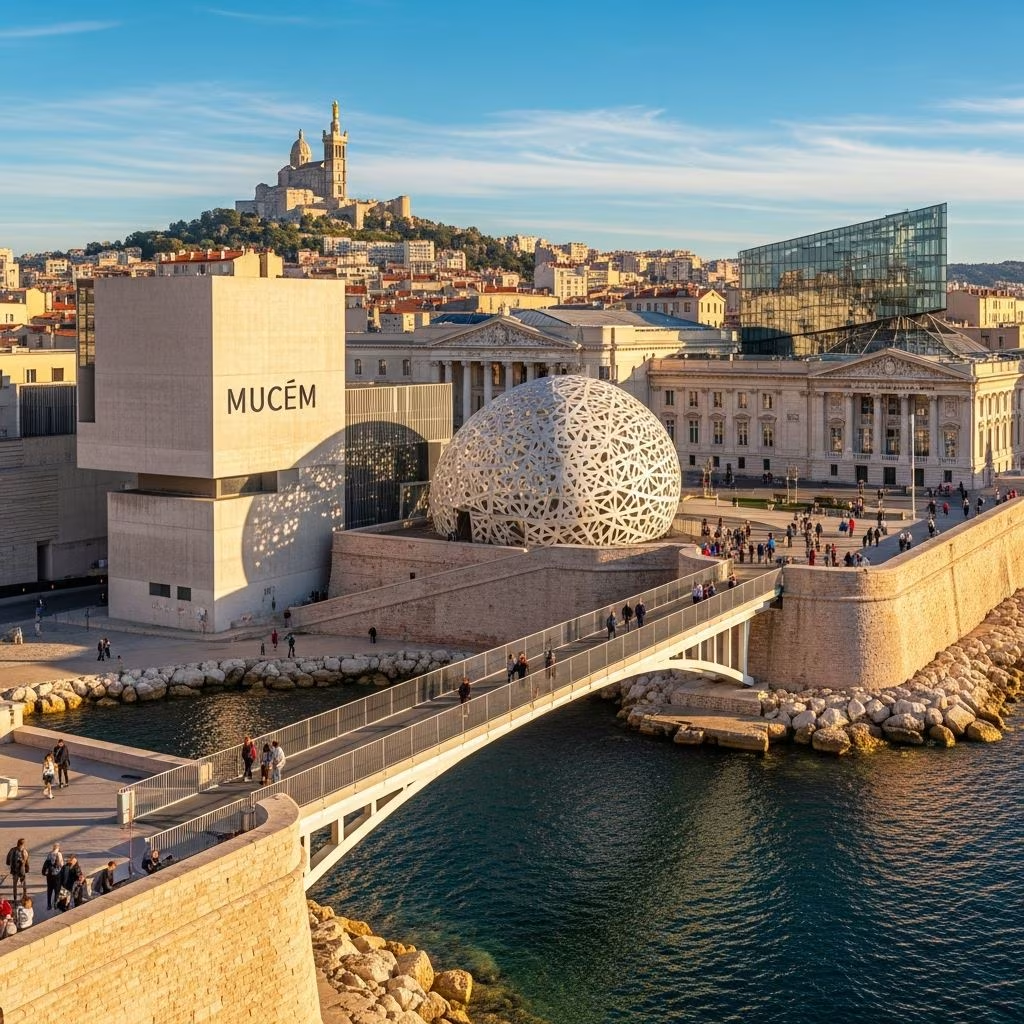
Standing boldly along Marseille’s waterfront, the Museum of European and Mediterranean Civilizations (MuCEM) represents one of France’s most architecturally distinctive museum buildings. Designed by renowned architect Rudy Ricciotti and completed in 2013, the structure features a striking latticed concrete exterior that creates interplay between light and shadow while maintaining visual connections to the surrounding seascape. The museum’s footprint spans approximately 3,600 square meters of exhibition space, with the building ingeniously split across two locations: the main J4 esplanade structure and the restored 12th-century Fort Saint-Jean, connected by an elegant aerial walkway.
Inside this modern complex, exhibitions rotate regularly to explore the complex relationships between European and Mediterranean cultures. Rather than presenting static displays, MuCEM curates storytelling experiences that examine trade networks, artistic traditions, religious practices, and social transformations across the Mediterranean basin. Visitors encounter rare artifacts, sculptures, textiles, and multimedia presentations that encourage deeper contemplation of how geography and history intertwine. The museum’s design philosophy emphasizes accessibility—portions of the exterior terraces and Fort Saint-Jean can be explored free of charge, allowing visitors to experience the architectural ambition and sea views without purchasing admission.
For those seeking to understand Marseille’s specific historical development, the Museum of Marseille’s History provides an essential foundation. This institution presents twelve interactive exhibits that traverse the city’s dramatic arc from its Greek founding through contemporary times. Visitors encounter narratives about the devastating plague outbreaks that periodically ravaged the population, the 18th-century creation of France’s national anthem—La Marseillaise—which bears the city’s name, and the waves of immigration that transformed Marseille’s demographic composition, particularly the arrivals from Algeria during the 1950s and beyond.
The museum’s strength lies in its approach to presenting historical information. Rather than overwhelming visitors with chronological timelines, it emphasizes dramatic turning points and personal perspectives. Interactive stations invite visitors to engage with historical materials, creating a more memorable learning experience than passive observation. The collection acknowledges both celebratory moments and painful chapters, presenting Marseille not as a static historical artifact but as a living city shaped by continuous change.
Within the monumental 19th-century Palais Longchamp, the Museum of Fine Arts maintains an impressive collection spanning four centuries of European artistic achievement. The museum occupies one wing of this historic palace, which originally served the utilitarian purpose of distributing water throughout Marseille. Today, visitors ascend through galleries displaying paintings, sculptures, and drawings from the 16th through 19th centuries, encountering works by both canonical masters and lesser-known regional artists.
Complementing this broader survey, the Cantini Museum offers a more intimate encounter with early-to-mid-20th-century modernism. Housed in an elegant 1694 mansion that once belonged to coral trader Jules Cantini, this museum specializes in contemporary art movements that dominated the early modern period. The permanent collection features works by Picasso, Matisse, Cézanne, Miró, and Jean Dubuffet, presented within the mansion’s refined rooms where natural light and architectural grace enhance appreciation of the works. The juxtaposition of cutting-edge artistic movements against period interiors creates an unique viewing experience unavailable in conventional white-box galleries.
The Centre de la Vieille Charité, located in Marseille’s oldest neighborhood Le Panier, houses two distinct but complementary museums dedicated to non-Western cultures and archaeological heritage. The building itself—a 17th-century almshouse with a baroque chapel—constitutes an architectural attraction in its own right. Within this restored structure, visitors discover France’s most significant collection of Egyptian antiquities outside the Louvre in Paris. The Museum of Mediterranean Archaeology expanded its original Egypt focus to include materials from the broader Middle East and North Africa, reflecting the interconnected nature of Mediterranean trade and cultural exchange.
On another floor, the Museum of African, American and Pacific Arts presents ethnographic materials that illuminate the aesthetic traditions and social structures of diverse non-European societies. Together, these institutions acknowledge that understanding Mediterranean civilization requires engagement with cultures beyond Europe’s borders. Notably, both museums within the Centre de la Vieille Charité offer free admission, making them exceptionally accessible cultural resources for all visitors.
Beyond the major institutions, Marseille’s museum landscape includes numerous specialized venues catering to specific interests. The Marseille Soap Museum documents the city’s historical role in soap production and Mediterranean trade. The Museum of Mediterranean Motorcycles showcases vintage two-wheelers and documents transportation history. The Museum of Illusions offers interactive exhibits designed for visitors seeking playful, participatory experiences rather than traditional curatorial presentation.
For families with children, the Children’s Museum—Préau des Accoules provides age-appropriate programming and hands-on learning opportunities. The Museum of Roman Docks preserves archaeological remains of Marseille’s ancient harbor infrastructure, providing tangible evidence of the city’s longstanding maritime significance. These smaller venues, while less internationally renowned than flagship institutions, often provide more personalized experiences and reveal aspects of Marseille’s identity that might not appear in broader historical surveys.
Also housed within the Palais Longchamp, the Museum of Natural History maintains collections documenting Mediterranean fauna, flora, and geological formations. This institution provides essential context for understanding the region’s environmental character and biodiversity. Visitors encounter preserved specimens, fossil records, and educational displays explaining ecological relationships and conservation challenges facing Mediterranean ecosystems.
Beyond traditional museums, Marseille’s cultural landscape includes contemporary art centers and alternative spaces. The Friche la Belle de Mai occupies a historic tobacco factory repurposed as an experimental arts venue. Such spaces often present avant-garde exhibitions, performance art, and site-specific installations that push boundaries of what museum presentation can encompass. These venues reflect Marseille’s ongoing cultural evolution and its commitment to supporting artistic innovation alongside historical preservation.
| Institution | Location | Specialization | Notable Features |
|---|---|---|---|
| MuCEM | Waterfront/Fort Saint-Jean | Mediterranean Civilizations | Architectural landmark, rotating exhibitions, free exterior access |
| Museum of Marseille’s History | Central Marseille | Local History | Interactive exhibits, comprehensive historical narrative |
| Palais Longchamp Complex | South Marseille | Fine Arts & Natural History | Two museums, historic palace gardens, architectural significance |
| Centre de la Vieille Charité | Le Panier (Old Town) | Archaeology & Ethnography | Two free museums, baroque chapel, neighborhood exploration |
| Cantini Museum | Near Vieux Port | Modern Art | Belle époque mansion, intimate scale, major 20th-century works |
A significant portion of Marseille’s cultural offering exists beyond formal institutional walls. Le Panier, the city’s oldest quartier, functions as a living museum in itself. The neighborhood’s steep golden-hued stone streets, dusty squares, and densely packed urban fabric evoke centuries of layered habitation. Walking through Le Panier provides direct sensory encounter with the physical environment that shaped Marseille’s identity. This experiential aspect complements formal museum visits, allowing visitors to understand how communities actually inhabited and adapted these historical spaces.
MuCEM offers the most comprehensive introduction to Mediterranean culture and Marseille’s historical significance. Its architectural distinctiveness and rotating exhibitions appeal to diverse visitor interests.
Yes, both museums within Centre de la Vieille Charité offer free admission. Additionally, portions of MuCEM’s exterior spaces and Fort Saint-Jean can be explored without purchasing tickets.
A thorough visit to major institutions requires 3-4 hours minimum per venue. Comprehensive exploration of multiple museums benefits from multi-day planning.
The Cantini Museum specializes in modern art movements and maintains works by major 20th-century artists, making it essential for contemporary art appreciation.
The Museum of Mediterranean Archaeology features France’s largest Egyptian collection after the Louvre, including artifacts from ancient Egypt and broader Mediterranean regions.
Effective museum exploration requires strategic planning. Consider beginning with the Museum of Marseille’s History to establish historical context, then moving to MuCEM for broader Mediterranean perspectives. The Centre de la Vieille Charité provides both free admission and concentration of multiple collections, making it efficient for visitors with limited time. Fine arts enthusiasts should prioritize both the Palais Longchamp galleries and the Cantini Museum’s specialized modern collection. Those interested in contemporary arts practice should factor in visits to alternative spaces like Friche la Belle de Mai.
Marseille’s museums reward unhurried exploration. Rather than attempting to visit every institution rapidly, consider identifying specific collections aligned with personal interests and dedicating sufficient time for meaningful engagement with artworks, artifacts, and narratives. The city’s waterfront location means that many institutions cluster within accessible proximity, facilitating efficient itinerary planning without sacrificing depth of experience.
