

 Travel Essentials
 Travel Essentials

Navigate beyond Bali's crowded tourist hotspots to discover tranquil villages, pristine islands, and cultural treasures that showcase the island's authentic character and natural beauty.
 Travel Essentials
Bali’s reputation as a premier tropical destination has transformed it into one of Southeast Asia’s most visited islands, drawing millions of travelers annually. While iconic locations like Ubud and Kuta Beach offer undeniable charm, the island’s infrastructure struggles to accommodate the sheer volume of visitors, often diminishing the authenticity that makes Bali remarkable. Fortunately, stepping away from these congested areas reveals an entirely different Bali—one characterized by misty mountain villages, pristine coastlines, and communities where traditional customs remain vibrantly alive.
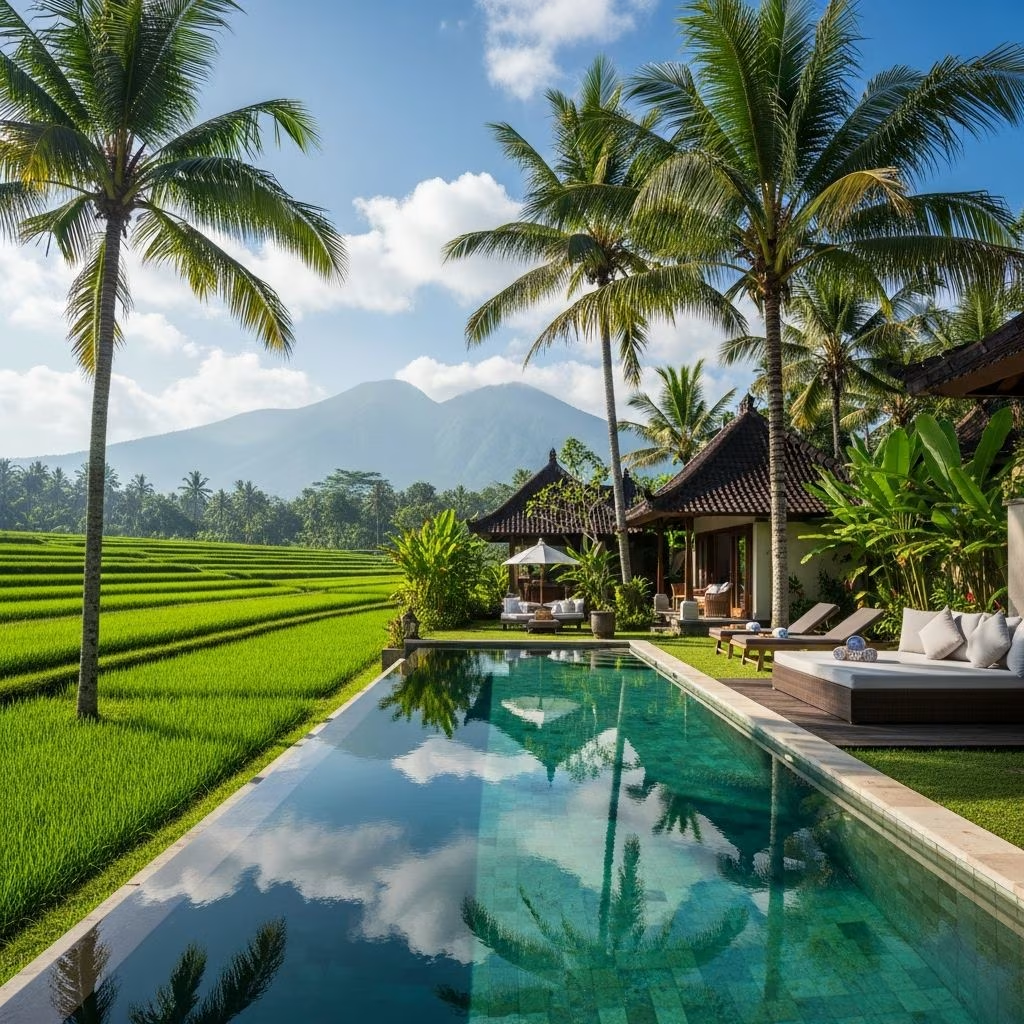
Positioned in eastern Bali, approximately 45 minutes from Ubud’s cultural center, Sideman represents a compelling alternative for travelers seeking genuine local experiences without sacrificing accessibility. This verdant valley possesses characteristics that define rural Balinese existence: emerald rice paddies cascade down hillsides, fruit orchards dot the landscape, and the dramatic silhouette of Gunung Agung—the island’s highest volcanic peak—dominates the horizon. The village functions as both a relaxation destination and an adventure base, with numerous trekking opportunities threading through countryside trails that connect traditional settlements and agricultural areas.
Visitors to Sideman engage with the region through multiple modalities. Leisurely walks navigate through productive rice fields, where farmers employ generations-old cultivation techniques. River bathing in natural pools provides refreshment within pastoral settings. Perhaps most enriching are encounters with community artisans who demonstrate traditional textile weaving and craft production, offering insights into livelihoods that have sustained Balinese culture for centuries. The valley’s modest tourism infrastructure—featuring guesthouses and simple dining establishments—preserves the environment’s tranquil character while providing necessary accommodations.
Bali’s northern highlands contain Munduk, a mountain village that embodies the island’s capacity for remote, undisturbed beauty. Positioned amidst dense forests and spice plantations whose aromatic compounds perfume the air, Munduk offers environmental contrast to coastal regions. The village functions primarily as a natural history destination, with waterfalls and hiking trails comprising its primary attractions. Multiple cascades provide swimming opportunities within forest settings, combining recreation with landscape immersion.
The hiking infrastructure around Munduk accommodates varying fitness levels. Accessible trails lead through forested terrain to panoramic viewpoints, while more challenging routes ascend to higher elevations and involve technical scrambling. The spice plantation landscape contributes distinctive sensory elements—nutmeg, cloves, and vanilla permeate the environment, creating an olfactory dimension rarely experienced in standard tourist contexts. Accommodations range from basic guesthouses to upscale glamping facilities, with the latter providing comfortable wilderness experiences without requiring traditional camping logistics.
While Nusa Lembongan has transitioned toward mainstream tourism, the neighboring islands in this tri-island chain offer progressively quieter experiences for travelers seeking island environments with reduced commercialization.
Nusa Penida, despite hosting a substantial indigenous population, remains in nascent stages of tourism development. This positioning creates advantage for contemporary visitors seeking island experiences before infrastructure expansion accelerates visitor arrival. The island caters to particular travel interests: diving enthusiasts pursue encounters with sunfish and manta rays—species that congregate around Penida’s waters during specific seasons—while cultural explorers investigate temples and isolated beaches less frequented by international tourists.
Transportation on Penida typically involves motorbike rental, essential given the island’s expansive geography and dispersed attractions. Alternatively, curated tour operators offer thematic excursions incorporating seaweed farming demonstrations, beach camping experiences, and cultural narratives. This flexibility enables travelers to construct island experiences aligned with specific interests rather than following standardized tourist itineraries.
Connected to Nusa Lembongan via the Love Bridge—opened in 2017 as a replacement for a previous structure—Nusa Ceningan occupies a positioning between Lembongan’s resort-oriented infrastructure and Penida’s underdeveloped tourism sector. The island maintains a modest backpacker community while preserving a fundamentally quiet character. This balance renders it suitable for travelers uncomfortable with either extreme: those desiring more development than Penida offers but seeking fewer crowds than Lembongan attracts.
Located on Bali’s eastern coastline, Amed provides beach experiences fundamentally distinct from southern resort zones. The town’s development remains constrained, resulting in preservation of village-scale aesthetics and rhythms. Tourism infrastructure, while present, maintains modest proportions, with local family-operated guesthouses predominating over large-scale developments. The coastal environment attracts particular visitor demographics: divers and snorkelers investigate nearby reef systems, while beach enthusiasts appreciate uncrowded sands and calm waters typical of Bali’s eastern exposure.
Amed’s principal limitation involves transportation accessibility. Independent exploration requires personal transportation—typically motorbike rental—as public transit connections remain underdeveloped. This transportation requirement, while presenting logistical challenges, simultaneously functions as a natural visitor filter, limiting arrival to travelers with sufficient independence and mobility to reach the destination without organized tour arrangements.
The palace complex of Tirta Gangga, despite attracting consistent day-visitor traffic, transforms significantly during evening hours. As organized tour groups depart, the palace grounds acquire a contemplative quality absent during peak visitation periods. The surrounding countryside contains substantial appeal: walking trails navigate through agricultural zones, connecting productive rice terraces with village settlements and temple structures. This peripheral countryside often receives minimal visitor attention despite offering profound cultural and environmental value.
The Gunung Batukau highland region achieves relative isolation through geographic positioning remote from primary population and tourism centers. World Heritage-designated rice terrace systems at Jatiluwih exemplify agricultural tradition and landscape aesthetics, while the highland temple complex Pura Luhur Batukau maintains religious significance within regional spiritual practice. While not unknown to experienced travelers, the region’s geographic isolation substantially limits visitor volume compared to more accessible destinations.
Positioned at Bali’s northwestern extremity, Pemuteran appeals to travelers motivated by maximum geographic distance from major tourism zones. The location’s remoteness has simultaneously preserved environmental character and attracted premium resort development, creating a mixed-use landscape. However, the dominance of upscale accommodations does not eliminate the area’s distinct sensibility: the region maintains stylistic continuity with historical Bali aesthetics, avoiding the architectural homogenization characterizing some developed beach zones. More budget-conscious travelers discover accessible guesthouses alongside luxury properties, enabling accommodation options across economic categories.
The agricultural landscape surrounding Ubud contains substantial cultural richness concentrated outside mainstream tourist circuits. Tembuku village represents extreme authenticity for contemporary Bali travel—minimal tourism infrastructure, authentic agricultural activity, and minimal international visitor presence characterize the settlement. Such villages offer profound cultural immersion for travelers comfortable with basic amenities and genuine uncertainty regarding tourist conveniences.
Waterfall destinations including Krisik provide natural recreation opportunities while remaining less marketed than signature Ubud attractions. These cascades feature significantly fewer visitors than celebrated sites, enabling more solitary nature experiences. Similarly, various rice terrace systems throughout the Ubud hinterland offer photographic and experiential value without competing for visitor attention with signature locations.
Lesser-visited destinations typically feature limited accommodation options, necessitating advance reservations during peak seasons (July-August, December-January). Guesthouses and small hotels predominate, with amenities varying considerably. Some locations now offer upscale alternatives catering to travelers prioritizing comfort within authentic settings.
Bali’s dry season (April-October) provides optimal conditions for trekking and general exploration. Rainy season (November-March) brings increased precipitation, which—while reducing visitor volume and creating dramatic atmospheric conditions—may complicate hiking accessibility and general transportation logistics.
The dry season (April through October) offers optimal conditions for hiking, waterfall visits, and general exploration. Weather stability enables convenient transportation and outdoor activities, while reduced rainfall maintains trail accessibility. Paradoxically, fewer international tourists visit during shoulder months (April-May and September-October), combining favorable conditions with reduced crowds.
Motorbike rental substantially enhances exploration flexibility for destinations with minimal public transportation infrastructure. However, hired drivers and organized tours provide alternatives for travelers uncomfortable with motorbike operation. Some locations, particularly Sideman and Munduk, maintain basic transportation connections via public or semi-public vehicles.
Tourism infrastructure in quieter destinations ranges from basic guesthouses to premium wellness resorts. Availability often exceeds demand, particularly outside peak seasons, yet advance booking remains advisable during December-January and July-August periods.
Villages experiencing minimal international tourism maintain stronger continuity with traditional practices and settlement patterns. However, authentic experience requires respecting community boundaries, avoiding exploitative photography, and potentially engaging local guides who facilitate meaningful cultural exchange rather than superficial observation.
Bali’s capacity for authentic experience extends substantially beyond celebrated tourist destinations. Geographic positioning of alternative locations—whether highland villages, eastern coastal towns, or neighboring islands—preserves environments and communities maintaining cultural specificity and environmental integrity. Strategic destination selection, appropriate preparation, and respectful engagement enable visitors to access Bali’s genuine character while supporting sustainable tourism patterns that benefit local communities. The island’s quieter territories reward exploration with encounters impossible within commercialized zones, creating travel experiences of substantial personal and cultural value.
