

 Travel Essentials
 Travel Essentials

Discover essential World War I sites in France, from Thiepval's massive arch to Verdun's ossuary, honoring millions lost on the Western Front.
 Travel Essentials
Northern France bears the scars of World War I, where the Western Front saw unimaginable loss from 1914 to 1918. Sites like Thiepval and Verdun stand as solemn reminders of battles that claimed over a million lives, offering visitors a chance to reflect on history’s lessons amid preserved landscapes and grand memorials.
The Western Front stretched across northern France and Belgium, turning fields into quagmires of mud and death. Major offensives like the Somme and Verdun epitomized the war’s futility, with artillery barrages and trench warfare leading to stalemates despite heroic efforts. Today, these areas draw pilgrims seeking to understand the scale of sacrifice.
France lost 1.3 million soldiers, many commemorated in vast cemeteries and monuments. Visiting these sites provides context to the war’s global impact, involving troops from Britain, Australia, Canada, and more.
Dominating the Somme landscape, the Thiepval Memorial rises 45 meters high, designed by architect Edwin Lutyens. Unveiled in 1932, it honors 73,000 British and South African soldiers with no known grave from the Battle of the Somme. The arch-shaped structure, built on a former German stronghold captured on July 1, 1916—the bloodiest day in British military history—bears names etched into its limestone pillars.
Visitors ascend steps to panoramic views of rolling fields dotted with craters. An underground visitor center displays personal stories, artifacts, and multimedia exhibits detailing the battle’s chaos, where over 57,000 British troops fell or were wounded in hours. Pair a visit with nearby preserved trenches at the Ulster Memorial Tower for deeper insight.
Near Lille, the Fromelles (Pheasant Wood) Military Cemetery, opened in 2010, reinterred 250 Australian soldiers unearthed from mass graves. Discovered in 2008, these remains from a disastrous July 1916 diversionary attack revealed the tragedy of 1,917 Australian casualties in just 24 hours.
Two kilometers away, the Australian Memorial Park preserves cratered earth from the assault, evoking the failed push against German lines. Interpretive panels recount the battle’s futility, intended to draw forces from the Somme. This site underscores Australia’s significant contribution, with over 416,000 troops serving on the Western Front.
Perched on a strategic Artois ridge, the Vimy Memorial gleams white against the sky, commemorating 11,285 missing Canadians. Captured in April 1917 after months of preparation, Vimy marked a turning point, showcasing innovative tactics like creeping barrages.
The preserved battlefield features reconstructed trenches, tunnels, and craters. Free guided tours from the visitor center explain the engineering feats and human cost. Nearby Grange Tunnel offers a descent into the subterranean world soldiers endured.
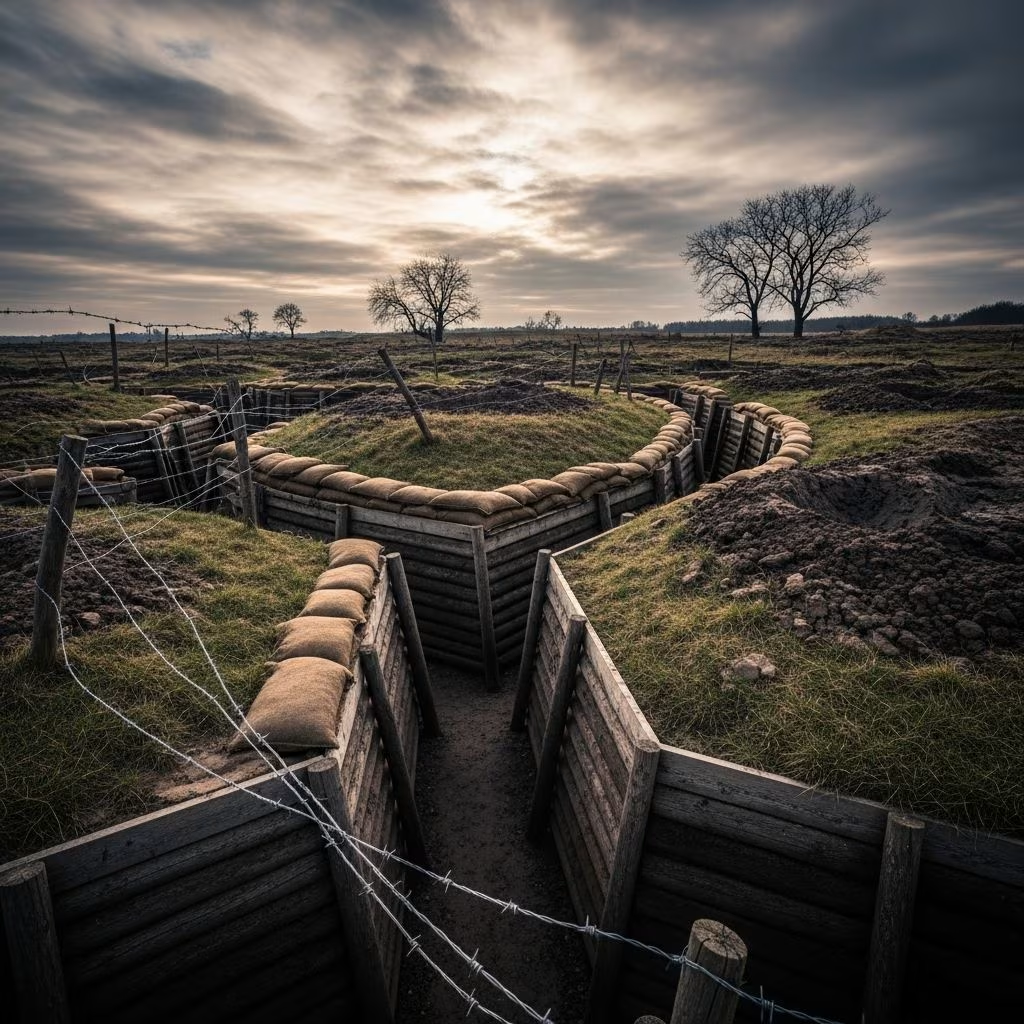
Nine kilometers north of Albert, this preserved site marks the near-annihilation of the Royal Newfoundland Regiment on July 1, 1916. Barbed wire, trenches, and a massive caribou statue overlook the pockmarked terrain, left untouched since the armistice.
Visitors walk paths tracing the deadly advance across no-man’s-land. The site, gifted to Britain by Newfoundland in 1921, includes a visitor center with films and artifacts, highlighting the regiment’s 90% casualty rate in minutes.
Over 300 days in 1916, Verdun became a symbol of French resilience against German aims to ‘bleed France white.’ Ten million shells devastated the area, killing 360,000 French and 340,000 Germans. The Ossuaire de Douaumont, a stark tower, holds remains of 130,000 unidentified soldiers from 52 battlefield sectors.
Adjacent, a cemetery with 16,000 graves overlooks Fort Douaumont, captured and recaptured in brutal fighting. Nearby, the Verdun Memorial Museum details the siege with immersive displays. Other sites like Fleury-devant-Douaumont village ruins and the Bayonet Trench preserve the desolation.
Start from Paris (160km to Thiepval) or Lille for northern sites. Rent a car for flexibility; trains reach Albert or Arras. Guided tours from Paris cover Somme and Vimy efficiently. Best visited April-November to avoid winter mud mirroring 1916 horrors.
| Site | Distance from Paris | Key Feature | Visitor Info |
|---|---|---|---|
| Thiepval | 160km | 73,000 names memorial | Free entry, center open daily |
| Fromelles | 200km | Australian cemetery | Self-guided, panels |
| Vimy Ridge | 180km | Preserved trenches | Free tours, parking |
| Beaumont-Hamel | 155km | Newfoundland memorial | Paths, exhibits |
| Verdun | 260km | Ossuary tower | Museum fee, guided options |
These spots allow tactile connection to history, with grass-covered trenches revealing the scale of fortifications.
Memorials personalize loss: Thiepval’s names include poets and privates; Vimy honors figures like Private Walter Ray. Museums feature letters, photos, and diaries, humanizing statistics.
French Flanders near Lille links to Belgian sites like Ypres. Visit Ring of Memory at Notre Dame de Lorette, etching 580,000 names from all sides—the world’s largest WWI inscription.
Most memorials like Thiepval and Vimy are free; museums charge €5-12. Guided tours often free at key sites.
Spring (poppy season) or autumn for mild weather and fewer crowds. Remembrance Day (Nov 11) features ceremonies.
Somme sites yes (3-4 hours drive); Verdun requires overnight.
Many paths paved; visitor centers wheelchair-friendly, but trenches uneven.
Comfortable shoes, rain gear, binoculars for distant views.
These sites transcend tourism, urging contemplation of war’s cost and peace’s fragility. As poppies bloom amid craters, they echo Lieutenant John McCrae’s words from nearby Flanders. Plan thoughtfully to honor the fallen.
