

 Travel Essentials
 Travel Essentials

Explore Bhutan's tourism fee structure, recent changes, and what they mean for your travel budget and experience in this Himalayan kingdom.
 Travel Essentials
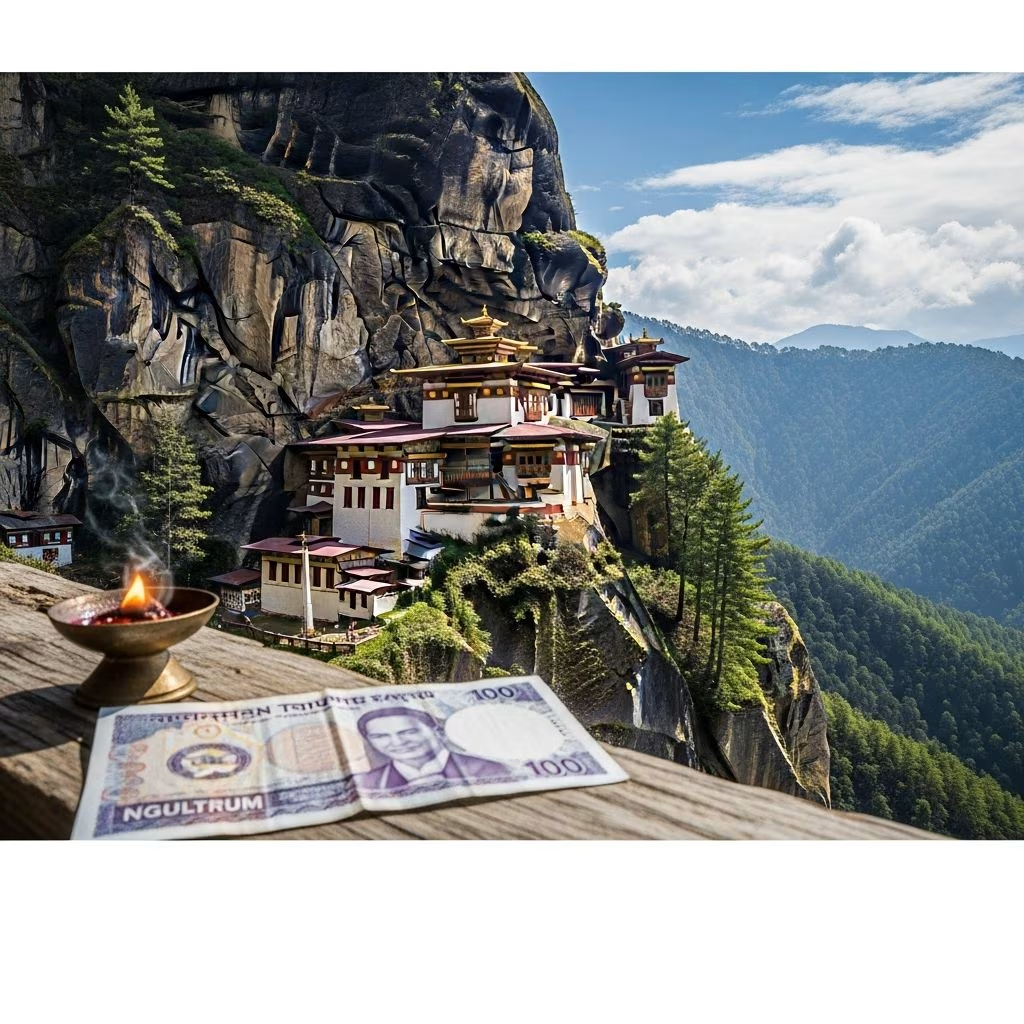
Bhutan stands apart from most global destinations with its distinctive approach to tourism management through mandatory daily fees. Rather than operating a traditional free-entry tourism model, the Himalayan kingdom requires all international visitors to contribute a Sustainable Development Fee (SDF) that directly supports the nation’s development initiatives. This approach reflects Bhutan’s commitment to preserving its cultural heritage and natural environment while generating revenue for critical social programs.
Bhutan’s government has deliberately structured its tourism industry around the principle of “High Value, Low Volume.” This philosophy prioritizes quality experiences over mass tourism, ensuring that visitor numbers remain manageable while maximizing economic benefits for local communities. The mandatory fee system serves as both a revenue generator and a visitor filter, discouraging impulsive tourism while attracting thoughtful travelers committed to respecting Bhutanese culture.
The foundation for this model emerged in 1991 when tourism was fully privatized, introducing a daily charge for international visitors. Over the following decades, the government refined this system, recognizing that sustainable tourism requires careful management of visitor impact on both cultural sites and natural landscapes. The fee structure evolved significantly in 2020 when the government rebranded its tourism approach with a new pricing framework designed to better align with sustainable development goals.
According to Bhutan’s Department of Tourism, this strategy was developed “in view of the important role of the tourism sector in generating employment; earning foreign exchange; realizing the potential for spillover benefits for ancillary industries; boosting overall economic growth; and funding important environmental, social and infrastructure projects.”
As of September 2023, international visitors to Bhutan pay a daily Sustainable Development Fee of $100 per person, representing a significant reduction from the previous $200 daily charge. This pricing remains in effect through August 31, 2027, creating a multi-year window of discounted access for travelers.
The SDF covers substantially more than a simple tourism tax. When you pay this daily fee, your package typically includes:
This comprehensive approach means that the daily fee genuinely represents an all-inclusive package rather than an additional charge on top of other tourism expenses. Visitors are protected from unexpected costs for standard travel necessities, making budget planning more straightforward.
Beginning January 1, 2026, Bhutan implemented a 5% Goods and Services Tax (GST) on most tourism services. This represents a significant development for travel planning, as the tax applies to accommodation, transportation, guiding services, and other tour package components.
However, it’s important to note that the Sustainable Development Fee itself remains exempt from this new GST. The $100 daily SDF continues unchanged, unaffected by the tax increase. This distinction means that while your overall trip cost will increase by approximately 5%, the core daily fee remains stable.
For travelers planning trips from 2026 onwards, this GST implementation should factor into budget calculations. A week-long journey that might have cost a certain amount in 2025 will now include the additional 5% tax on most service components.
Bhutan’s fee structure recognizes different visitor categories with adjusted pricing:
| Visitor Category | Daily Fee | Notes |
|---|---|---|
| International adults | $100 USD | Standard rate through August 2027 |
| Children ages 6-12 | $50 USD | 50% discount applied |
| Children under 6 | Free | No fee required |
| Regional visitors (specific countries) | $16 USD | Budget-friendly regional rate |
These tiered rates were designed to encourage family travel while keeping the destination accessible to regional visitors from South Asia. The significantly lower regional rate acknowledges the economic differences between neighboring countries and Bhutan’s role as a cultural hub for the region.
The revenues generated through the Sustainable Development Fee fund crucial national programs. A portion of collected fees supports free healthcare for all Bhutanese citizens, free education through secondary school, poverty alleviation initiatives, and critical infrastructure development projects. This direct linkage between tourism revenue and social welfare programs creates a transparent system where visitors can see how their fees contribute to national development.
In 2020, when the SDF structure was reformed, the government acknowledged that previous fee levels had not sufficiently discouraged budget tourism or generated adequate revenue for conservation efforts. The updated system addressed these concerns by increasing fees while simultaneously improving service quality and accountability.
The environmental protection achieved through this system is substantial. By limiting visitor numbers through the fee structure, Bhutan maintains strict control over infrastructure strain, pollution, and cultural disruption. This conservation approach has earned international recognition and positioned Bhutan as a model for sustainable tourism practices.
Understanding the complete cost structure helps with accurate trip planning. Beyond the daily SDF, consider these additional expenses:
The beauty of the SDF system is that most daily expenses are predetermined, reducing financial uncertainty. Once you’ve committed to the daily fee and booked your trip, major cost categories are settled, allowing you to budget more confidently for discretionary spending.
Yes, the Sustainable Development Fee and visa charges are distinct. Visitors must pay both the visa processing fee and the daily SDF when applying for travel authorization. SDF payments typically occur during the visa application process.
The daily fee structure means that each night in Bhutan incurs the full daily charge. A three-day visit costs three days’ worth of fees ($300 for adults), while a seven-day visit costs $700. There are no bulk discounts, though the reduced rate through 2027 already represents significant savings compared to previous pricing.
No, the SDF specifically remains exempt from the 5% Goods and Services Tax implemented in 2026. The tax applies to other service components of your package but not to the base Sustainable Development Fee.
Regional visitors from neighboring countries receive significantly reduced rates ($16 daily) rather than exemptions. Children under age six are exempt entirely. Most international travelers must pay the full SDF without exception.
Bhutan projected that visitor arrivals would return to pre-pandemic levels by 2025. The halved SDF through 2027 was specifically designed to encourage longer stays and attract more tourists during the recovery period. Should tourism recovery stall, the government has indicated flexibility in reassessing pricing, though any changes would be announced well in advance.
Among world destinations, Bhutan maintains the highest mandatory visitor fee structure. Most countries employ entry fees far below $100 daily, instead relying on hospitality industry revenue and indirect taxation. Bhutan’s comprehensive approach is virtually unique in its combination of daily fees, mandatory package inclusion, and strict visitor filtering.
This distinctiveness creates both advantages and considerations for travelers. The regulated system ensures consistent quality and environmental protection but requires acceptance of higher upfront costs. For visitors prioritizing authentic, uncrowded experiences in pristine environments, the fee represents good value. For budget-conscious travelers, the daily cost may prove prohibitive.
Understanding fee structures and implementation timelines helps optimize travel planning. The current $100 daily SDF rate continues through August 2027, providing a window of known pricing. Beyond that date, fee adjustments are possible, though none have been formally announced.
The 5% GST implemented in January 2026 affects all bookings for travel after that date. Travelers who completed reservations before the implementation date may benefit from grandfather pricing on certain components, depending on their booking terms. Consulting with tour operators about pricing structures and effective dates ensures clarity before committing financially.
Bhutan’s tourism model represents a deliberate choice to prioritize sustainability over maximizing visitor numbers. While the daily fees exceed typical tourist destinations, they fund genuine conservation efforts, cultural preservation, and social development. Understanding this philosophy helps travelers appreciate the complete value proposition of visiting this remarkable Himalayan kingdom.
