

 Travel Essentials
 Travel Essentials

Discover the layered human history of Big Island, Hawaii: ancient Polynesian arrivals, sacred sites, Kamehameha's legacy, and sites preserving Hawaiian heritage amid volcanic landscapes.
 Travel Essentials
The Big Island of Hawaii stands as a living chronicle of human endeavor, where Polynesian voyagers first touched land, chiefs forged kingdoms amid volcanic fury, and modern stewards preserve ancient traditions. This expansive island, still shaped by active volcanoes, hosts traces of settlement from over a millennium ago, royal legacies, and spiritual sanctuaries that reveal the depth of Hawaiian identity.
Long before European sails dotted the horizon, intrepid Polynesian navigators from the Marquesas and Society Islands reached Hawaii’s shores around 900-1200 AD, with some estimates pushing back to the 3rd century. These seafarers, guided by stars, currents, and ancestral knowledge, landed primarily at South Point on the Big Island’s southern tip, the earliest known human foothold in the archipelago.
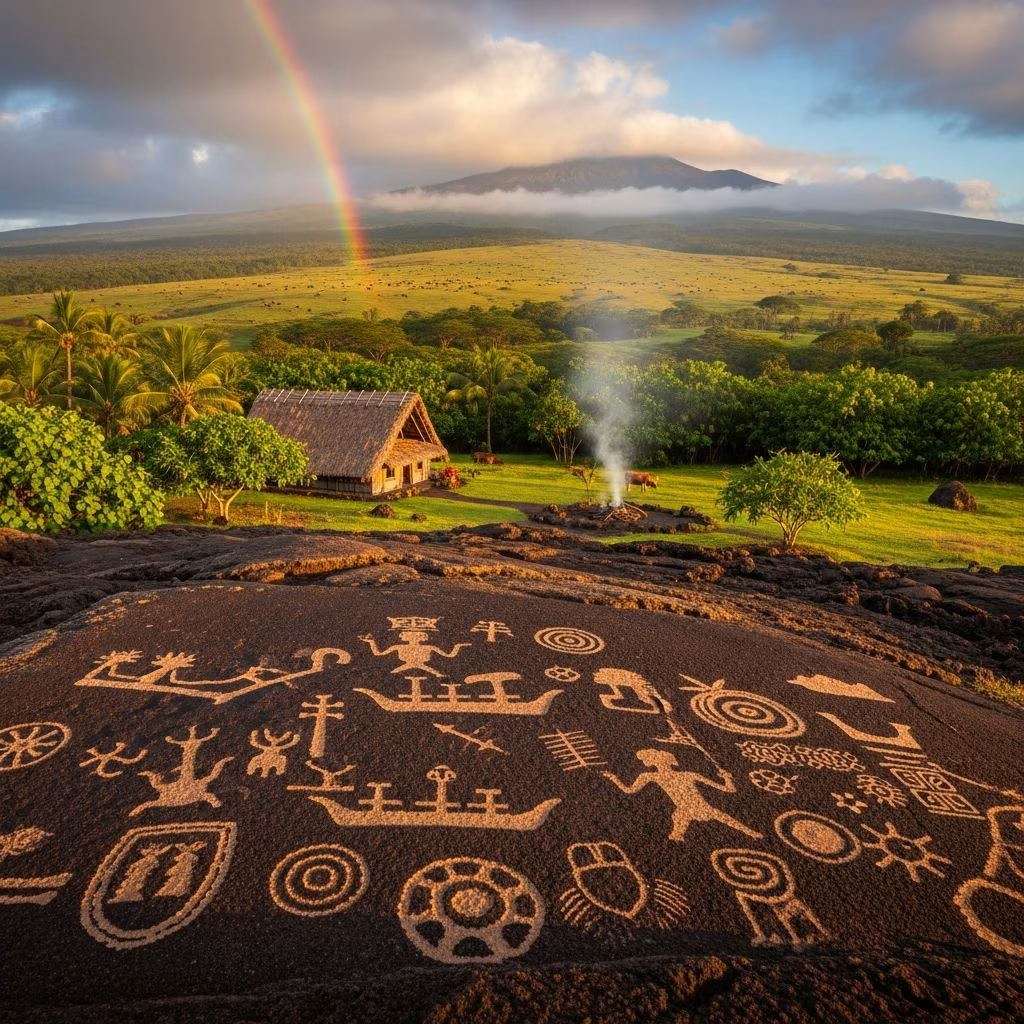
Archaeological remnants like mooring holes carved into lava cliffs and intricate petroglyphs—rock carvings depicting human forms, canoes, and sails—dot the barren lava fields near South Point. These artifacts speak of a sophisticated society that quickly adapted to the island’s diverse ecosystems, from fertile uplands to coastal fisheries. The ahupua’a system emerged, dividing land into self-sustaining wedges from mountain to sea, fostering communal harmony and resource stewardship.
Legends credit Hawai’iloa, a master navigator, with discovering the island, naming it after himself and infusing it with mythic significance as a realm tied to the afterlife. This era laid the cultural foundation, blending oral histories with practical survival in a geologically youthful landscape formed 400,000-800,000 years ago.
As populations grew, the Big Island fractured into rival chiefdoms—moku—spanning districts like Kohala, Kona, Hilo, Puna, and Ka’u. Power struggles defined this pre-contact period, with ali’i (chiefs) ruling through mana (spiritual power) and kapu (taboo) systems enforcing social order.
Legendary figures like ‘Umi-a-Līloa exemplified cunning leadership. Born in Waipi’o Valley on Kohala—the island’s oldest volcano and revered kupuna (ancestor)—’Umi overthrew his half-brother Hakau, conquering Hāmākua, Hilo, Puna, Ka’u, and Kona. He established his seat in Kailua-Kona, centralizing authority and weaving kapu with governance.
Sacred heiau (temples) dotted the land, accessible only to kahuna (priests) and ali’i nui (high chiefs). Pu’ukohola Heiau, built in 1791, epitomized this era’s intensity. Dedicated with human sacrifices under the kapu regime—abolished in 1819—it became a National Historic Site. Today, stone platforms amid surrounding farmlands evoke the violence and devotion of unification wars.
| Key Pre-Contact District | Notable Chief/Event | Legacy Site |
|---|---|---|
| Kohala | Kamehameha’s birthplace; ‘Umi conquests | Waipi’o Valley cliffs |
| Kona | ‘Umi’s capital; Heiau temples | Pu’ukohola Heiau |
| Hilo/Puna | Warring chiefdoms | Agricultural terraces |
Born circa 1758 in Kohala, Kamehameha I rose from prophecy-fulfilling warrior to Hawaii’s first king. After Captain James Cook’s fateful 1778-1779 visits—ending in his death at Kealakekua Bay—Kamehameha leveraged Western firearms to subdue rivals.
By 1791, after eight years of stalemates with chiefs like Keōua and Keawema’uhili, Kamehameha orchestrated Keōua’s killing at Pu’ukohola during a truce, securing the Big Island. He ruled until 1804, expanding to O’ahu and beyond, returning in 1812 before his 1819 death. His legacy unified the islands, blending Hawaiian tradition with foreign influences.
Pu’uhonua o Hōnaunau National Historical Park, the “Place of Refuge,” highlights kapu consequences. Law-breakers found sanctuary here, protected by priests if they reached its walls, underscoring spiritual justice.
Cook’s landing opened floodgates. By 1820, missionaries arrived in Kailua-Kona, introducing Christianity that dismantled kapu and heiau worship in 1819 under Kamehameha II. Westerners brought cattle—sparking Parker Ranch, one of America’s largest—and sugar plantations thriving in Hilo.
The island’s youth—half a million years old, still erupting—contrasted booming industries. Kohala’s mana endured as Kamehameha’s birthplace, while Hulihe’e Palace in Kailua-Kona preserved royal artifacts.
Today, the Big Island safeguards its past through national parks and sites. Hawai’i Volcanoes National Park neighbors historic zones, where lava flows threaten yet enrich cultural narratives.
Visit Pu’uhonua o Hōnaunau for reconstructed hale (houses) and ki’i (wooden deities). Pu’ukohola offers ranger-led tours of unification grounds. South Point’s petroglyphs invite quiet reflection on ancestral voyages.
Waipi’o Valley, shrouded in mist, hides ‘Umi’s strongholds and Kamehameha lore, accessible by rugged trails. These sites blend with the island’s five volcanoes—Kohala, Mauna Kea, Hualālai, Mauna Loa, Kīlauea—reminding visitors of earth’s ongoing creation intertwined with human story.
For travelers, the Big Island offers immersive history. Hike to petroglyph fields at dawn, join cultural demonstrations at historical parks, or stargaze from Mauna Kea, sacred to Native Hawaiians. Respect protocols: no trespassing on private heiau, support local guides.
This island’s human history—from canoe prows slicing waves to cannons thundering unification—pulses in its people and land. It’s a call to connect with ancestors who tamed volcanoes and seas.
Petroglyphs and mooring holes at South Point indicate Polynesian landings around 900-1200 AD.
King Kamehameha I, born in Kohala, conquered rivals by 1791 using Western arms.
A sanctuary for kapu violators, now a national park preserving ancient Hawaiian justice.
Yes, formed 400,000-800,000 years ago, with ongoing eruptions from Kīlauea and Mauna Loa.
Many are national parks with guided access; respect kapu by following rules and supporting Native-led tours.
