

 Travel Essentials
 Travel Essentials

Explore Black Canyon of the Gunnison National Park, featuring stunning 2,000-foot cliffs, ancient Precambrian rock, and world-class outdoor activities in southwestern Colorado.
 Travel Essentials
Nestled in the remote southwestern corner of Colorado lies one of North America’s most striking geological formations: Black Canyon of the Gunnison National Park. Covering 30,750 acres across Montrose County, approximately 250 miles southwest of Denver, this remarkable landscape represents millions of years of continuous geological processes. The park stands as a testament to the power of water, time, and tectonic forces, showcasing some of the oldest exposed rock on the continent and one of the world’s most impressive canyons carved by a single river.
The Black Canyon’s extraordinary geological character begins nearly 2 billion years ago, when Precambrian basement rocks formed deep beneath the Earth’s surface. These ancient crystalline rocks—composed of gneiss, schist, quartz-monzonite, and granite-pegmatite—remained hidden for billions of years until tectonic activity thrust them toward the surface. Approximately 60 million years ago, the formation of the Rocky Mountains elevated these hard, metamorphic rocks to near-surface levels through the Gunnison uplift. This uplift created the foundation upon which the canyon’s dramatic relief would eventually be carved.
Between 35 and 18 million years ago, volcanic activity from the West Elk and San Juan Mountains deposited thick layers of ash, tuff, and breccia across the region. Over subsequent millennia, erosion progressively wore away these volcanic deposits along with underlying sedimentary rocks, gradually establishing the course of the Gunnison River. Around 2 million years ago, the river began its relentless cutting into the igneous and metamorphic basement rocks, initiating the formation of the dramatic gorge visible today. This relatively recent phase of canyon development, spanning just 1.3 to 1.75 million years, has produced approximately 700 meters of vertical incision.
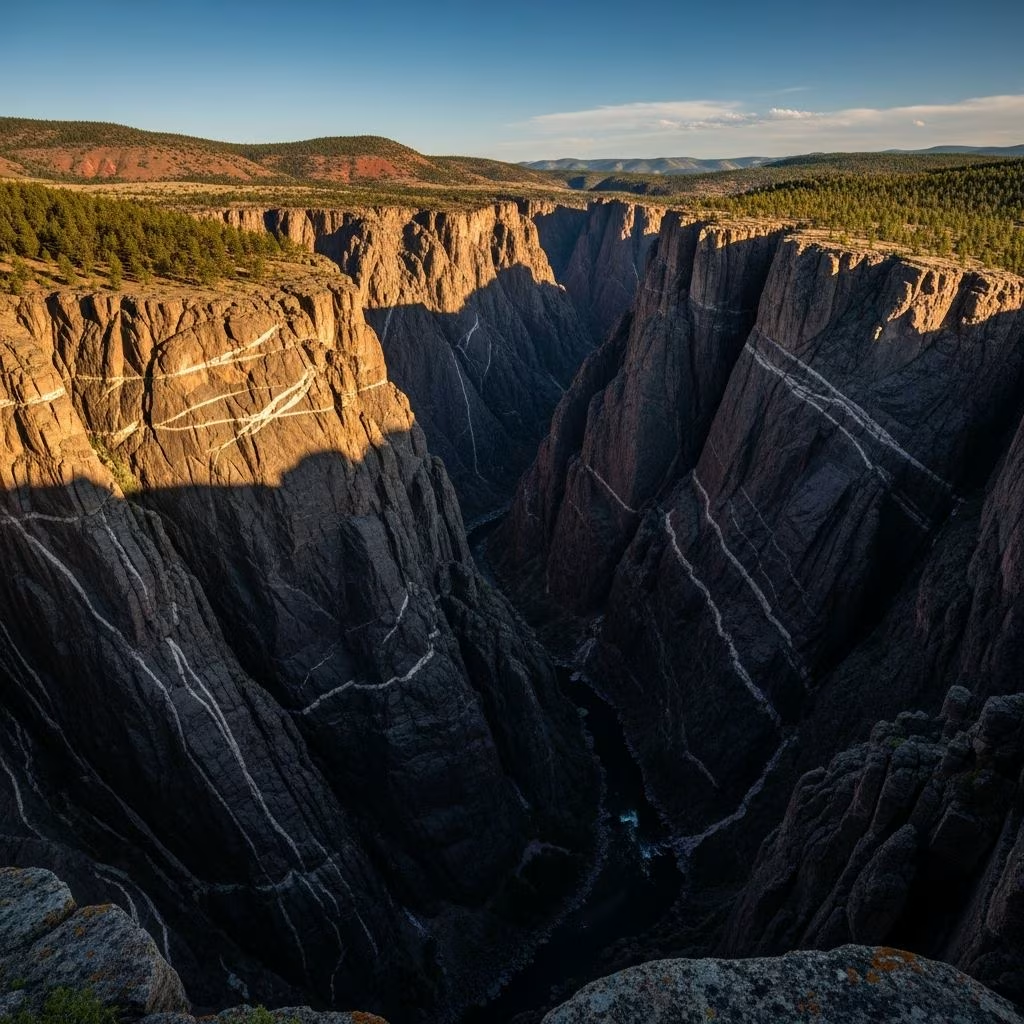
Black Canyon earns its distinctive name from its startling appearance—the canyon walls are so steep and narrow that sunlight rarely penetrates the depths, casting the gorge in perpetual shadow. At its narrowest point, the chasm measures just 40 feet across, making it one of the most compressed canyon environments in the continent. The walls themselves tower dramatically: elevations range from 1,645 meters (5,400 feet) at the canyon bottom to 2,675 meters (8,775 feet) atop Signal Hill, creating relief exceeding 2,700 feet.
The Gunnison River, which has carved this geological masterpiece, descends at one of the fastest rates of any North American river, averaging 29 meters (95 feet) per mile throughout the park. This steep gradient transforms the water into a roaring torrent that continuously cuts downward through the ancient bedrock. The combination of narrow width and extreme depth makes Black Canyon more than double the depth of the Grand Canyon of the Yellowstone, positioning it among North America’s deepest canyons.
Among the park’s most iconic landmarks stands the Painted Wall, soaring 2,250 feet as Colorado’s highest cliff face. This monumental rock formation rises 1,000 feet higher than the Empire State Building and showcases the stunning geological complexity of the region. The wall’s dramatic striated appearance results from veins of pink and white granite that marble through the darker Precambrian basalt, creating a natural mosaic visible from multiple vantage points throughout the park.
The canyon walls themselves represent a textbook example of a superimposed stream—a geological phenomenon where a river maintains its original course despite changes in underlying rock composition as it cuts downward through different geological layers. This process explains why the Gunnison River continues its southwestern course even as it encounters the exceptionally hard Precambrian rocks of the canyon depths, unable to meander or redirect its flow.
The South Rim Road provides an accessible introduction to the canyon’s majesty, winding along the canyon’s edge with multiple pullouts and viewing areas. Along this route, visitors encounter Tomichi Point, Chasm View, and Painted Wall View, each offering distinct perspectives of the geological formations and river dynamics. The Warner Point Trail, a 1.5-mile round-trip hike from the South Rim Road, leads to the canyon’s deepest section, providing panoramic vistas of the most dramatic portion of the gorge.
The Rim Rock Nature Trail, covering approximately 1 mile and following a relatively flat path along the canyon rim, offers stellar views of the Gunnison River, the canyon’s sheer walls, and diverse plant life without requiring technical climbing skills. For more adventurous visitors, the Oak Flat Loop Trail spans 2 miles and descends below the canyon rim through narrow, steep terrain, providing glimpses of the landscape beyond the rim’s edge. However, only experienced and well-prepared hikers should attempt to descend into the inner canyon, as no maintained or marked trails exist within the gorge itself.
Black Canyon has earned recognition as a premier destination for experienced rock climbers, who find the ancient crystalline rock formations and dramatic vertical terrain irresistible. The park offers several established routes for inner-canyon climbing, with the Gunnison Route representing the most accessible option for climbers seeking to descend to the river. Permits are required for all climbing activities, with north rim permits available on a first-come, first-served basis and south rim permits requiring advance reservation through Recreation.gov.
The Gunnison River maintains Gold Medal fishery status, attracting anglers pursuing trout in one of Colorado’s premier fly-fishing destinations. Beyond fishing opportunities, the park supports diverse wildlife and plant communities, with visitors regularly observing bighorn sheep, mule deer, and various bird species adapted to the canyon’s unique microclimate and elevation range.
Black Canyon of the Gunnison provides three distinct campgrounds to accommodate different visitor preferences and experience levels. South Rim Campground offers impressive vistas of the Painted Wall and serves as the primary accommodation hub for most visitors. Additional camping areas provide alternatives for those seeking different perspectives or less crowded experiences within the park.
The canyon’s extraordinary geological and scenic value prompted federal protection efforts beginning in 1933, when President Herbert H. Hoover established Black Canyon of the Gunnison National Monument under the Antiquities Act for the preservation of “the spectacular gorges and additional features of scenic, scientific, and educational interest”. In 1976, Congress designated 4,525 hectares (11,180 acres) as wilderness pursuant to the Wilderness Act of 1964.
The monument’s status remained unchanged until 1999, when Public Law 106-76 elevated the designation to national park status and added 1,790 hectares (4,423 acres) of additional wilderness lands. This upgrade reflected growing recognition of the area’s “unique ecological, geological, scenic, historical, and wildlife components” and the importance of preserving adjacent uplands from development pressures.
The park’s remote location and narrow canyon walls combine to create exceptional conditions for astronomical observation. The minimal light pollution and dramatic natural landscape make Black Canyon an increasingly popular destination for stargazing and astrophotography, attracting visitors interested in experiencing the night sky without urban light interference.
| Planning Factor | Details |
|---|---|
| Location | Montrose County, southwestern Colorado; 250 miles southwest of Denver; 15 miles east of Montrose |
| Park Size | 30,750 acres total |
| Elevation Range | 5,400 feet (canyon bottom) to 8,775 feet (Signal Hill) |
| Primary Activities | Scenic driving, hiking, climbing, fishing, stargazing |
| Best Visiting Season | Spring through fall; winter access may be limited |
| Climbing Permits | North Rim: first-come, first-served; South Rim: advance reservation via Recreation.gov |
Black Canyon of the Gunnison National Park represents far more than a spectacular natural landscape. It serves as an open-air geological textbook, where visitors can literally touch rocks nearly 2 billion years old and observe the continuous sculpting power of water and time. The park appeals to diverse visitor interests: casual sightseers can experience dramatic vistas from accessible rim trails, while experienced adventurers find world-class climbing and backcountry exploration opportunities. The combination of ancient geology, extreme topography, diverse recreation, and exceptional stargazing makes Black Canyon a destination where natural forces and human curiosity converge in a landscape of unparalleled drama.
No. While the park offers premier climbing opportunities, most visitors experience the canyon’s majesty through scenic drives, rim trails, and viewpoints requiring minimal technical skill. However, those descending into the canyon interior should possess significant backcountry experience.
Trail difficulty varies considerably. The Rim Rock Nature Trail offers an easy 1-mile flat walk, while the Oak Flat Loop presents moderate challenges with narrow sections and steep slopes. Inner-canyon routes demand advanced skills and are not recommended for casual hikers.
Spring through fall generally provide optimal conditions, with comfortable temperatures and reliable weather. Summer offers the longest daylight hours, while fall presents stunning foliage. Winter access may be limited due to snow and icy conditions.
Permits are mandatory for climbing and inner-canyon activities but not for rim walking or scenic driving. Permit requirements and availability vary by specific activity and trailhead location.
Yes, the rim area provides safe access for families willing to respect guardrail-less sections and cliff edges. Many rim trails and scenic drives accommodate visitors of all ages, though supervision is essential near canyon edges.
