

 Travel Essentials
 Travel Essentials

Bogotá's first metro line nears completion in 2028, slashing travel times and serving millions, while Line 2 advances underground planning amid massive investments.
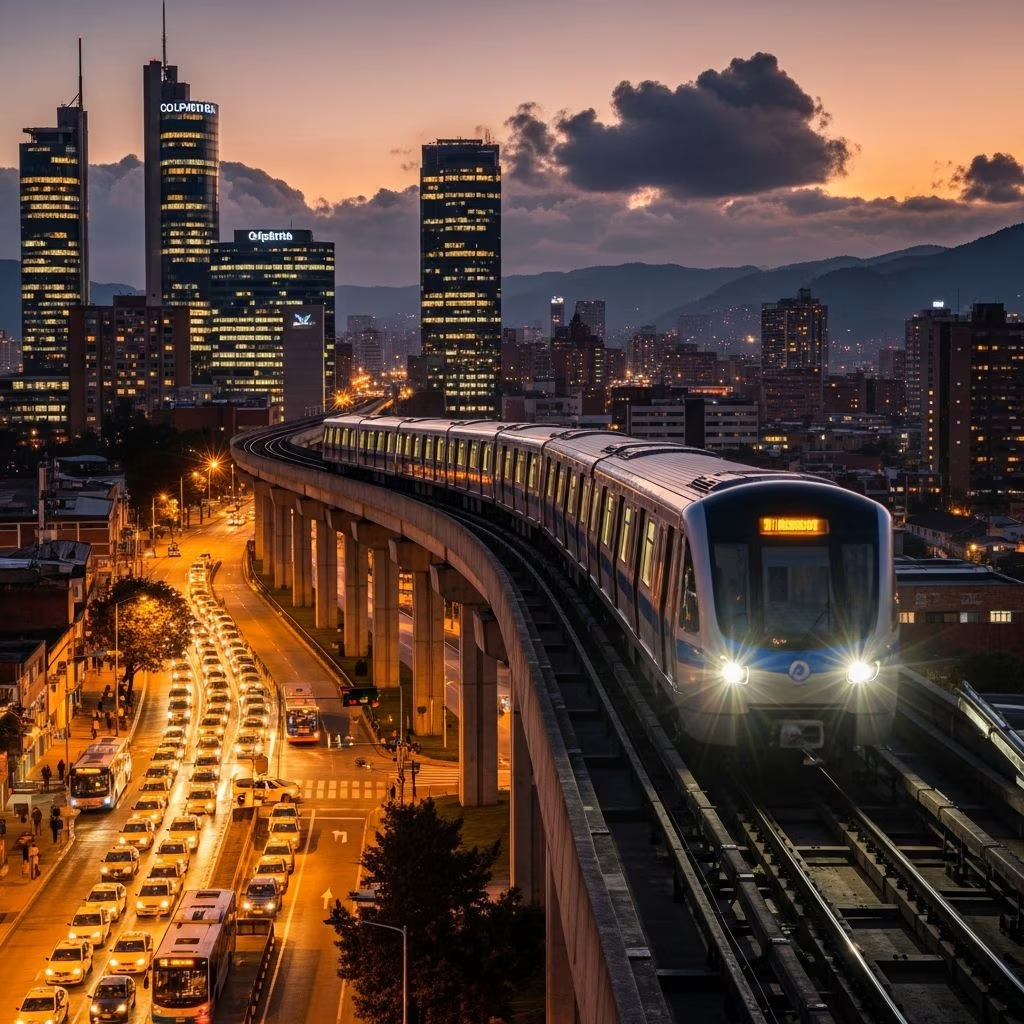 Travel Essentials
Bogotá, Colombia’s bustling capital with nearly 8 million residents, is on the cusp of a mobility transformation. After decades of reliance on overcrowded buses and gridlocked roads, the city is building its first metro system. Line 1, an elevated rail corridor, is set to launch commercial operations in 2028, promising to carry over 1 million passengers daily and cut commute times dramatically. This $7.5 billion initiative, now bolstered by international financing, marks a pivotal shift toward sustainable urban transport.
Plans for a metro in Bogotá date back years, evolving from initial concepts of underground lines to a practical elevated design for Line 1 due to challenging soil conditions. Early estimates pegged costs at lower figures, but the final $7.5 billion price tag reflects the complexities of building in a seismically active zone with soft soils. Government commitment, including national funding pledges, has kept the project alive despite political debates over affordability.
Today, construction is in its most intensive phase, with viaducts rising and stations taking shape. The 24-kilometer Line 1 will link the southwest to the expanded downtown via 16 stations, integrating seamlessly with the existing TransMilenio Bus Rapid Transit (BRT) system at multiple points. This hybrid approach leverages Bogotá’s current infrastructure while introducing high-capacity rail.
At the heart of Bogotá’s metro is Line 1, a fully electric, driverless system engineered for efficiency. Spanning 24 kilometers on an elevated viaduct, it will feature 16 modern stations designed for accessibility and speed. Trains will whisk passengers from one end to the other in under 30 minutes—slashing the current 93-minute bus journey along the Caracas corridor to just 29 minutes.
Capacity is staggering: up to 72,000 passengers per hour per direction, totaling 1.05 million daily riders. This will directly benefit 2.92 million people across nine localities and 78 neighborhoods, many in vulnerable areas, enhancing access to jobs, education, and services. The project’s inclusive design incorporates gender-sensitive features, youth programs, and support for low-income users.
| Key Line 1 Specifications | Details |
|---|---|
| Length | 24 km elevated viaduct |
| Stations | 16 |
| Daily Capacity | 1.05 million passengers |
| Travel Time (End-to-End) | <30 minutes |
| Operations Start | Q1 2028 |
| Job Creation | 115,000 during construction; 1,500 permanent |
Economically, Line 1 is a powerhouse. To date, it has generated 17,000 jobs and engaged over 500 local companies. Peak construction will create 115,000 positions across sectors like engineering, services, and management. Sustainable materials, such as low-carbon concrete from certified suppliers, underscore its green credentials.
Funding this behemoth requires more than local budgets. The World Bank recently approved a $530 million loan for Line 1’s critical construction phase, focusing on viaducts, stations, systems installation, and 23 trains. This complements co-financing from the Inter-American Development Bank (IDB) and European Investment Bank (EIB), plus private capital mobilized via the World Bank’s MIGA—totaling over $670 million in private investment.
National support remains crucial, with past presidential pledges covering a significant portion. These partnerships not only ensure financial viability but also transfer technical expertise, vital for a city new to metro operations.
While Line 1 addresses north-south flows, Line 2 targets east-west congestion in Bogotá’s densest districts. This 15.5-kilometer underground line, estimated at $9.3–9.7 billion, will feature 10 subway stations plus one elevated, threading through Chapinero, Barrios Unidos, Engativá, and Suba.
Bidding reopened in 2026, signaling firm commitment despite past delays. Integrating with five TransMilenio lines and the new Line 1, it will form a robust multi-modal network, alleviating pressure on surface transport. Expected to handle hundreds of thousands daily, Line 2 embodies Bogotá’s vision for a comprehensive metro grid.
Bogotá’s metro prioritizes sustainability. Fully electric trains will curb emissions, improving air quality in a city plagued by pollution. Road safety enhances with fewer buses on key corridors, and reduced congestion cuts fuel use citywide.
Socially, the system promotes equity. Stations in low-income areas will boost economic opportunities, with projections of urban renewal around transit hubs. Inclusive policies ensure women, youth, and disabled users have tailored access, fostering broader societal benefits.
No mega-project is without trials. Early criticism targeted the ballooning $7.5 billion cost for Line 1—double initial estimates due to underground alternatives being scrapped for elevated tracks amid soil issues. Political shifts have sparked debates on city funding capacity, necessitating national and international aid.
Yet progress is tangible: 2025 World Bank approval and ongoing viaduct work affirm momentum. Line 2 faces similar scrutiny over its $9+ billion tag, but reopened tenders indicate resolve.
Beyond Lines 1 and 2, Bogotá eyes regional integration, linking metro to broader rail networks for commuter relief. By 2050, the system could handle 2 million daily riders, revolutionizing life in the capital. Urban development will follow, with transit-oriented neighborhoods spurring investment and livability.
Line 1 is scheduled for commercial operations in the first quarter of 2028.
How does Line 1 benefit the environment?
As a fully electric, driverless system, it reduces emissions, congestion, and road accidents while promoting sustainable urban growth.
Line 1: 1.05 million passengers/day; up to 72,000/hour/direction.
Primarily yes, with 15.5 km and 10 underground stations to navigate dense areas.
Via World Bank ($530M loan), IDB, EIB, national government, and private capital.
