

 Travel Essentials
 Travel Essentials

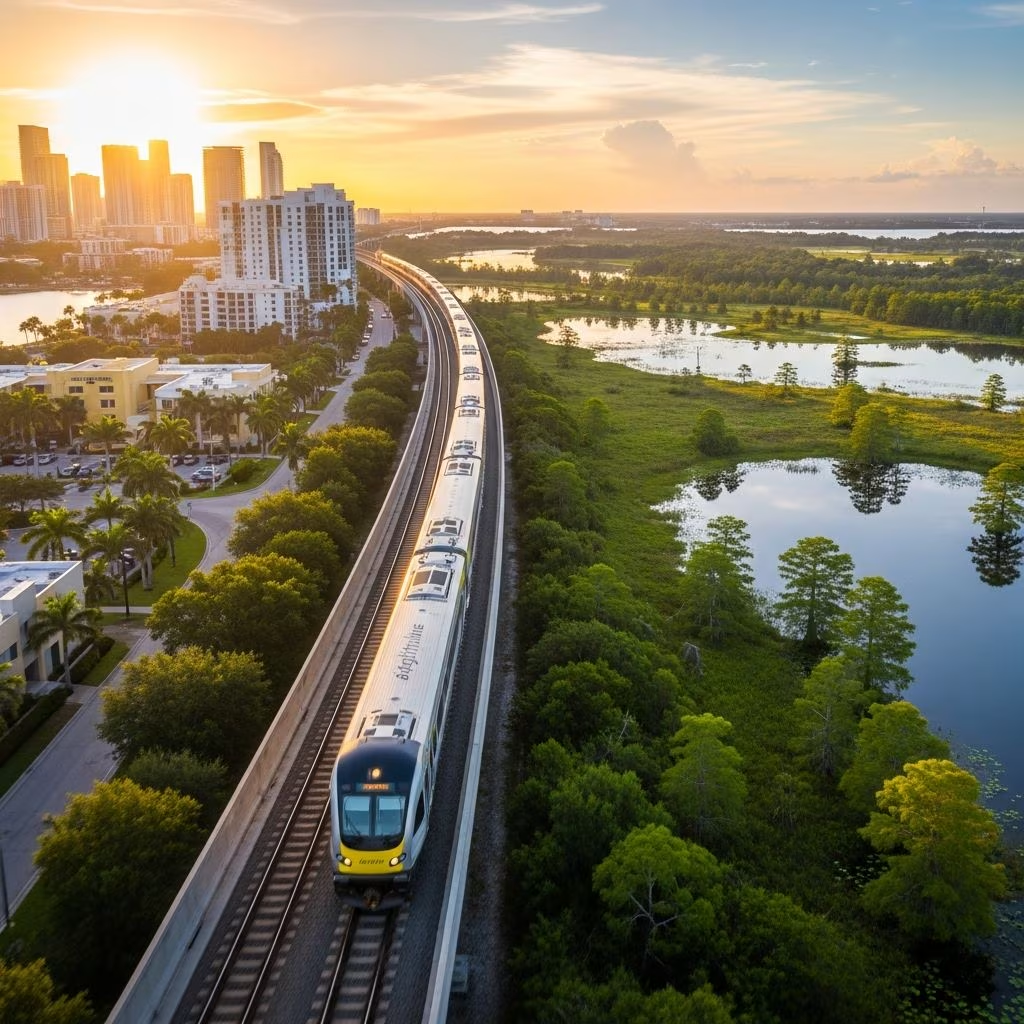
Brightline's high-speed rail connects Miami to Orlando, reducing car trips, enhancing commuter options, and spurring development in South Florida.
 Travel Essentials
Brightline has emerged as a pioneering force in American passenger rail, delivering the nation’s first privately developed and operated intercity service. By revitalizing existing tracks and building new infrastructure, it connects key Florida destinations at speeds up to 125 mph, offering a sustainable alternative to driving.
Launched in 2018 as the initial privately funded intercity rail project in the U.S., Brightline originated from Fortress Investment Group’s vision to upgrade the historic Florida East Coast (FEC) corridor. Starting with service between Fort Lauderdale and West Palm Beach, it quickly expanded northward.
The system’s first phase utilized 65 miles of shared tracks at 79 mph, accommodating both freight and passengers through innovative partnerships. By 2023, extensions reached Cocoa at 110 mph and a dedicated 125-mph line to Orlando International Airport, spanning 235 miles total.
Brightline’s stations, designed by Skidmore, Owings & Merrill (SOM), serve as vibrant hubs beyond mere transit points. Located in walkable downtowns, they integrate with local buses, trolleys, and bikes, fostering connectivity.
MiamiCentral anchors the city’s core, Fort Lauderdale links to beaches and airports, and West Palm Beach enhances regional access. Each features retail, dining, and lounges, drawing visitors pre- and post-ride.
| Station | Key Features | Connectivity |
|---|---|---|
| MiamiCentral | Retail, dining, event spaces | Metrorail, buses, airport shuttles |
| Fort Lauderdale | Walkable to beaches | Tri-Rail, local transit |
| West Palm Beach | Neighborhood anchor | Tri-Rail, Palm Tran buses |
| Boca Raton (newer) | Increased daily stops | Local roads, future commuters |
| Orlando Int’l Airport | Flagship hub, expandable | Airport terminals, SunRail |
These designs eliminate over three million car trips annually, easing congestion on I-95.
Ridership data drives constant enhancements. In 2025, Brightline responded to demand with peak-hour frequency every 30 minutes in South Florida, adding Boca Raton stops to 28 daily—up from 19.
Longer trains—eight coaches now, ten by year-end—nearly double capacity for Orlando routes. Commuter-focused schedules include five southbound arrivals in Miami (4:15-7:00 p.m.) and northbound departures (3:45-6:45 p.m.).
Brightline catalyzes growth by linking economic engines. Miami’s tech and finance sectors gain from Orlando’s tourism and theme parks, while intermediate cities see transit-oriented development (TOD).
Stations spur mixed-use projects: offices, residences, and retail bloom nearby, boosting property values and tax revenues. The private model avoids public subsidies, proving rail’s viability.
In South Florida, reduced highway reliance cuts emissions and travel times—Miami to West Palm Beach drops to 45 minutes versus hours by car.
Future plans blend intercity with local service. By 2028, a 27-mile Broward County commuter line from Aventura to Deerfield Beach will use Brightline tracks, adding 10 stations.
Florida DOT and counties fund stations and sidings; Brightline handles operations. This hybrid reduces costs on the 110-year-old right-of-way, serving daily workers.
Tri-Rail integration on shared segments and SunRail links in Orlando position Brightline as a regional backbone.
As America’s eco-friendly intercity rail, Brightline slashes carbon footprints. Electric locomotives and efficient routing replace gas-guzzling cars and flights for short hauls.
Annual car trip reductions prevent millions of miles driven, aligning with Florida’s growth without infrastructure strain. Dedicated segments minimize wildlife disruption.
| Aspect | Brightline | Amtrak (NEC) | California HSR |
|---|---|---|---|
| Ownership | Private | Public-private | Public |
| Top Speed | 125 mph | 160 mph | Planned 220 mph |
| Status | Operational 235 mi | Operational | In construction |
| Funding | $5B private | Gov’t subsidies | $100B+ public |
Brightline’s speed leads outside the Northeast Corridor, offering a blueprint for private innovation.
Shared tracks demand precise scheduling, solved by joint dispatchers. Freight priority is offset by Brightline’s payments and upgrades.
Peak demand strains capacity, addressed via expansions. Hurricane-prone Florida requires resilient designs, met with elevated tracks and backups.
Plans extend to Tampa via an 85-mile dedicated line at 125 mph, partly shared with SunRail. This east-west link could spawn cross-Florida service.
Orlando’s flagship station expands for hubs, potentially integrating national routes. High-speed plans from the 1990s enable greenfield segments.
It runs from Miami to Orlando International Airport, stopping at Aventura, Fort Lauderdale, Boca Raton, and West Palm Beach.
Up to 125 mph on dedicated tracks, averaging 79-110 mph elsewhere.
Yes, fully privately owned and operated—the only such intercity rail in the U.S.
Expected by 2028 between Miami and Fort Lauderdale.
Yes, eliminating over 3 million car trips yearly.
Brightline reimagines rail as modern, accessible, and profitable, blending intercity speed with commuter utility. Its growth heralds a less car-dependent Florida.
