

 Travel Essentials
 Travel Essentials

Discover the authentic locations behind Bruce Springsteen's most celebrated songs and plan your own journey through American music history.
 Travel Essentials
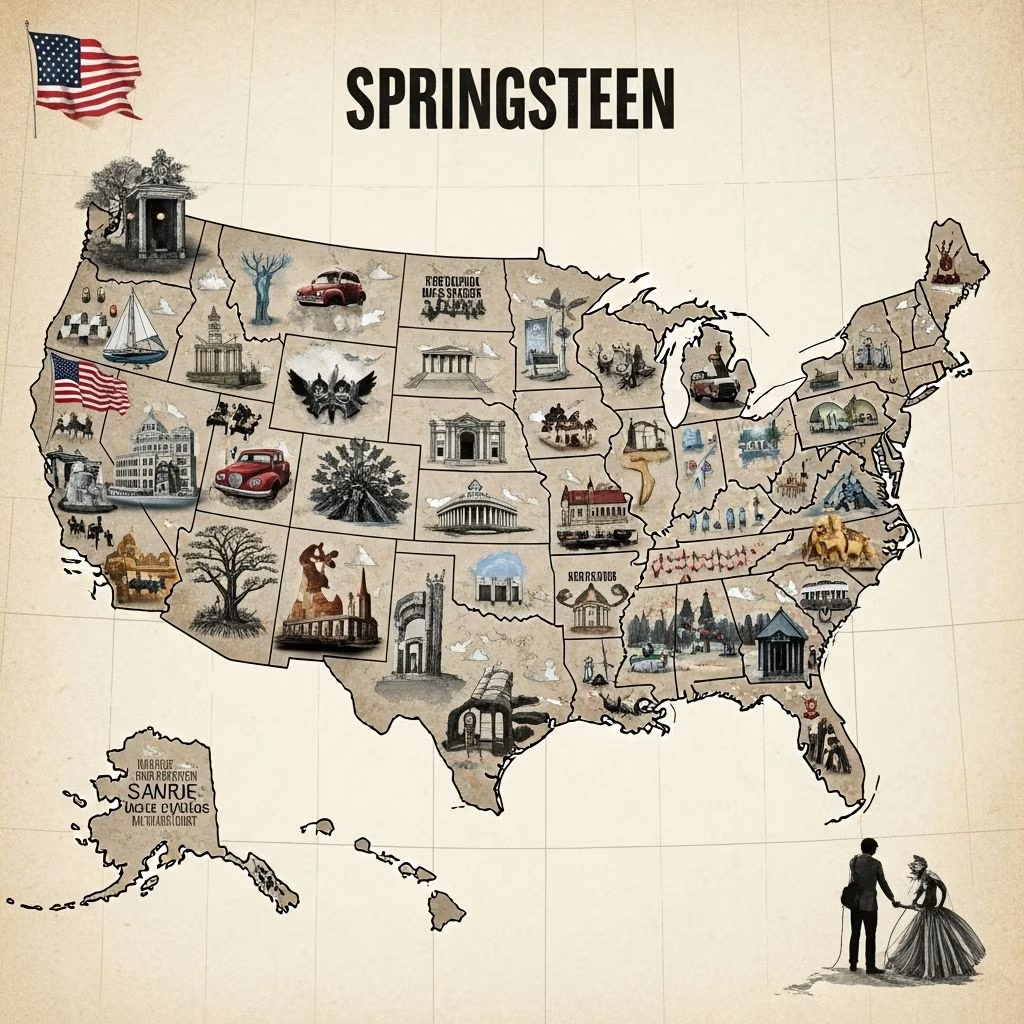
Bruce Springsteen has built a legendary career chronicling the American experience through music, and his songwriting frequently draws inspiration from real places across the United States. While some locations remain metaphorical—like the famous “Thunder Road”—many of his most memorable tracks reference actual cities, neighborhoods, and landmarks that shaped his artistic vision. Understanding these geographic references offers listeners a deeper connection to his work and creates opportunities for meaningful travel experiences rooted in musical history.
New Jersey, particularly the Jersey Shore region, remains the geographic and emotional center of Springsteen’s musical universe. His connection to this area runs deep, appearing consistently throughout his discography and serving as the launching point for his entire career. The specific streets, towns, and landmarks of coastal New Jersey transformed from mere geography into mythology through his songwriting.
Asbury Park stands as perhaps the most iconic location in Springsteen’s work. His debut album, “Greetings from Asbury Park, N.J.,” announced both his arrival as an artist and cemented this seaside town’s place in rock and roll history. The city’s Convention Hall became a legendary performance venue where Springsteen frequently played, turning it into a pilgrimage site for devoted fans. References to this community appear throughout his catalog, including specific street names like Kingsley Avenue and detailed descriptions of the boardwalk culture that defined the area during his formative years.
Moving southward along the coast, Atlantic City emerges as another crucial Jersey Shore reference point. Springsteen’s stark and haunting track “Atlantic City” from his 1982 album “Nebraska” presents a darker portrait of this gambling destination. The song captures economic desperation and moral compromise, using the glittering casino culture as a backdrop for a story of criminal activity and survival. This composition represents one of his most direct and unflinching geographic references, naming the city explicitly within the opening lyrics.
Route 88 features prominently in multiple Springsteen compositions, particularly “Spirit in the Night,” which references this highway as it cuts through the heart of Point Pleasant in North Jersey. The route serves as more than mere directional information; it becomes a symbol of restlessness, adventure, and the youthful exploration that characterizes much of Springsteen’s early work.
Beyond the Jersey Shore, Springsteen’s geographic interests expand into the industrial Midwest, where he documented the economic decline affecting working-class communities. These songs reveal his deep empathy for ordinary Americans facing industrial collapse and economic displacement.
Youngstown, Ohio serves as the focal point for one of Springsteen’s most powerful social commentaries. His song “Youngstown” tells the story of the city’s rise and fall, chronicling how manufacturing prosperity gave way to devastating plant closures and job losses. The composition captures the personal tragedy embedded within larger economic trends, using a specific geographic location to represent broader national patterns of deindustrialization.
Mahwah, New Jersey appears in “Johnny 99,” where Springsteen references the closure of an auto manufacturing plant in this town. The song tells the fictional account of an unemployed worker facing criminal charges, using the factory shutdown as the catalyst for the protagonist’s desperate circumstances. This track exemplifies how Springsteen weaponizes specific place names to ground abstract economic concepts in human experience.
Philadelphia, another major East Coast metropolis, features in Springsteen’s work as a symbol of urban life and opportunity. The city’s architectural and cultural significance provides a backdrop for exploring themes of ambition and social mobility within his broader artistic vision.
The American highway system itself functions as both a literal setting and metaphorical framework throughout Springsteen’s catalog. Songs celebrating movement, escape, and restless searching consistently employ specific roads and routes as their geographic foundation.
Highway 9 appears in “Born to Run,” one of Springsteen’s most iconic compositions. The highway represents both escape and entrapment, freedom and desperation intertwined. The famous opening couplet mentions “sprung from cages out on Highway 9,” establishing the road as a liberation route for characters seeking to transcend their circumstances.
The New Jersey Turnpike features in multiple tracks, including “Living on the Edge of the World.” The turnpike becomes a character itself in Springsteen’s work—a lonely, spooky passage through the night that separates the safe from the unknown, the home from the unfamiliar.
The broader theme of American highways and roads extends beyond these specific references. Springsteen frequently employs driving, travel, and movement as narrative devices that allow characters to escape, explore, or relocate their lives. The highway represents possibility but also the uncertainty of what lies ahead.
While the Northeast dominates Springsteen’s geographic references, he occasionally ventures westward in his songwriting. “Rosalita (Come Out Tonight)” includes the memorable line about “a pretty little place in Southern California, down San Diego Way.” This reference stands out within his catalog as an explicit gesture toward the West Coast, using San Diego as a symbol of escape, romance, and possibility.
The song’s context—a youthful love story set against the promise of westward movement—positions San Diego as more than a simple location. It represents the ultimate destination for dreamers seeking to start fresh and forge new lives beyond the constraints of their origins.
South Dakota’s Badlands, while not directly featured in a Springsteen song title, emerged from his creative imagination. He conceived the title “Badlands” as an evocative sound before considering any specific geographic location. Interestingly, the actual Badlands National Park in South Dakota has become a symbolic destination for Springsteen fans, representing the landscape that inspired his artistic vision even though it wasn’t explicitly the song’s geographic reference point.
Beyond the highways and major cities, Springsteen demonstrates remarkable specificity when referencing individual streets, neighborhoods, and smaller geographic details. This precision grounds his stories in believable, recognizable settings.
Freehold, New Jersey holds particular significance as Springsteen’s hometown. References to Freehold Regional appear in his work, while “In Freehold” contains the famous line “I was born right here on Randolph Street.” These specific street-level details create a sense of intimate authenticity, positioning Freehold as the geographic center of his personal identity.
The Meadowlands, another New Jersey location, features in “Wrecking Ball,” where Springsteen reflects on his home and community connection. The Meadowlands reference demonstrates how even sprawling industrial or commercial areas can acquire emotional and personal significance through artistic treatment.
E Street in Asbury Park deserves particular attention, as it names the iconic band that accompanied Springsteen throughout much of his career. The E Street Band transformed a simple street name into a legendary institution, with references appearing throughout his catalog, including “E Street Shuffle” and numerous other compositions.
An important distinction exists between Springsteen’s deliberately fictional locations and his references to actual places. “Thunder Road,” one of his most famous compositions, doesn’t reference a real location—instead, Springsteen created the title as a metaphorical concept representing the journey toward dreams and possibilities.
This mixture of real and imagined geography characterizes much of his work. Even fictional settings are grounded in authentic regional details and cultural specificity that makes them feel real. The combination of precise geographic references with metaphorical place names creates a rich tapestry where listeners can engage at multiple levels—both as documentation of actual American locations and as artistic exploration of universal human experiences.
For fans interested in visiting locations referenced in Springsteen’s work, several logical travel routes emerge:
Springsteen’s geographic specificity distinguishes him among major rock artists. Rather than creating entirely fictional worlds or remaining abstractly universal, he grounds his narratives in actual American locations. This approach transforms travel into a form of musical pilgrimage, allowing fans to walk the same streets, drive the same highways, and inhabit the same physical spaces that inspired his greatest artistic achievements.
The relationship between his music and American geography reveals something fundamental about how artists draw inspiration from the world around them. Springsteen didn’t simply write about abstract themes; he observed specific communities, absorbed their character, and translated lived experience into universal artistic expression. By visiting these locations, travelers gain insight into both Springsteen’s creative process and the authentic American experience he sought to capture.
Whether exploring the boardwalks of Asbury Park, driving through industrial Ohio, or contemplating the highways that connect these disparate places, fans can deepen their appreciation for Springsteen’s work by understanding its geographic roots. His songs become more vivid, more meaningful, and more powerful when experienced within the actual settings that inspired them.
