

 Travel Essentials
 Travel Essentials

Explore Brussels' rich architectural heritage: Art Nouveau by Horta, Gothic grandeur, modernist structures, and hidden treasures perfect for architecture lovers.
 Travel Essentials
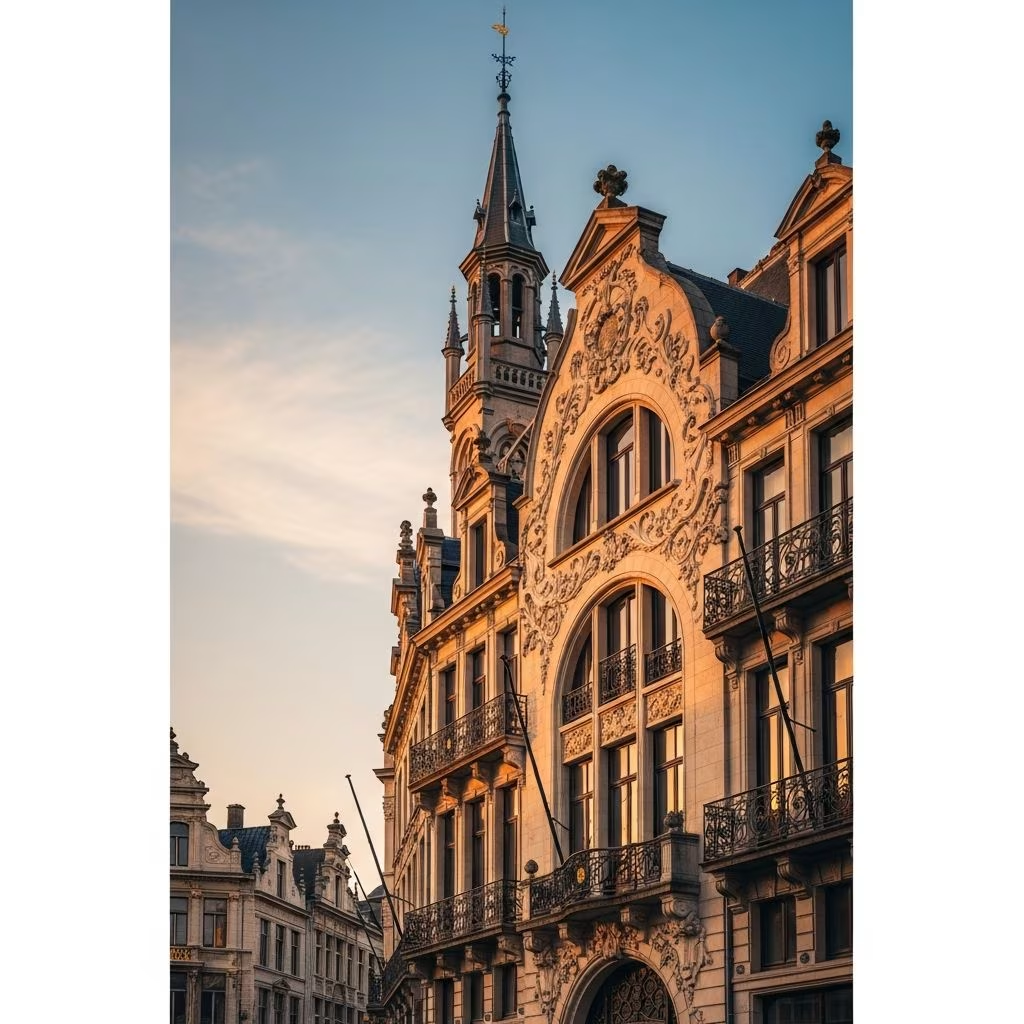
Brussels stands as a living museum of architectural evolution, where centuries of innovation blend seamlessly into its urban fabric. From the organic curves of **Art Nouveau** to the stark lines of modernism, the Belgian capital offers a diverse palette of styles that reflect its dynamic history. This guide takes you through the city’s most captivating structures, providing practical tips for exploration and insights into their cultural significance.
The architectural story of Brussels begins in the medieval era, with Gothic spires piercing the skyline around the **Grand-Place**. This UNESCO-listed square exemplifies 15th-century craftsmanship, where guildhalls and the towering Hôtel de Ville showcase intricate stonework and gilded facades. The cobblestone streets radiating from here, laid with granite and sandstone from various historical periods, add a tactile dimension to the experience.
As the city grew into a hub of trade and politics, Baroque influences emerged in the 17th and 18th centuries. Structures like the Royal Palace and nearby Mont des Arts integrate grand symmetry with ornate details, creating public spaces that balance majesty and accessibility. These foundations set the stage for the 19th-century explosion of creativity that would define Brussels globally.
In the late 1800s, Brussels became the epicenter of **Art Nouveau**, a movement rejecting rigid classicism in favor of flowing lines, natural motifs, and innovative materials like iron, glass, and brick. Architects drew inspiration from flora and fauna, crafting buildings that appear to grow organically from the ground.
At the forefront was **Victor Horta**, whose visionary designs transformed residential and public spaces. His works emphasize light, space, and asymmetry, using whiplash curves and stained glass to evoke movement. Key examples include:
Other pioneers like Paul Hankar contributed with Maison Hankar on Rue Defacqz, his personal residence that boldly integrated sculptural elements into everyday architecture. Gustave Strauven, Horta’s protégé, pushed boundaries further with the whimsical **Maison Saint Cyr**, a narrow Ixelles facade packed with turrets, balconies, and floral ironwork, evoking a fairy-tale quality.
To immerse yourself, visit the **Horta Museum** in Saint-Gilles, Horta’s former home and studio. Every detail—from mosaic floors to furniture—reflects his holistic approach. Open daily with guided tours available, it’s an essential stop for understanding Art Nouveau’s intimacy.
Following Art Nouveau’s peak around 1910, **Art Deco** arrived in the 1920s, favoring geometric precision and luxury materials. Brussels examples include streamlined facades in the European Quarter and the elegant lines of the Palais des Beaux-Arts (now BOZAR), designed by Victor Horta in a transitional style. This cultural center hosts exhibitions amid its marble halls and vast atrium.
Post-World War II, **Brutalism** introduced raw concrete forms, seen in residential blocks and public buildings that prioritize function over ornament. The era’s bold experimentation contrasts sharply with earlier elegance, offering a gritty counterpoint.
| Style | Key Period | Signature Features | Notable Brussels Example |
|---|---|---|---|
| Art Nouveau | 1890s-1910 | Curves, nature motifs, iron/glass | Hôtel van Eetvelde |
| Art Deco | 1920s-1930s | Geometry, chrome, symmetry | BOZAR |
| Brutalism | 1950s-1970s | Concrete, monolithic forms | European Quarter residentials |
Brussels’ contemporary skyline challenges traditional beauty with audacious designs. The **Berlaymont Building**, an X-shaped glass behemoth housing the European Commission, polarizes opinions—loved for its transparency, derided as the ‘Berlamonster’ for its imposing scale. Located near Schumann metro, it’s a symbol of EU power.
Nearby, the **Old England Building** on Mont des Arts merges Art Nouveau flair with functional reuse. Originally a department store, it now shelters the Musical Instruments Museum (MIM), where steel skeletons and vast windows frame panoramic views. Inside, exhibits span global music history amid preserved interiors.
Don’t miss the **Atomium**, a 1958 World’s Fair relic towering 102 meters with nine interconnected spheres representing iron crystals. Its reflective skin and observation decks offer futuristic vistas, embodying post-war optimism. Further afield, the **Royal Greenhouses of Laeken** provide a serene escape with iron-framed glasshouses blooming seasonally, accessible during limited public openings.
Beyond the famous, Brussels hides lesser-known gems. The **Temple of Human Passions** in Ixelles, a pseudo-Greek edifice by Victor Horta, features Paul Dubois’ massive sculptures inside—viewable for just one hour daily. The **Maison de la Bellone**, a Baroque survivor wrapped in a modern arts center, juxtaposes eras elegantly.
In Saint-Gilles and Ixelles, stroll Rue Defacqz or Avenue des Courses for dense concentrations of Art Nouveau row houses, many privately owned but visible from the street. The **Stoclet Palace** in Woluwe Park, a late Art Nouveau/Art Deco hybrid by Josef Hoffmann, is UNESCO-protected but rarely open—admire its pristine white facade externally.
Brussels rewards walkers: most sites cluster in walkable districts like the Pentagone (historic center), European Quarter, and southern communes. Use trams (lines 92/93 for Saint-Gilles) or bikes via Villo! stations. Download self-guided maps from Visit Brussels or join free Brussels Greeters tours for insider stories.
Timing matters—spring (April-May) highlights blooming facades, while March’s **BANAD Festival** unlocks private Art Nouveau homes with tours and exhibits. Wear comfortable shoes for cobblestones and check opening hours, as many private buildings offer only exterior views.
Start with the Horta Museum, then walk Etterbeek’s Place Ambiorix and Ixelles’ streets. Guided tours via ARAU or apps enhance the experience.
Limited access during heritage days or festivals like BANAD; otherwise, exteriors and museums like MIM suffice.
Yes, but seasonal events and weather affect outdoor exploration. Indoor sites like BOZAR operate daily.
One full day covers highlights; extend to 2-3 for depth, including neighborhoods like Saint-Gilles.
Atomium and MIM offer interactive elements; Royal Greenhouses appeal to all ages during openings.
