

 Travel Essentials
 Travel Essentials

Dive into the world of Calcio Storico Fiorentino, Florence's iconic violent sport rooted in Renaissance defiance, featuring four neighborhood teams in epic June battles.
 Travel Essentials
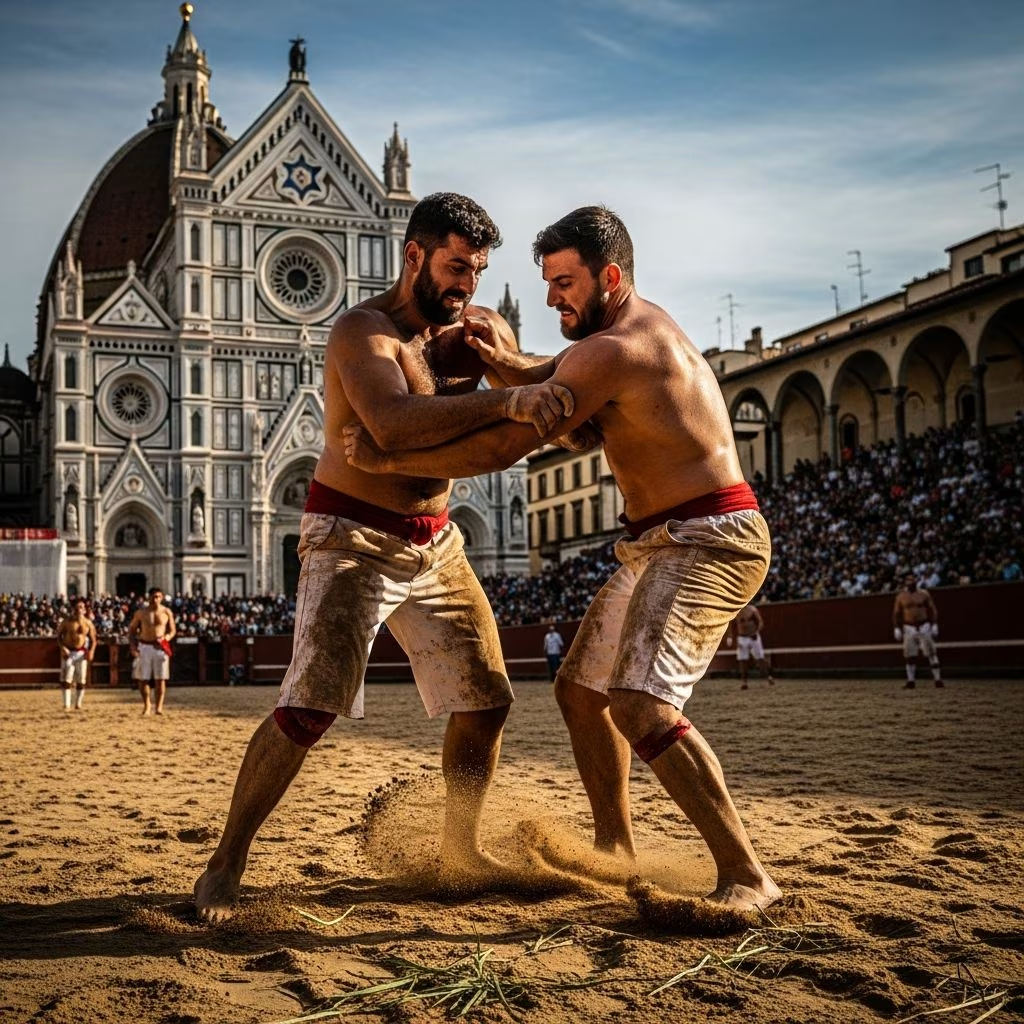
Calcio Storico Fiorentino stands as one of Italy’s most visceral cultural treasures, a hybrid sport fusing elements of soccer, rugby, and bare-knuckle fighting played on the sands of Florence’s historic piazzas. This Renaissance-era game, revived in the 20th century, captivates with its blend of athleticism, neighborhood pride, and unyielding aggression, drawing thousands to witness brutal clashes each June.
The origins of Calcio Storico trace back over two millennia to the Roman game of harpastum, a grueling ball sport used by gladiators for training, emphasizing strength, agility, and relentless pursuit. By the late 15th century, this evolved into a popular pastime among Florentine youth, with the first documented match occurring in 1470 amid the city’s bustling streets and squares.
Public fervor led to impromptu games everywhere, prompting authorities to impose restrictions by confining play to designated piazzas and posting bans on unauthorized ball games—signs that echo in modern Florence where children still kick soccer balls near ancient churches. During Carnival season, the sport flourished in the 17th century, entertaining nobles and commoners alike on city squares, but it faded by the mid-1700s, with the last pre-revival match in 1739 before Austrian royalty.
The pivotal moment defining Calcio Storico arrived on February 17, 1530, during the siege of Florence by Emperor Charles V’s imperial forces. Amid rebellion against Medici rule, Florentines staged a massive game in Piazza Santa Croce, visible to enemy troops on nearby hills, accompanied by musicians atop the basilica. This audacious display symbolized unbreakable spirit, mocking invaders and rallying the besieged republic’s defenders who briefly abandoned posts for the match.
Nobles in elaborate costumes clashed fiercely, etching the event into history as the sport’s legendary cornerstone. This act of cultural resistance not only boosted morale but cemented Piazza Santa Croce as the eternal venue, a 5,000-square-meter sand arena known as the sabbione.
After nearly two centuries of dormancy, Calcio Storico roared back in 1930 under Alessandro Pavolini, a Fascist leader commemorating the 400th siege anniversary with a reenactment in Piazza Santa Croce. This revival tapped into Italy’s push to reclaim ancient grandeur, transforming the game into an unbroken annual tradition, paused only by wartime.
Today, three matches unfold in Florence’s third week of June: two semifinals determining finalists, culminating in a championship. Pairings are drawn Easter Sunday at the Scoppio del Carro festival, where colored marble eggs from a velvet pouch decide first-round opponents.
Florence divides into four historic quarters, each fielding a 27-player team—calcianti—clad in district colors, fostering intense local rivalries.
Players must be lifelong Florentines or decade-long residents, ensuring deep quartier loyalty. Teams feature specialized roles: one goalkeeper, three backs, 15 midfielders, and eight forwards, all vying in 50-minute halves.
Beneath its chaotic facade, Calcio Storico follows codified rules from centuries past, documented by early chroniclers like Giovanni Bardi. Played on a 95×47-meter sand field with massive goal openings at each end, the objective is simple: score the caccia by forcing a small, hard leather ball across the opponent’s line, either by foot, head, or hand.
Punches and kicks to opponents are permitted above the shoulders, but strikes below the waist draw whistles. No wrestling holds, tripping, or glass shards—referees (sgambannari) and linesmen enforce amid the fray, though enforcement bends to the game’s spirit. A match spans two 25-minute halves with minimal halftime, rewarding endurance over finesse.
| Position | Number per Team | Primary Duties |
|---|---|---|
| Goalkeeper | 1 | Guard the massive goal (5m high, 2m wide) |
| Defensive Backs | 3 | Block advances near own goal |
| Midfielders | 15 | Control center, battle for possession |
| Forwards | 8 | Push offensively, score cacce |
Games erupt into a Renaissance fever dream: teams parade in 16th-century velvet costumes, preceded by flag-throwers, drummers, and pike-wielding nobles on horseback. Thousands pack bleachers, with prime Verdi spots claimed days ahead, as the neo-Gothic Santa Croce facade looms overhead.
Pre-match rituals include the historic ox-drawn cart circling the arena, heightening tension before the referee’s whistle unleashes 54 warriors in a scrum for the ball. Crowds roar through every brawl, score, and triumphant caccia, blending communal ecstasy with quartier chants.
Secure free standing-room tickets via Florence’s comune website months in advance; numbered bleacher seats cost €20-€30, vanishing fast. Arrive early for the 5 PM kickoff after parades starting at 4 PM. Dress comfortably for June heat, stand for hours if unreserved, and embrace the crush—personal space vanishes.
Santa Croce remains the hub; Rossi vs. Verdi often opens, with winners facing Bianchi or Azzurri in finals. Pair with Florence’s June festivities like San Giovanni feasts for immersion.
Calcio Storico transcends sport, embodying Florentine identity—resilience, rivalry, and ritual. It unites generations, with youth training in quartier gyms, preserving a living link to 1530’s defiance. Globally, it draws adventurers seeking authentic Italy beyond museums.
Critics decry its violence, yet proponents hail regulated brutality as heritage. Annually, it reaffirms Florence’s unyielding soul.
A standard caccia scores 1 point; crossing via the central porta (narrower section) nets 0.5. Highest score wins; ties replay.
Yes—fistfights and falls injure players yearly, but medical teams stand ready, and rules mitigate extremes.
Semifinals mid-June (exact dates via comune); final follows Sunday. Check visittuscany.com for updates.
No—only qualified locals. Spectate or join amateur demos.
Its 1530 legacy and vast sand pit make it ideal; alternatives like Santa Maria Novella host rarely.
