

 Travel Essentials
 Travel Essentials

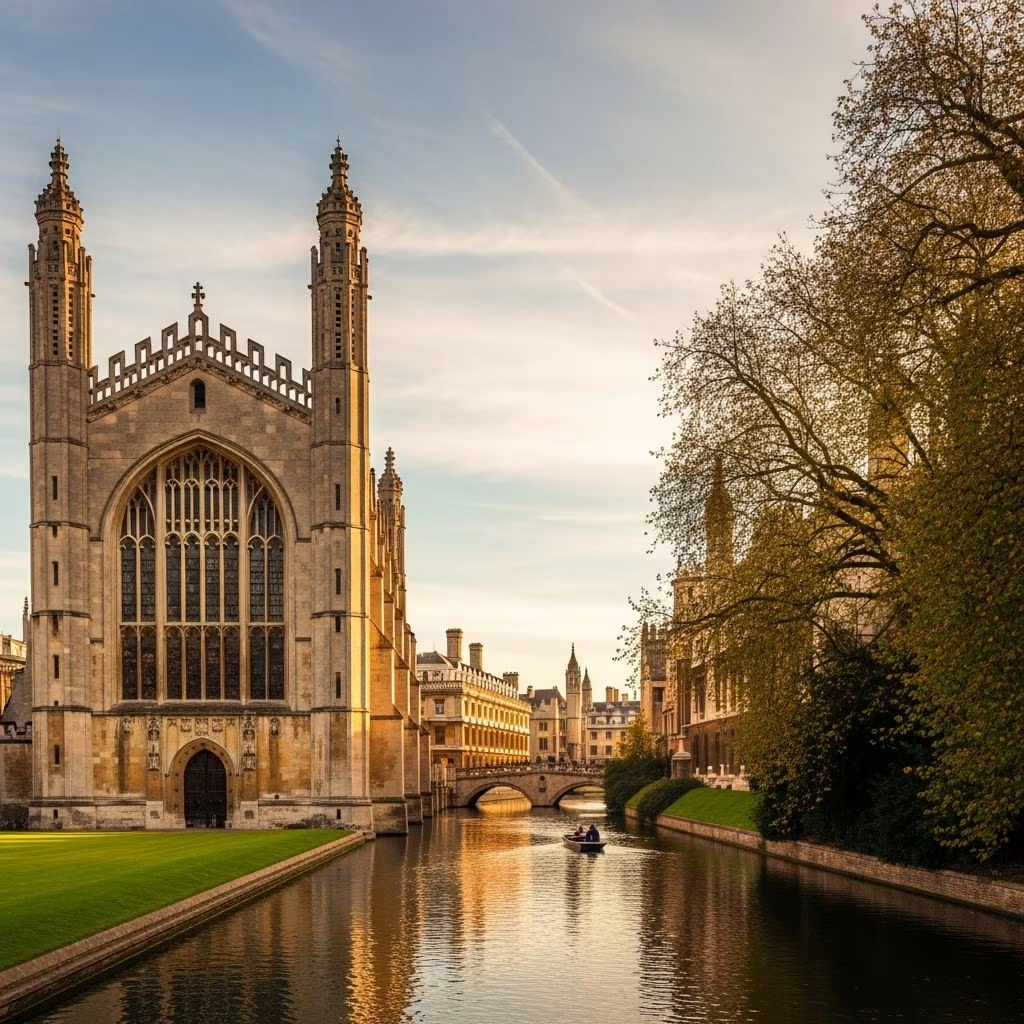
Explore Cambridge's iconic buildings from Gothic masterpieces like King's College Chapel to neoclassical gems and contemporary designs, highlighting the city's rich architectural heritage.
 Travel Essentials
Cambridge stands as a living testament to centuries of architectural evolution, where ancient stonework harmonizes with innovative designs. This university city boasts over 100 Grade I and II listed buildings, primarily centered around its prestigious colleges. From the soaring vaults of medieval chapels to sleek modern facilities, each structure tells a story of innovation, patronage, and craftsmanship. Whether you’re wandering the historic core or seeking hidden gems, Cambridge offers a visual feast for architecture lovers.
The roots of Cambridge’s architectural fame lie in its medieval heritage, particularly the Perpendicular Gothic style that defines many university buildings. This late Gothic phase, emerging in the 14th century, emphasizes verticality, intricate tracery, and expansive windows, creating ethereal interiors flooded with light.
Dominating the skyline on King’s Parade, King’s College Chapel exemplifies Perpendicular Gothic at its zenith. Initiated in 1446 by King Henry VI and completed nearly a century later, this chapel features the world’s largest fan-vaulted ceiling, spanning 80 feet without interruption. Its 16th-century stained glass windows, restored yet original in essence, depict biblical scenes in vibrant hues. The Tudor wooden rood screen, carved with exquisite detail, divides the nave from the choir, adding a layer of Renaissance finesse to the Gothic framework.
Visitors enter via the grand ante-chapel, stepping into a space that measures 289 feet long, 63 feet wide, and 80 feet high at the crossing. The chapel hosts the renowned Festival of Nine Lessons and Carols, amplifying its cultural resonance. Location: King’s Parade, Cambridge CB2 1ST. Open daily; choral evensong services offer free entry on select days.
Overlooking the Market Square, Great St Mary’s Church anchors Cambridge’s Gothic legacy. Originating in the 13th century with Perpendicular additions, its tower rises 160 feet, providing panoramic city views for a modest fee. Inside, the nave’s hammerbeam roof and ornate stained glass blend medieval purity with later restorations, reflecting the church’s role as the university’s official place of worship.
Climb the 123 steps to the top for vistas encompassing college spires and the fens beyond. This structure not only served academic congregations but also witnessed pivotal events like the 16th-century Reformation debates.
As Gothic gave way to classical influences, Cambridge’s skyline incorporated Renaissance symmetry and Georgian restraint, often commissioned by royal founders and wealthy benefactors.
Founded in 1546 by Henry VIII, Trinity College boasts the largest enclosed quadrangle in Europe. The Great Court, redesigned by Thomas Nevile in the late 16th century, surrounds a central fountain with uniform facades blending Tudor and classical elements. Its Grade I listing underscores the harmonious proportions.
The Wren Library, crafted by Sir Christopher Wren in 1676-1695, elevates the site with neoclassical poise. Oak bookcases house rarities like Newton’s manuscripts, illuminated by vast sash windows. The ceiling’s allegorical paintings and limewood carvings by Grinling Gibbons epitomize 17th-century opulence. Access via guided tours; Trinity Street, Cambridge CB2 1TQ.
James Gibbs’ 1730 Senate House on King’s Parade embodies Georgian architecture’s refined Palladianism. Corinthian columns frame the entrance, leading to an interior used for degree ceremonies where graduates receive parchments from the Chancellor. Its rusticated base and pedimented windows exemplify early 18th-century British classicism.
Cambridge’s River Cam inspires poetic architecture, with bridges linking college courts in stylistic splendor.
St John’s College, established in 1511, merges Gothic, Tudor, and Victorian elements across its expansive grounds. The 1831 Bridge of Sighs, architect Henry Hutchinson’s Gothic Revival tribute to Venice, arches over the Cam with ogee windows and balustrades. This Grade I structure connects Third Court to New Court, its yellow stone glowing at dusk.
Punting beneath it reveals intricate carvings of flora and fauna, drawing photographers year-round. St John’s Street, Cambridge CB2 1TP; college tours available seasonally.
The 19th century brought neoclassical grandeur, inspired by ancient Greece and Rome, to Cambridge’s cultural institutions.
George Basevi’s 1837-1848 design for the Fitzwilliam Museum mimics an Ionic temple with its hexastyle portico. Flanked by wings, the facade rises imposingly on Trumpington Street. Interiors feature coffered ceilings and marble staircases housing antiquities, Impressionist paintings, and sculptures by Rodin and Hepworth.
The bequest of Viscount Fitzwilliam in 1816 seeded a collection exceeding 500,000 items, making it a neoclassical shell for global treasures. Free entry; special exhibitions may charge. CB2 1RB.
Cambridge balances heritage with forward-thinking designs, integrating sustainable and minimalist aesthetics.
Designed in the 1960s, West Court at Jesus College introduces modernist principles with expansive glazing and concrete frames, contrasting the college’s medieval core. Its open-plan layout maximizes light and views of the Cam.
Completed in 2019, this mosque by Marks Barfield Architects is Europe’s first eco-mosque, featuring a lattice timber dome, photovoltaic panels, and rainwater harvesting. The crescent-topped minaret and prayer hall’s birch plywood undulations blend Islamic geometry with environmental ethos.
Michael Hopkins’ 1985 Grade II-listed facility on Madingley Road pioneered high-tech modernism with its saw-tooth roof and glass curtain walls, optimizing natural ventilation for research labs.
One of Britain’s four medieval round churches, dating to 1130, models the Holy Sepulchre. Its sturdy Norman apse and 12th-century arcade have endured atop Bridge Street, surrounded by bloom. Entry £3.50 reveals Templar history.
The Saxon tower of St Bene’t’s (c. 1020) predates the Conquest, featuring double-splayed windows. The 14th-century body adds Perpendicular flair.
To navigate efficiently:
| Site | Style | Build Date | Access |
|---|---|---|---|
| King’s College Chapel | Perpendicular Gothic | 1446-1515 | Daily, evensong free |
| Bridge of Sighs | Gothic Revival | 1831 | View from punt |
| Fitzwilliam Museum | Neoclassical | 1837 | Free entry |
| Wren Library | Neoclassical | 1695 | Guided tours |
Spring or autumn for mild weather and fewer crowds; summer offers longer days for photography.
Many via guided tours (£5-15); check websites for schedules as they vary by term.
Yes, self-hire or chauffeured punts (£20-30/hour) offer prime views.
Limited; use Park & Ride buses from outskirts.
Exteriors of all colleges, Great St Mary’s tower views, Fitzwilliam entry.
