

 Travel Essentials
 Travel Essentials

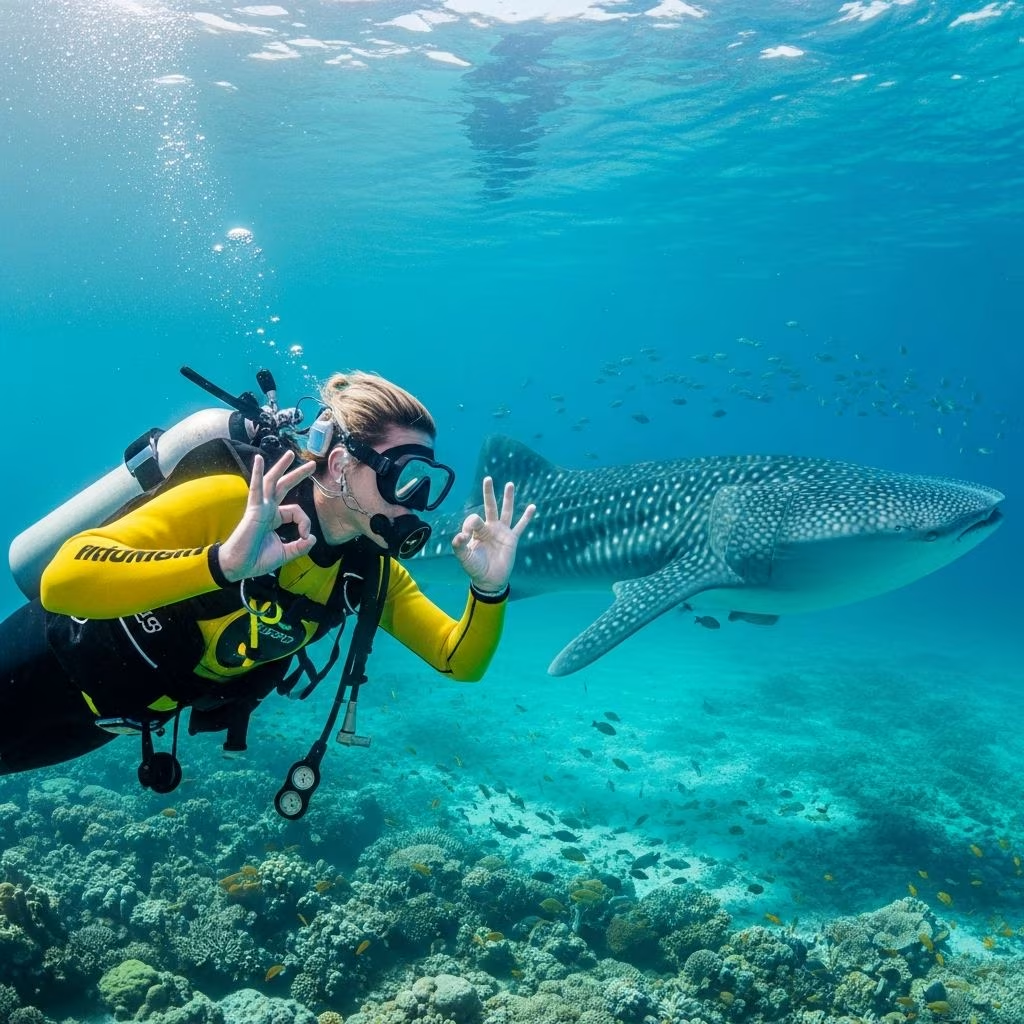
Explore how Deaf divers challenge misconceptions about hearing loss and underwater diving, featuring innovative inclusive dive operations.
 Travel Essentials
For decades, a persistent misconception has limited access to scuba diving for Deaf and hard-of-hearing individuals. The assumption that hearing loss automatically disqualifies someone from safely exploring underwater environments has created unnecessary barriers to an activity that millions of people enjoy worldwide. However, this outdated belief is rapidly changing, thanks to pioneering Deaf entrepreneurs, specialized training programs, and a growing understanding of how hearing loss actually relates to diving safety and capability.
The underwater realm offers unique opportunities for Deaf divers, presenting advantages that hearing divers often overlook. Rather than viewing deafness as a limitation in aquatic environments, the diving community is increasingly recognizing it as a different way of engaging with the ocean that brings distinct benefits. This transformation reflects broader changes in how society approaches accessibility and inclusion across recreation and adventure activities.
The primary myth surrounding Deaf diving centers on equalization—the process of managing pressure changes in air spaces within the body as divers descend and ascend. Many people mistakenly believe that hearing loss prevents equalization, when in fact these are entirely separate physiological functions. Equalization involves the Eustachian tubes and air pressure regulation, systems that operate independently from the auditory system.
The reasons for hearing loss vary significantly among individuals. Some people lose hearing due to noise exposure, illness, injury, or age-related changes that do not affect their ability to equalize pressure. Others experience congenital deafness with fully functional Eustachian tubes. For Deaf individuals interested in diving, the critical first step is medical clearance from an audiologist or ear, nose, and throat specialist to confirm equalization capability. With proper medical approval, Deaf divers proceed safely into certification training.
This medical reality has opened doors for thousands of Deaf people to pursue diving. Once cleared by healthcare professionals, the path to becoming a certified diver follows the same basic trajectory as hearing divers, though with important adaptations in instruction and communication methods.
Underwater communication represents one of the most significant differences between Deaf and hearing divers. While hearing divers rely on standardized hand signals and the assumption that they can hear equipment noise and their instructor’s proximity, Deaf divers have developed alternative approaches that often prove more effective.
In shallow recreational diving, Deaf divers use the same universal hand signals as hearing divers, maintaining full compatibility with standard diving practices. However, when instructors and dive guides possess fluency in American Sign Language (ASL) or other signing systems, communication possibilities expand dramatically. Sign language allows Deaf divers and instructors to have complete conversations underwater, discussing observations, adjusting plans, and addressing concerns with far greater nuance than basic hand signals permit.
This enhanced communication creates measurable advantages during training and certification. Deaf divers working with ASL-fluent instructors report faster learning curves for critical skills like buoyancy control and equipment management. The ability to receive detailed explanations, ask clarifying questions, and receive immediate feedback accelerates skill development. Hearing divers working with these same instructors must rely on written materials, subtitled videos, and predetermined hand signals, which can slow the learning process.
For dive operations without ASL-fluent staff, creative solutions bridge the communication gap. Printed laminated guides describing dive sites, boat procedures, and emergency protocols allow Deaf divers to prepare thoroughly before entering the water. Whiteboards used topside enable quick sketches of dive plans and key information. Many dive centers now provide these materials as standard practice, benefiting both Deaf and hearing divers who may struggle with verbal briefings due to noise, accent variations, or environmental factors.
The landscape of recreational diving began shifting when entrepreneurial Deaf individuals recognized opportunities to create specialized dive operations addressing the unique needs of the Deaf community. These ventures go beyond simply accommodating Deaf divers; they center Deaf culture, communication preferences, and learning styles at every operational level.
Aqua Hands, established in Clearwater, Florida, represents a groundbreaking model in this space. Founded with the explicit mission of serving and empowering the Deaf community, Aqua Hands operates as the first and only Deaf-owned dive center of its kind. The facility demonstrates that Deaf entrepreneurs bring valuable perspectives to dive operation management, from instructor training and equipment selection to customer service and safety protocols.
What distinguishes Deaf-owned operations is their deep understanding of communication needs from lived experience rather than theoretical knowledge. Staff members who are Deaf themselves understand the specific challenges their clients face and implement solutions proactively. While a majority of divers at facilities like Aqua Hands are Deaf or hard-of-hearing, hearing divers also participate in dives alongside their Deaf counterparts, creating integrated experiences where both groups navigate underwater environments together.
This inclusive model benefits all participants. Hearing divers gain exposure to different communication methods and perspectives on diving. Deaf divers benefit from being in environments specifically designed for their comfort and success. The resulting dive community becomes more diverse, interconnected, and ultimately safer through shared knowledge and varied problem-solving approaches.
Beyond dispelling myths, it is important to recognize genuine advantages that Deaf divers possess in underwater environments. These benefits stem from how deafness shapes perception, attention, and adaptation strategies.
Responsible diving requires addressing legitimate safety considerations specific to Deaf divers. The primary concern involves surface hazards—Deaf divers cannot hear approaching boat engines or other water traffic when at the surface.
However, effective mitigation strategies address this concern thoroughly:
These precautions, when implemented consistently, effectively manage the specific risk profile Deaf divers face. Many diving professionals argue these practices ultimately benefit all divers, regardless of hearing status, by encouraging situational awareness and conservative diving practices.
Standard diving certification organizations have adapted their training materials and approaches to accommodate Deaf students. The Professional Association of Diving Instructors (PADI) offers eLearning options with subtitled videos and downloadable reading materials, eliminating reliance on verbal instruction or ambient audio.
Universities and dive schools increasingly recognize their responsibility to provide accessible instruction. Some academic institutions offering scuba certification now provide American Sign Language interpreters at no charge to Deaf students, recognizing this as a standard accessibility accommodation.
The ideal training scenario pairs Deaf students with instructors fluent in ASL. In these situations, instruction mirrors surface communication methods, allowing students to ask questions and receive feedback with the same ease as hearing students working with hearing instructors. When ASL-fluent instructors are unavailable, written materials, visual demonstrations, and patient repetition allow Deaf students to achieve certification successfully, though the process may require additional time.
Instructors and dive shops increasingly recognize that serving Deaf divers well requires asking prospective students about their specific communication preferences and learning needs, then implementing those preferences thoughtfully. This responsiveness benefits all divers by normalizing communication accommodation and customized instruction.
Beyond individual skill development, Deaf-owned and Deaf-inclusive dive operations create community spaces where shared cultural identity intersects with adventure and recreation. For Deaf divers, the significance extends beyond the sport itself.
Many Deaf diving couples or friend groups dive together, communicating through sign language underwater as naturally as they communicate on land. This represents a freedom unavailable in many recreational activities, where Deaf individuals must rely on written communication, separate accommodations, or participation with hearing guides rather than as fully autonomous community members.
Some Deaf divers deliberately choose to use only standard hand signals despite signing fluency, seeking the meditative experience that underwater environments provide. Others prioritize the social and communicative dimensions of diving with Deaf peers. Both approaches are equally valid and demonstrate the diversity within Deaf diving communities.
The success of operations like Aqua Hands has inspired broader recognition throughout the diving industry that Deaf representation enhances rather than complicates dive operations. As more hearing divers encounter Deaf divers in their recreational activities, stereotypes diminish and understanding grows.
For Deaf or hard-of-hearing people considering scuba diving, several practical steps facilitate successful entry into the sport:
The transformation of scuba diving into a genuinely inclusive recreational activity continues accelerating. Deaf entrepreneurs establishing specialized operations, hearing instructors investing time in ASL fluency, and diving organizations updating training materials all contribute to this evolution.
As more Deaf divers enter the water safely and successfully, the assumption that deafness prevents diving becomes increasingly untenable. The diving community benefits from this diversity, gaining new perspectives, communication innovations, and expanded understanding of how different human experiences interact with underwater environments.
The message from experienced Deaf divers is clear and compelling: not only can Deaf people scuba dive, but they often excel at it, bringing unique strengths and approaches that enhance the entire diving community. With proper medical clearance, appropriate accommodations, and supportive instructors, the underwater world opens to Deaf adventurers seeking connection with marine environments and the profound joy of exploration beneath the surface.
