

 Travel Essentials
 Travel Essentials

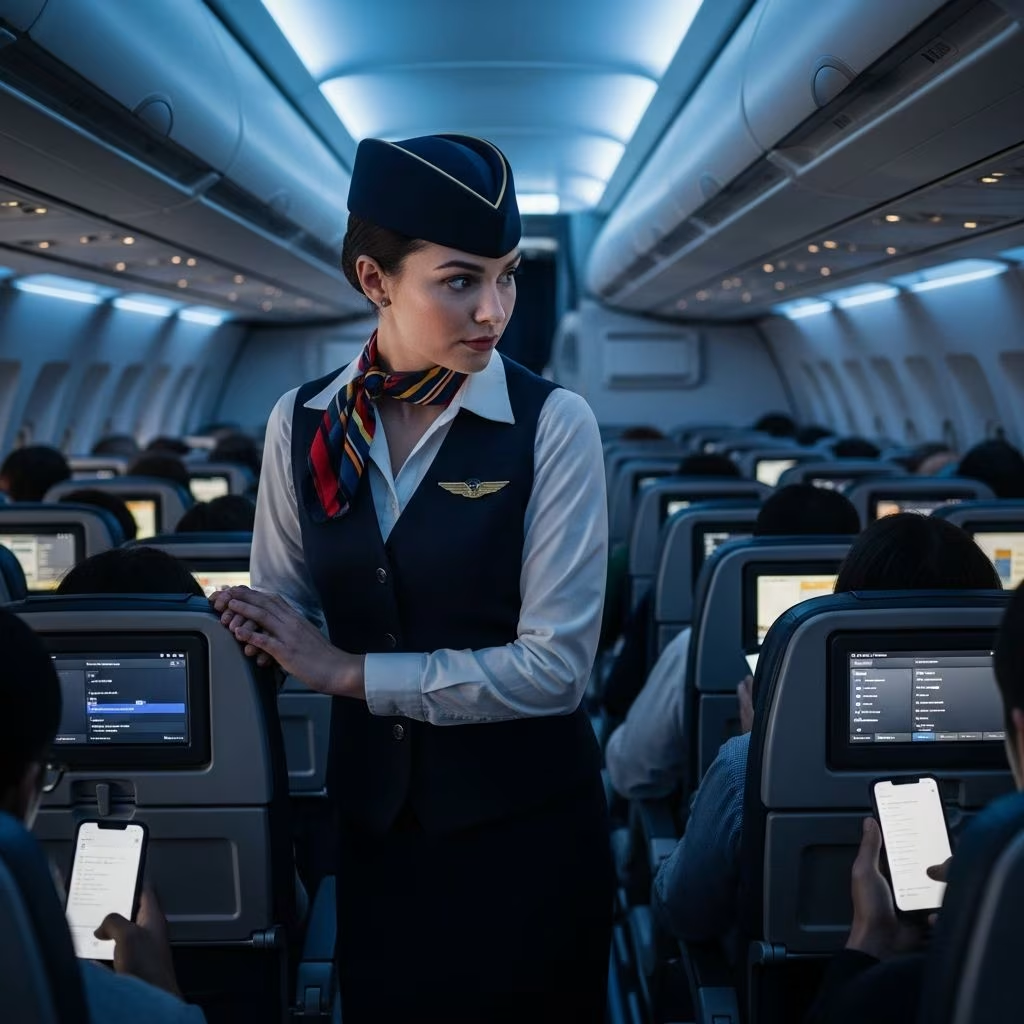
Flight attendants can’t directly detect off-mode phones, but they use visual cues, network counts, and cameras to spot noncompliance.
 Travel Essentials
Flight attendants typically cannot directly detect if individual passenger devices are not in airplane mode, as no standard equipment exists on most aircraft to monitor active phones, tablets, or e-readers in the cabin.
The requirement to switch devices to airplane mode stems from early concerns about radio frequency interference with aircraft navigation and communication systems. In the past, when in-flight WiFi was scarce and comprehensive testing on electronic device impacts was limited, airlines adopted strict policies to eliminate any potential risks. Aviation prioritizes absolute certainty over mere probability, leading to blanket rules even as technology advanced.
Today, extensive testing by bodies like the Federal Aviation Administration (FAA) confirms that modern smartphones and tablets in normal use pose negligible risks to flight safety. Portable electronic devices (PEDs) emit low-power signals that do not significantly affect avionics, especially above 10,000 feet where interference potential drops further. Despite this, the policy endures to maintain uniformity and address edge cases.
Airplane mode disables cellular, WiFi, Bluetooth, and GPS transmissions, preventing any radio emissions. Active devices could theoretically interfere with sensitive onboard systems like GPS receivers or radar altimeters during critical phases such as takeoff and landing. However, real-world incidents are exceedingly rare, with millions of flights annually showing no widespread problems attributable to passenger gadgets.
While no centralized “phone detector” scans the cabin, crews employ practical observation and limited tech aids.
Experienced flight attendants rely on sharp eyesight and pattern recognition. Bright screens, finger movements, or notification sounds betray active use. Cabin lighting dims during announcements, making devices stand out. Regulations require crew access to all areas, enabling discreet patrols.
Newer long-haul aircraft with cellular-based WiFi systems allow crews to activate ground-to-air connections pre-takeoff. Connecting devices automatically link via 3G/4G, revealing connection counts on cockpit or crew displays. This doesn’t identify seats but flags high activity levels, prompting checks. Feature limited to equipped planes like Boeing 787s or Airbus A350s.
Recent installations of cabin cameras, mandated for visibility in larger aircraft, provide real-time feeds to crew stations. Primarily for security, they capture overt use like scrolling or video playback. Regulations from the European Union Aviation Safety Agency (EASA) and FAA encourage such systems without privacy invasions, as feeds are not recorded.
| Method | Effectiveness | Aircraft Type | Privacy Impact |
|---|---|---|---|
| Visual Patrols | High for obvious use | All | Low |
| Network Counts | Moderate (aggregate) | Modern long-haul | Low |
| CCTV | High if active viewing | Newer/Refurbished | Moderate |
Airlines increasingly offer WiFi via satellite or cellular, allowing device use post-takeoff. Systems like Viasat or Gogo require airplane mode with WiFi re-enabled. Crews announce when safe, often after 10,000 feet. Bluetooth headphones pair legally once permitted.
Non-compliance risks verbal warnings, device confiscation, or FAA fines up to $1,500 for willful interference. Repeated offenses could lead to no-fly lists. Crews document incidents, prioritizing safety over confrontation.
Follow instructions to avoid hassle:
Yes, per FAA and ICAO guidelines, to eliminate all risks during sensitive flight phases, though actual danger is minimal.
Bluetooth is off in airplane mode; re-enabling post-cruise is standard and safe.
Turn it off completely or inform crew for assistance.
Yes, if cellular-enabled; most auto-toggle with paired phones.
No, universal policy across FAA/EASA jurisdictions.
While FAA leads in the US, EASA in Europe permits WiFi earlier, and ICAO sets international standards. All emphasize PED policies. Emerging 5G concerns prompted temporary restrictions on certain frequencies near airports.
Advancing shielding and testing may relax rules further. Full 5G integration and bone-conduction audio promise seamless experiences. For now, compliance ensures smooth travels.
