

 Travel Essentials
 Travel Essentials

Discover essential guidelines for carrying power banks on planes, including capacity limits, carry-on requirements, and top compliant options for seamless travel.
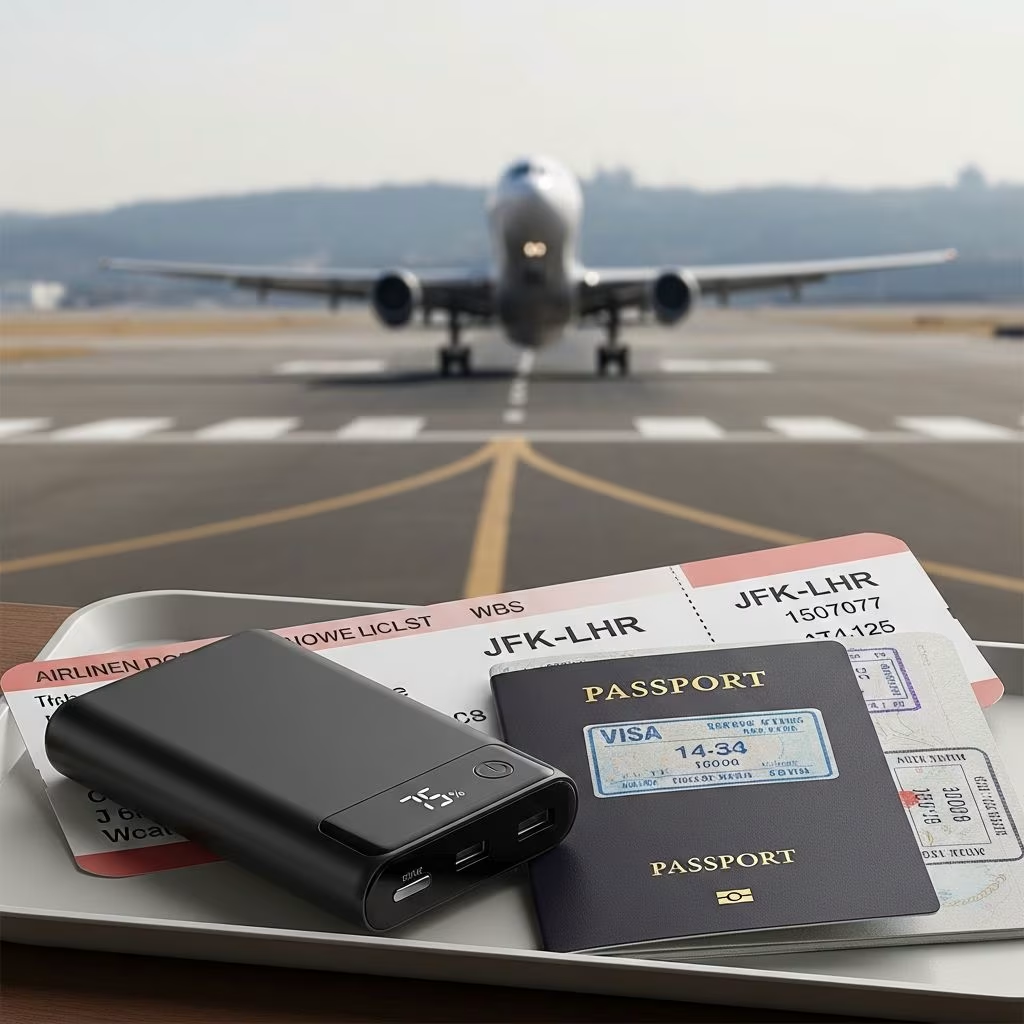 Travel Essentials
Traveling with portable chargers has become essential in our connected world, but strict aviation regulations govern their transport to ensure safety. Power banks, powered by lithium-ion batteries, pose fire risks if mishandled, prompting rules from agencies like the TSA and FAA that mandate carry-on placement and capacity caps. This guide breaks down these requirements, helping you pack smartly and avoid surprises at security.
Lithium-ion batteries can experience thermal runaway, leading to fires, especially if damaged or short-circuited. Aviation authorities prohibit them in checked luggage because baggage holds lack immediate monitoring, unlike cabins where crew can respond quickly. Spare batteries, including power banks, must stay with passengers for oversight.
The FAA emphasizes that all spare lithium batteries and power banks must be carried in the cabin, not stowed below. This aligns with TSA protocols, which classify power banks as prohibited in checked bags due to these hazards. Devices with installed batteries, like laptops, may go in checked luggage if powered off, but spares cannot.
Regulations hinge on watt-hour (Wh) ratings, not just milliamp-hours (mAh). Most power banks under 100Wh require no approval and are freely allowed in carry-ons. Between 101Wh and 160Wh, airlines may permit up to two per passenger with prior consent. Anything over 160Wh is typically banned.
To calculate Wh, multiply voltage (usually 3.7V) by mAh divided by 1000. A 20,000mAh bank at 3.7V equals about 74Wh, well under limits. Labels must clearly show capacity; unlabeled or faded ones risk confiscation.
| Capacity Range | Approval Needed | Max per Person | Allowed Location |
|---|---|---|---|
| Under 100Wh | No | Unlimited (airline discretion) | Carry-on only |
| 101-160Wh | Yes, from airline | 2 spares | Carry-on only |
| Over 160Wh | Generally prohibited | N/A | Not allowed |
Airlines may impose stricter rules, so verify with your carrier.
At checkpoints, remove power banks from bags if requested, just like laptops, for X-ray clarity.
While TSA rules apply to U.S. flights, global carriers follow similar IATA guidelines: carry-on only, 100Wh unrestricted, 100-160Wh approved. Some countries or airlines tighten limits—e.g., certain Asian carriers cap at 160Wh total per passenger. Always cross-check with your itinerary’s operators.
For example, EU regulations mirror FAA standards, prioritizing cabin carry for monitoring. International hubs like Dubai or Singapore enforce labeling rigorously.
Select models with clear specs under 100Wh for hassle-free trips. Popular options include those around 20,000mAh (typically 70-80Wh), sufficient for multiple phone charges. Look for airline-approved designs with safety certifications like UL or CE.
Brands emphasize TSA compliance in marketing, but confirm via official specs.
Imagine a transatlantic flight: A 27,000mAh (100Wh) bank fits perfectly, charging your device mid-flight. For families, multiple small banks distribute load without exceeding per-person caps.
Pro tips:
Yes, as it’s typically under 100Wh and must go in carry-on.
No, TSA and FAA ban them there due to fire risks.
It may be confiscated; always choose labeled models.
Under 100Wh: As needed, per airline; 101-160Wh: Max two with approval.
Similar to TSA, but confirm with carrier for variances.
Batteries degrade over time, increasing risks—replace every 2-3 years. Avoid extreme temperatures, and don’t charge unattended. FAA PackSafe resources offer visuals for proper packing. Informed travelers breeze through security, devices ready for adventures.
