

 Travel Essentials
 Travel Essentials

Explore why opening an airplane emergency door mid-flight is nearly impossible due to pressure differences, with insights from experts and real-world examples.
 Travel Essentials
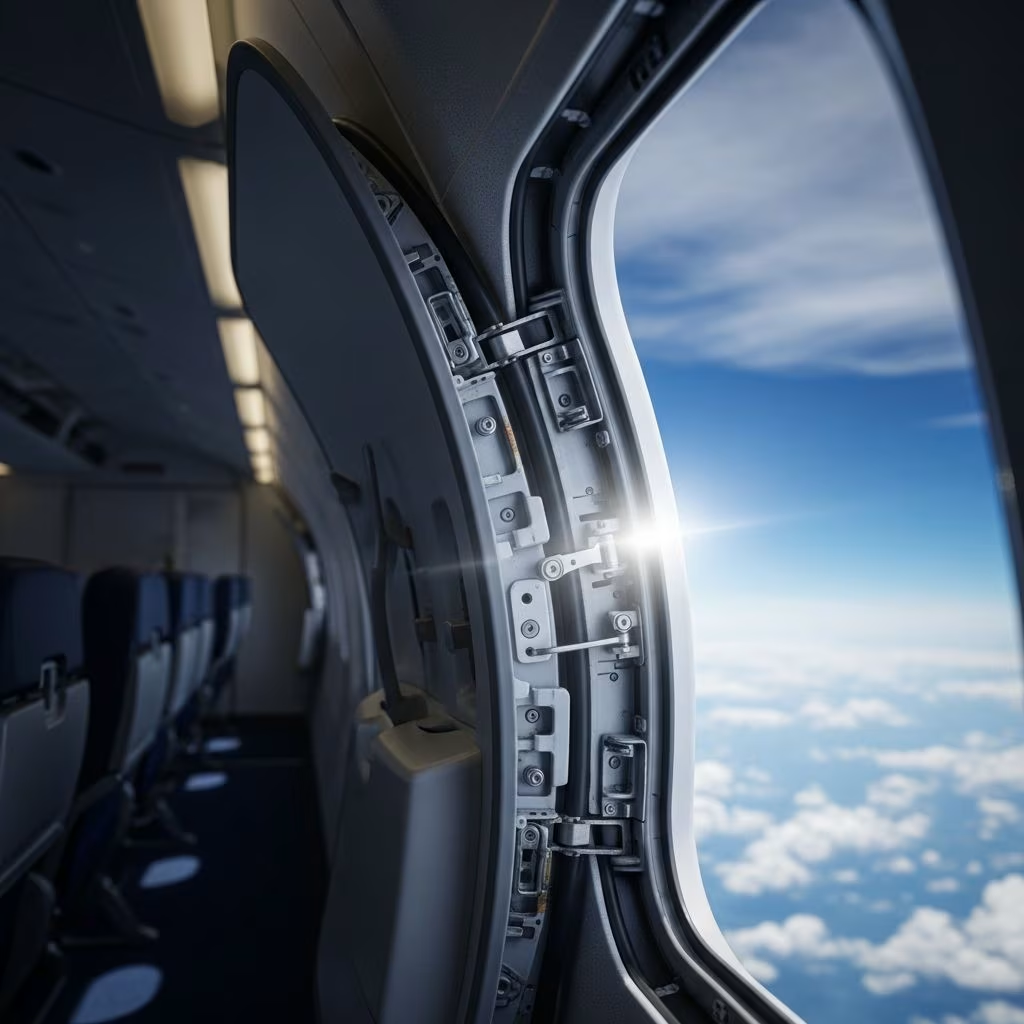
Airplane doors are engineered with multiple safety layers to prevent unauthorized opening during flight, primarily relying on cabin pressurization and mechanical locks. At cruising altitudes, the pressure differential—around eight pounds per square inch—creates a force exceeding 1,100 pounds per square foot, sealing doors firmly inward.
Commercial aircraft maintain cabin pressure equivalent to 6,000-8,000 feet altitude while flying at 30,000-40,000 feet to ensure passenger comfort and oxygen availability. This pressurization pushes doors against their frames, making manual opening impossible without specialized tools or crew intervention.
Doors on most jets, like the Boeing 737 or Airbus A320, open inward before swinging or sliding out, a design mandated by aviation standards to leverage internal pressure as a safety mechanism. Professor Michele Meo from the University of Bath explains that this seal is absolute during cruise, as external atmospheric pressure is far lower.
As aircraft descend below 10,000 feet, cabin pressure equalizes with the outside, reducing the sealing force. At very low altitudes, such as 700 feet, a determined individual might overcome residual pressure—around 2 psi—and mechanical resistance.
Associate Professor Steve Wright from the University of the West of England notes that pilots control door locks via a ‘doors to manual’ command only after landing, adding another barrier.
Several high-profile cases highlight door vulnerabilities during non-cruise phases. In December 2023, on an Asiana Airlines flight approaching Jeju Island at 700 feet, a passenger opened an emergency exit, injuring 12 people amid wind gusts and chaos.
Another event involved a Southwest Airlines passenger who, before takeoff, accessed an overwing exit and jumped onto the wing, prompting immediate crew response and medical evaluation. These incidents occurred when pressure differentials were minimal, underscoring that mid-flight at altitude remains secure.
| Incident | Altitude/Phase | Outcome |
|---|---|---|
| Asiana Airlines, 2023 | 700 ft, approach | 12 injured, safe landing |
| Southwest Airlines | Pre-takeoff | Passenger apprehended |
| American Airlines | In-flight, low alt. | Passengers intervened |
Opening a door triggers rapid decompression if above 10,000 feet, deploying oxygen masks automatically. JetBlue flight attendant Danielle Keenan states that above this threshold, immediate oxygen use is required; below, normal breathing suffices.
On descent or ground, effects include violent wind, object displacement, and potential slide inflation, endangering ground crew. No catastrophic ‘suction’ occurs without pressure difference—passengers won’t be pulled out.
The Federal Aviation Administration (FAA) mandates rigorous door designs under 14 CFR Part 25, requiring doors to withstand pressurization and include fail-safes. Pilots must secure doors before flight, with indicators in the cockpit.
Overwing exits feature similar plugs but arm-disarm mechanisms to prevent premature slide deployment. Violations lead to severe penalties: fines up to $37,000 per incident under FAA rules, potential bans, and criminal charges.
In genuine emergencies, crew train for 90-second evacuations. Doors transition to manual mode post-landing, allowing rapid opening. Historical events, like the 1989 British Airtours fire, refined these protocols, ensuring only trained personnel handle exits.
D.B. Cooper’s 1971 hijacking succeeded because pilots depressurized at 10,000 feet per demands, eliminating pressure barriers—a scenario impossible today with enhanced security.
Movies depict doors flying open with passengers sucked out—a dramatic fiction. In truth, inward-opening plugs and pressure prevent this. Even if opened low, wind is the main hazard, not vacuum.
Fellow travelers often thwart attempts, as on a recent American Airlines flight where quick action stopped a door breach. Crew training emphasizes restraint use and pilot notification, diverting if needed.
Modern aircraft incorporate sensors detecting tampering, alerting cockpits instantly. Biometric locks and AI monitoring are in development, per FAA NextGen initiatives, further fortifying against disruptions.
No, the pressure differential makes it physically impossible for human strength.
Wind rushes in, potentially deploying slides; no major decompression if low altitude.
Yes, cockpit controls maintain security until manual mode post-landing.
Rare; injuries from wind/slides, but no suction fatalities in modern jets.
Fines, flight bans, and possible arrest by authorities.
Understanding door mechanics builds confidence: they’re among aviation’s safest features. Report suspicious behavior to crew, and remember—security starts with awareness.
