

 Travel Essentials
 Travel Essentials

Discover Cartagena's premier annual festival celebrating Carthaginian and Roman heritage with elaborate battle reenactments, parades, and interactive experiences.
 Travel Essentials
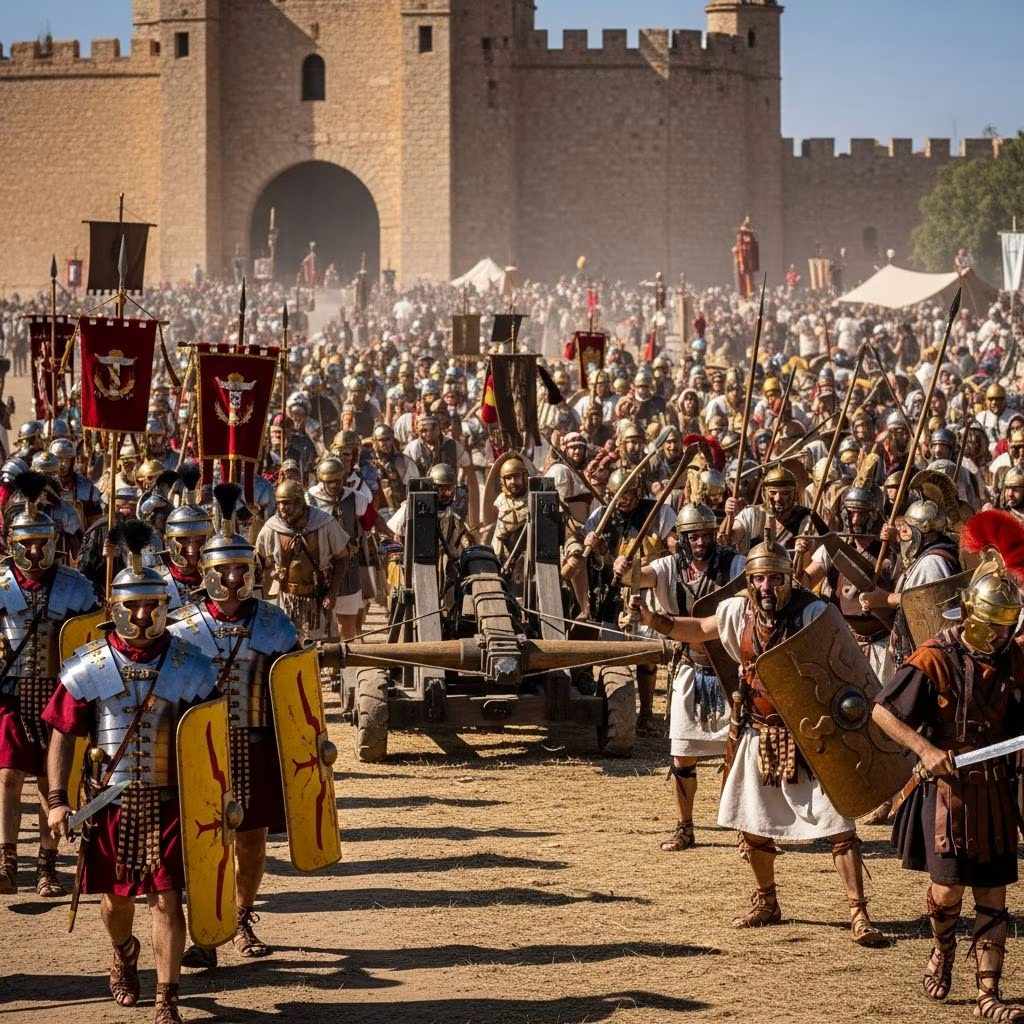
Nestled on Spain’s southeastern coast, the city of Cartagena transforms each September into an open-air theater of ancient history. The Fiestas de Carthagineses y Romanos (Festival of Carthaginians and Romans) stands as one of the most distinctive cultural celebrations in Spain, drawing thousands of participants and visitors who gather to witness the dramatic events that shaped the Mediterranean world over two millennia ago. This isn’t merely a tourist attraction; it represents the genuine passion of Cartagena’s residents to honor their city’s remarkable heritage through immersive storytelling and authentic recreation.
The festival operates as a living museum, where history enthusiasts and casual observers alike can walk through streets lined with ancient combatants, witness ceremonial rituals, and participate in competitions that echo those of classical antiquity. Unlike typical historical museums confined within walls, this celebration sprawls across the entire urban landscape, transforming the fabric of daily city life into a canvas for historical interpretation.
The Festival of Carthaginians and Romans emerged relatively recently compared to many European traditions, first launching in 1990 as a grassroots initiative to celebrate Cartagena’s profound connection to ancient history. What began as a modest reenactment has blossomed into a major cultural phenomenon, earning the prestigious designation of International Tourist Interest status in 2017, cementing its position among Spain’s most important celebrations.
The festival’s creation reflects a deliberate choice by Cartagena’s residents to actively engage with their historical identity rather than allowing it to remain confined to academic texts and archaeological sites. Over more than three decades, the celebration has continuously evolved, incorporating new historical interpretations, expanding participant numbers, and refining the theatrical production values that make each iteration more compelling than the last.
Today, approximately 4,000 residents participate actively in the festival, organized into roughly 50 associations that represent various Carthaginian and Roman military units, civilian groups, and historical figures. This substantial volunteer participation demonstrates the deep community investment in preserving and promoting their ancestral history.
To understand the festival’s significance, one must grasp the historical events it commemorates. The narrative centers on the Second Punic War (218–208 BCE), a pivotal conflict between the expanding Roman Republic and the Carthaginian Empire fighting to maintain dominance in the Mediterranean. The festival’s chronological framework begins around 227 BCE with the founding of Qart Hadasht by the Carthaginian general Hasdrubal, progressing through the dramatic final conquest of the city by Roman General Scipio in 209 BCE.
Qart Hadasht, meaning “new city” in Phoenician, was strategically established as a major Carthaginian stronghold on the Iberian peninsula. The settlement became a crucial base for Carthaginian military operations and represented their ambitions to control trade routes and territorial expansion. However, the city’s fate changed dramatically when Roman legions arrived under Scipio’s command, ultimately leading to the Roman conquest that reshaped the entire region’s political geography.
This historical backdrop provides the emotional and intellectual foundation for the festival’s narrative arc, creating a compelling human drama that resonates across centuries.
The festival unfolds across ten consecutive days during the second half of September, with the 2026 festival scheduled for September 19-28. Rather than occurring as isolated events, the celebration maintains a carefully choreographed narrative progression that builds tension and drama toward climactic confrontations.
The festival commences with the opening Friday events featuring the symbolic Arrival of the Sacred Fire. This ceremony evokes ancient religious practices, with participants transporting flame by boat before a Roman priestess officially ignites the sacred fire atop Cerro del Molinete, one of Cartagena’s five hills. The flame maintains a symbolic presence throughout the ten days, burning at the temple of Isis in the ancient Roman forum district, connecting participants spiritually to the historical period being commemorated.
Accompanying the flame ceremony, elaborate opening parades traverse the city’s main thoroughfares, including the elegant Calle Mayor, where hundreds of costumed participants in full battle regalia march past contemporary fashion boutiques and art nouveau architecture, creating striking juxtapositions between modern and ancient worlds.
The festival’s middle days feature diverse events that showcase both martial and civilian aspects of ancient life. Monday celebrates the wedding of Hannibal and Iberian princess Himilce with festive ceremonies at the Festival Camp, a dedicated area serving as the operational and social hub for all ten days. This celebration honors the historical unions that represented political alliances between Carthaginian and local Iberian powers.
Wednesday programming emphasizes family participation, with children’s competitions and games occurring simultaneously in both Carthaginian and Roman sections of the Festival Camp. These activities ensure younger generations engage directly with historical concepts rather than remaining passive observers.
Thursday marks the dramatic Carthaginian armada’s disembarkation at the harbor, with troops parading toward the Festival Camp in reenactment of Hannibal’s march toward Rome, recreating the ambitious military movements that defined this historical era.
The festival reserves its most spectacular moments for the final weekend. The second Friday features a theatrical harbor rowing competition between Carthaginians and Romans before the Roman Armada arrives and the epic Battle for Qart-Hadasht unfolds, complete with hundreds of warriors engaging in choreographed combat that captures the chaos and courage of actual warfare.
Saturday provides a unique opportunity to see all participants unified in their battle costumes, marching together through city streets, while Sunday concludes the celebration with the Great Roman Circus, featuring chariot races and gladiatorial competitions held within a portable bullring structure. This final event requires advance ticket purchases, distinguishing it from most festival activities that remain free to all attendees.
Central to the festival’s appeal is the Festival Camp, established adjacent to Estadio Cartagonova, where approximately fifty associations maintain headquarters recreating ancient settlements and military encampments. This designated area functions simultaneously as a cultural venue, marketplace, social gathering place, and culinary destination.
Visitors navigate reconstructed ancient streets, visiting craft markets where artisans display goods reflecting historical production methods and materials. Multiple bars and restaurants operate within the camp, offering both traditional Cartagena cuisine and provisions catering to contemporary dietary preferences, allowing visitors to dine while surrounded by historically-costumed participants celebrating between organized events.
The Festival Camp becomes increasingly vibrant after sunset, with evening celebrations and “warrior’s rest” festivities continuing late into the night, particularly during the Feriae Latino Roman celebration. This creates an atmosphere where festival participation extends throughout day and evening hours, fully immersing attendees in the historical narrative.
The festival deliberately maintains accessibility for spontaneous attendance, as the majority of events occur without admission charges, though premium seating for specific performances requires advance tickets. This democratic approach ensures that economic barriers don’t prevent participation from diverse audience segments.
Visitors need not commit to the entire ten-day duration; memorable events occur throughout the festival, allowing flexible scheduling based on individual preferences and availability. The opening and closing events, harbor battle reenactment, and marriage celebration represent particularly significant experiences, though daily programming ensures worthwhile activities across all festival dates.
Festival attendees encounter hundreds of costumed participants in authentic-style armor and period clothing, moving through contemporary city streets in coordinated processions and battle formations. The visual spectacle contrasts sharply with modern surroundings—ancient warriors parade past coffee shops and contemporary retail establishments, creating surreal and compelling imagery that photographers and observers find particularly compelling.
The festival atmosphere combines theatrical production elements with genuine community celebration, avoiding the sterile quality sometimes associated with historical recreations. Participants maintain enthusiasm and energy throughout the ten-day period, suggesting authentic engagement with the historical narrative rather than perfunctory obligation.
Beyond entertainment value, the festival represents Cartagena residents’ determination to maintain active connection with their historical identity in an increasingly globalized world. This celebration asserts that ancient history remains relevant to contemporary communities, worthy of significant time, financial investment, and emotional commitment from thousands of participants.
The festival also positions Cartagena’s archaeological heritage as living culture rather than static museum exhibits. By reenacting historical narratives, residents and visitors develop intuitive understanding of how ancient people experienced their world, what motivated their decisions, and what challenges they confronted. This embodied learning creates deeper comprehension than passive observation alone can achieve.
| Day | Primary Event | Experience Type |
|---|---|---|
| Friday (Opening) | Sacred Fire Ceremony, Opening Parades | Ceremonial, Processional |
| Monday | Hannibal and Himilce Wedding Celebration | Ceremonial, Festival Camp Party |
| Wednesday | Children’s Games and Competitions | Interactive, Family-Oriented |
| Thursday | Carthaginian Armada Disembarkation | Naval Reenactment, Processional |
| Friday (Second) | Rowing Race and Battle for Qart-Hadasht | Competitive, Major Battle |
| Saturday (Second) | Combined Warriors March | Processional, Full Costume Display |
| Sunday (Closing) | Great Roman Circus with Chariot Races | Competitive, Spectacular |
The festival has transformed Cartagena into a significant cultural destination during September, attracting international visitors alongside Spanish domestic tourists and expatriates living in the region. This influx provides economic benefits to local hospitality, retail, and service sectors while simultaneously promoting the city’s archaeological attractions and historical significance.
The International Tourist Interest designation recognizes the festival’s appeal beyond regional audiences, positioning it among Spain’s premier cultural celebrations worthy of dedicated travel planning. This status enhances Cartagena’s competitive positioning among Mediterranean destinations, helping differentiate it from competitors offering similar beach and resort experiences.
Walking through Cartagena during the festival, visitors encounter not merely entertainment but a profound statement about historical continuity. The city’s archaeological sites—Roman forums, Punic fortifications, and cultural artifacts—gain vitality when contemporary residents embody the people who originally created them. This living connection bridges ancient and modern, reminding us that contemporary European civilization grew directly from these historical foundations.
The festival demonstrates that historical celebration need not remain confined to academic study or museum visitation. Instead, communities can claim ownership of their heritage through active participation, transforming streets into stages and residents into historians who teach through performance and embodied experience.
