

 Travel Essentials
 Travel Essentials

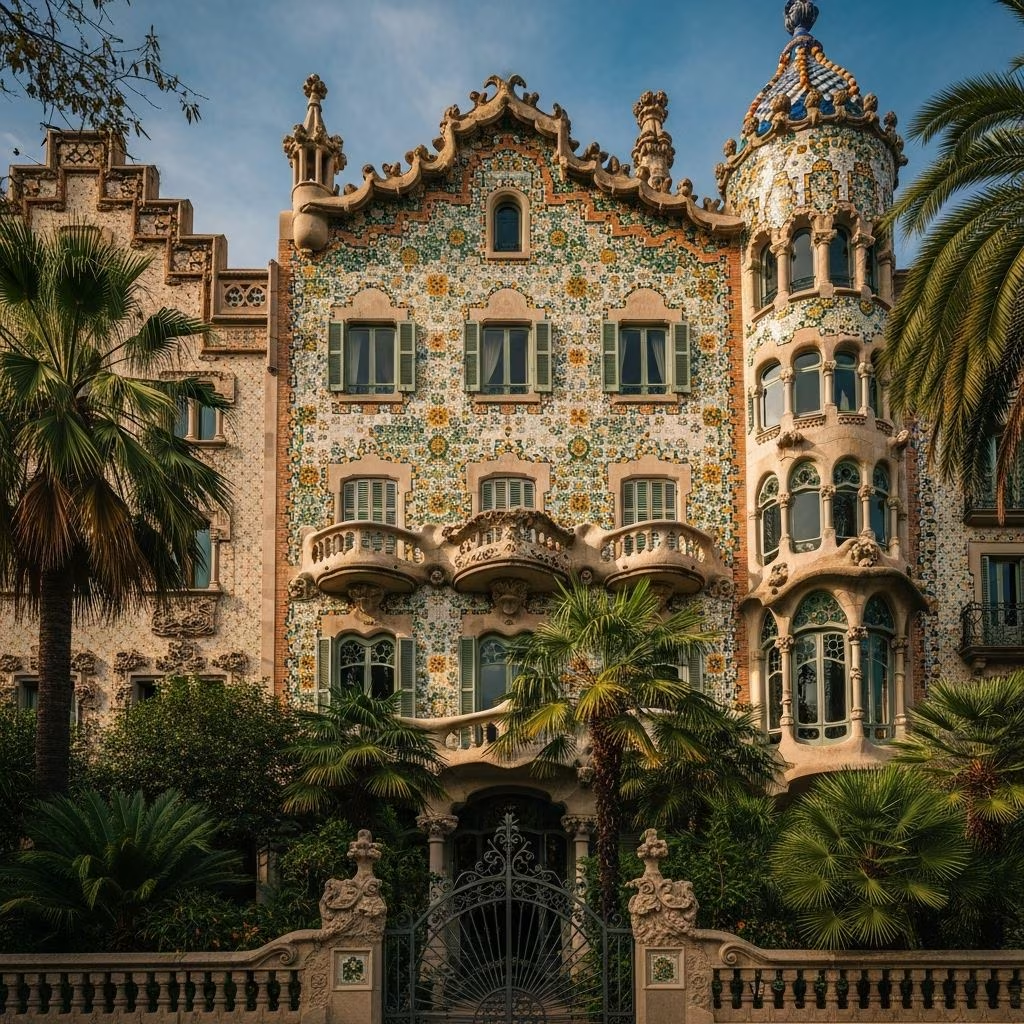
Casa Vicens showcases Gaudí's early genius with bold tiles, organic forms, and Moorish influences. This UNESCO site in Gràcia offers a glimpse into his revolutionary style and Barcelona's modernist legacy.
 Travel Essentials
Antoni Gaudí’s inaugural major commission, Casa Vicens stands as a testament to the budding genius of one of architecture’s most iconic figures. Constructed between 1883 and 1885 in Barcelona’s charming Gràcia neighborhood, this building fuses natural inspiration with bold experimentation, marking the dawn of Catalan Modernisme. Originally a summer retreat for tile magnate Manuel Vicens i Montaner, it now welcomes visitors as a meticulously restored museum, offering intimate insights into Gaudí’s formative years.
Casa Vicens emerged during a transformative period in Barcelona’s history, when the city’s elite sought escapes from urban hustle in the then-independent village of Gràcia. Commissioned by Vicens, a prosperous stockbroker and ceramics entrepreneur, the project allowed a 31-year-old Gaudí to flex his creative muscles on a compact urban plot. Unlike his later grand basilicas and undulating apartments, this was a residential endeavor rooted in practicality yet brimming with whimsy.
Gaudí’s initial sketches date to 1878-1880, but construction kicked off in 1883 under the guidance of architect Joan Martorell, who handed over the reins to his promising protégé. The result was a structure that defied conventions, blending Neo-Mudéjar elements with Gothic Revival touches and an unmistakable Oriental flair. This eclectic mix foreshadowed Gaudí’s evolution into the organic architect whose works define Barcelona’s skyline.
The exterior of Casa Vicens immediately arrests the eye with its riot of green and white tiles, evoking lush vegetation climbing a rocky hillside—a deliberate nod to the site’s natural contours. Gaudí drew inspiration from the surrounding gardens, incorporating motifs of palm fronds, flowers, and iron palm trees that frame windows like metallic foliage. These parabolic arches and wrought-iron palm leaves create a sense of movement, as if the building breathes with the landscape.
This playful yet harmonious exterior not only honored Vicens’s tile business but also showcased Gaudí’s philosophy: architecture as an extension of nature.
Stepping inside reveals Gaudí’s mastery of space, light, and material. The ground floor features a grand smoking room with a coffered ceiling painted in vivid frescoes depicting exotic birds and foliage, illuminated by stained-glass windows that filter sunlight into jewel tones. Vaulted ceilings in the dining area employ catenary arches—curves derived from hanging chains—that would become Gaudí’s structural signature.
Woodwork gleams with intricate carvings of vines and flowers, while brick vaults in the bedrooms blend rustic charm with structural ingenuity. The papier-mâché tiles, a rare surviving Modernisme technique, adorn ceilings with delicate patterns. Every detail, from doorknobs shaped like mushrooms to furniture integrated into walls, underscores Gaudí’s total-design approach.
| Room | Key Features | Gaudí’s Innovation |
|---|---|---|
| Smoking Room | Frescoes, stained glass | Natural light diffusion via parabolic windows |
| Dining Room | Catenary arches, tile floors | Organic structural forms for stability |
| Bedrooms | Brick vaults, carved wood | Integrated furniture for spatial flow |
| Garden Terrace | Palm ironwork, fountains | Blurring indoor-outdoor boundaries |
At Casa Vicens, Gaudí’s obsession with the natural world is palpable. He transformed the modest plot into a verdant oasis, with gardens featuring grottos, fountains, and pavilions that extend the house into the landscape. Floral mosaics, vine-like railings, and fieldstone walls evoke a Catalan countryside idyll, predating his later biomorphic masterpieces like Park Güell.
This proto-organicism stemmed from Gaudí’s studies in nature’s geometries—tree branches, honeycomb structures, and plant cells—which informed his rejection of straight lines in favor of flowing forms. The building’s colors and textures mimic the Mediterranean terrain, harmonizing with Gràcia’s bohemian vibe.
After Vicens’s death in 1895, the house passed through owners who subdivided it into apartments, obscuring Gaudí’s vision. A 1925 expansion added floors, but by 2015, the Mora family launched a restoration to revive the original design. Opened as a museum in 2017, it now includes augmented reality tours and immersive exhibits tracing its evolution.
UNESCO recognized it as part of Gaudí’s Works in 2005, affirming its role in the Modernisme movement. Today, it stands apart from tourist throngs at Sagrada Família, offering a quieter portal to Gaudí’s mind.
Enhanced experiences include VR recreations of the original gardens and workshops on Modernisme crafts.
Though eclipsed by later icons like Casa Batlló (1904-1906) and La Pedrera (1906-1912), Casa Vicens planted seeds for them: colorful mosaics, trencadís (broken tile technique), and nature-inspired curves. It reflects Catalonia’s cultural renaissance, blending local vaulting with Oriental exoticism amid 19th-century industrial boom.
As Gaudí’s first independent commission, it launched his career, influencing a generation of architects. Visiting reveals the spark that ignited Barcelona’s UNESCO-listed portfolio.
Beyond aesthetics, Casa Vicens offers a narrative of innovation on a human scale. In Gràcia’s village-like streets, it feels intimate, allowing contemplation of Gaudí’s evolution from orientalist phase to full organic modernism. For design enthusiasts, it’s a masterclass in materiality; for families, a colorful playground of discovery.
Its restoration exemplifies heritage preservation, using original techniques to revive lost splendor. In a city of spectacles, this understated gem rewards the curious with profound architectural poetry.
Yes, it’s his first major independent project, built 1883-1885, though he contributed to earlier works.
More orientalist and geometric than the fluid organicism of Sagrada Família or Park Güell, yet previews key motifs.
Partially; restored terraces and grottos are accessible, enhanced by AR for original vision.
Metro L3 to Fontana (5-min walk) or FGC to Gràcia; ample nearby parking scarce.
Yes, without flash indoors; drones prohibited.
1-2 hours ideal; guided tours extend to 90 minutes.
