

 Travel Essentials
 Travel Essentials

A comprehensive guide to Central Asia's five republics, covering geography, culture, travel logistics, and planning strategies for first-time visitors.
 Travel Essentials
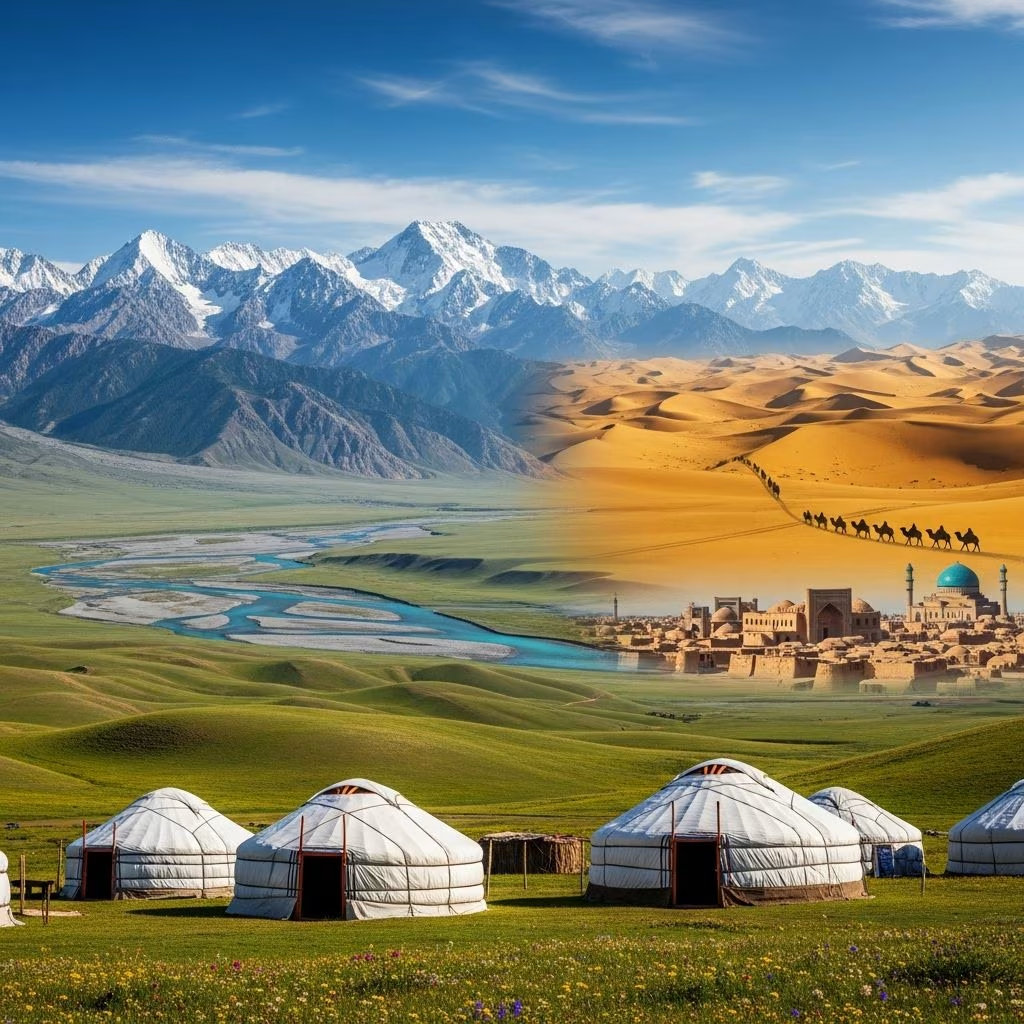
Central Asia represents one of the world’s most compelling yet underexplored travel destinations, offering an extraordinary blend of historical significance, natural grandeur, and authentic cultural experiences. The region, commonly referred to as the Five Stans, encompasses Kazakhstan, Uzbekistan, Tajikistan, Kyrgyzstan, and Turkmenistan—five independent republics that collectively form the geographical and cultural heart of Asia. These nations share a complex history intertwined with the legendary Silk Road, nomadic traditions, and the remnants of Soviet influence, creating a destination that challenges conventional travel narratives and rewards curious explorers with unforgettable encounters.
The five Central Asian republics occupy a vast continental expanse characterized by dramatic topographical variation and distinct cultural identities. Kazakhstan, the largest by area, spans from the Caspian Sea across endless steppes to mountainous regions in the east. Uzbekistan, positioned in the region’s heart, serves as the primary cultural hub, containing the most significant historical sites and urban centers. Kyrgyzstan captivates visitors with its mountainous terrain, where over three-quarters of its territory features the majestic Tien-Shan and Pamir Alay mountain ranges. Tajikistan, equally mountainous, includes the famous Pamir Highway—a legendary route attracting adventure seekers worldwide. Turkmenistan, the most isolated and least visited republic, maintains unique traditions and archaeological treasures largely unknown to international travelers.
The region’s geography extends far beyond standard expectations. Rather than homogeneous landscapes, Central Asia presents vast deserts, enormous mountain ranges, expansive valleys, and endless plains—everything on an epic scale. This diversity creates multiple travel experiences within a single region, allowing visitors to traverse radically different environments and ecosystems during a single journey.
Understanding Central Asia requires recognizing its historical role as the crossroads of civilizations. The legendary Silk Road trade routes that connected China with Western markets traversed these territories, facilitating not merely commercial exchange but profound cultural, religious, and intellectual transmission. This historical importance manifests in contemporary urban centers throughout the region, particularly in Uzbekistan, where ancient cities preserve remarkable architectural and cultural heritage.
The Silk Road’s legacy permeates contemporary Central Asia, influencing everything from urban planning to cultural practices. Cities like Samarkand, Bukhara, and Khiva contain some of the most exquisite examples of Islamic architecture and Eastern artistry, representing concentrated repositories of historical mastery. These destinations attract history enthusiasts, architectural photographers, and cultural researchers seeking tangible connections to pre-modern global commerce and exchange.
Successfully traveling through Central Asia requires understanding the region’s transportation infrastructure and customs. The most prevalent method involves using marshrutkas and shared taxis—minivans that depart designated locations when reaching capacity rather than operating on fixed schedules. While initially disorienting to Western travelers, this system proves cost-effective and deeply integrated into local travel culture. Identifying departure points typically involves consulting local residents or accommodation staff, as schedules remain informal and location-dependent.
Rail networks represent a more structured transportation alternative, particularly within Kazakhstan and Uzbekistan, which maintain the region’s most developed railway systems. Trains offer comfort advantages over shared transportation and provide lower-stress travel compared to the notoriously unpredictable road conditions characteristic of Central Asian driving. For adventurous travelers, cycling across the Pamir Highway and other rural routes presents an increasingly popular option, particularly among international cyclists pursuing bucket-list experiences.
Hitchhiking remains fairly common throughout Central Asia, though with important caveats. In most regions, drivers expect nominal compensation, as vehicle owners routinely function as informal taxi operators. Organized tours provide valuable alternatives for travelers facing language barriers or time constraints, offering logistical coordination and enhanced enjoyment of complex regions like Afghanistan or remote mountain areas.
Determining appropriate trip duration significantly impacts the quality and depth of Central Asian experiences. Visiting all five republics comfortably requires a minimum three-week commitment, allowing adequate time to appreciate each region’s highlights—from Kazakhstan’s Kolsai Lakes to Samarkand’s magnificent minarets and madrassas. This timeframe permits the cultural immersion and natural exploration that Central Asia demands for meaningful engagement.
For travelers with limited availability, combining Uzbekistan and Kyrgyzstan within a 7-10 day window offers an excellent introduction to the region’s defining characteristics. This pairing effectively demonstrates Central Asian history, culture, and landscape diversity, providing representative experiences across distinct geographic and cultural zones. Uzbekistan contributes historical and cultural dimensions, while Kyrgyzstan offers mountain scenery and nomadic cultural insights.
| Trip Duration | Recommended Focus | Experience Level |
|---|---|---|
| 7-10 days | Uzbekistan and Kyrgyzstan | Introduction |
| 2-3 weeks | All five republics | Comprehensive |
| 1 month+ | All republics plus adjacent regions | Intensive |
Almaty, Kazakhstan’s largest city, functions as the optimal entry point for most Central Asian itineraries. Its geographic position, excellent connectivity, affordability, and abundance of activities make it an ideal foundation for regional exploration. The city’s famous subway system, featuring ornate tiled murals and grand vaulted ceilings, provides cultural interest beyond typical urban infrastructure. Moreover, Almaty’s immediate surroundings offer exceptional day-trip and hiking opportunities in accessible mountain terrain, allowing visitors to combine urban exploration with natural immersion seamlessly.
Starting from Almaty eliminates logistical complications associated with alternative gateways while positioning travelers favorably for onward movement throughout the region. The city provides necessary services, comfortable accommodations, quality dining options, and reliable tourist infrastructure—advantages particularly valuable for first-time Central Asia visitors still acclimating to regional travel dynamics.
Central Asia’s cultural composition reflects fascinating historical layering, combining ancient nomadic traditions with Soviet-era urbanization. Remote villages and nomadic communities throughout the region maintain traditional practices largely unchanged from preceding centuries, offering authentic encounters with historical ways of life. Simultaneously, the region contains distinctive Soviet-style cities, complete with monumental architecture commemorating historical figures and ideological commitments of the Soviet period.
This cultural duality creates unique travel experiences unavailable elsewhere. Visitors traverse landscapes encompassing both ultra-modern urban developments and virtually unchanged traditional settlements, observing how contemporary Central Asians navigate between globalization and cultural preservation. Understanding this tension provides essential context for interpreting regional dynamics and appreciating the sophistication of contemporary Central Asian society.
Kyrgyzstan stands unparalleled among Central Asian destinations for natural beauty concentration. The Pamir Highway, frequently cited among the world’s most spectacular mountain routes, traverses landscapes of stunning alpine scenery, crystalline lakes, and dramatic peaks. Beyond this legendary highway, Kyrgyzstan offers abundant mountainous terrain suitable for trekking, horseback riding, and mountain climbing at various difficulty levels.
The Wakhan Valley and Wakhan Corridor in adjacent Afghanistan represent additional natural attractions for intrepid travelers, featuring verdant landscapes and geographic formations remarkably untouched by human development. These regions, while requiring careful planning and heightened security awareness, offer access to some of Asia’s most pristine wilderness areas.
Uzbekistan’s major urban centers—Samarkand, Bukhara, Khiva, Tashkent, and Shakhrisabz—concentrate the region’s most significant cultural and historical treasures. These cities represent repositories of Eastern architectural mastery, featuring intricate tilework, soaring minarets, and madrassas (Islamic schools) that exemplify Islamic artistic traditions at their finest. Samarkand particularly stands as a superlative destination, its blue-tiled domes and ancient bazaars immediately recognizable and culturally iconic.
These destinations attract not merely tourists but serious students of Islamic architecture, history, and decorative arts. The concentration of masterpieces within these relatively compact urban areas makes them extraordinarily efficient bases for cultural tourism, permitting visitors to encounter numerous significant sites within walking distance.
Successfully navigating Central Asia requires addressing several practical dimensions. Language barriers exist but prove manageable, particularly in tourist-frequented areas and major cities where English speakers increasingly work in hospitality sectors. Learning basic phrases in Russian or local languages significantly enhances experiences and demonstrates respectful cultural engagement.
Currency exchange, accommodation quality, and food availability vary significantly across the region. Major cities offer international standards of comfort and amenities, while rural areas require flexibility and adaptation to more basic conditions. Vaccination recommendations, visa requirements, and border crossing procedures vary by nationality and destination country, necessitating careful advance research and preparation.
Despite potential logistical challenges, Central Asia consistently impresses first-time visitors as remarkably accessible and genuinely welcoming. The region’s relative lack of international tourism paradoxically enhances visitor experiences through authentic interactions and uncrowded attractions, while established infrastructure in primary destinations ensures functional travel experiences.
Central Asia represents an increasingly attractive destination for adventurous travelers seeking authenticity, historical depth, and natural grandeur beyond conventional tourist circuits. The region’s combination of Silk Road heritage, dramatic mountain landscapes, nomadic cultural traditions, and Soviet historical layers creates multidimensional travel experiences rivaling any global destination. Whether pursuing historical scholarship, mountain adventure, cultural immersion, or simple escape from familiar environments, Central Asia delivers profound and transformative experiences.
The five republics collectively represent one of Asia’s most compelling frontiers, offering intelligent travelers opportunities for meaningful engagement with fundamentally different ways of living, thinking, and experiencing the world. As international interest in Central Asia gradually increases, early visits capture experiences still characterized by authentic human contact and underdeveloped tourism infrastructure—advantages increasingly rare in globally connected travel landscapes.
