

 Travel Essentials
 Travel Essentials

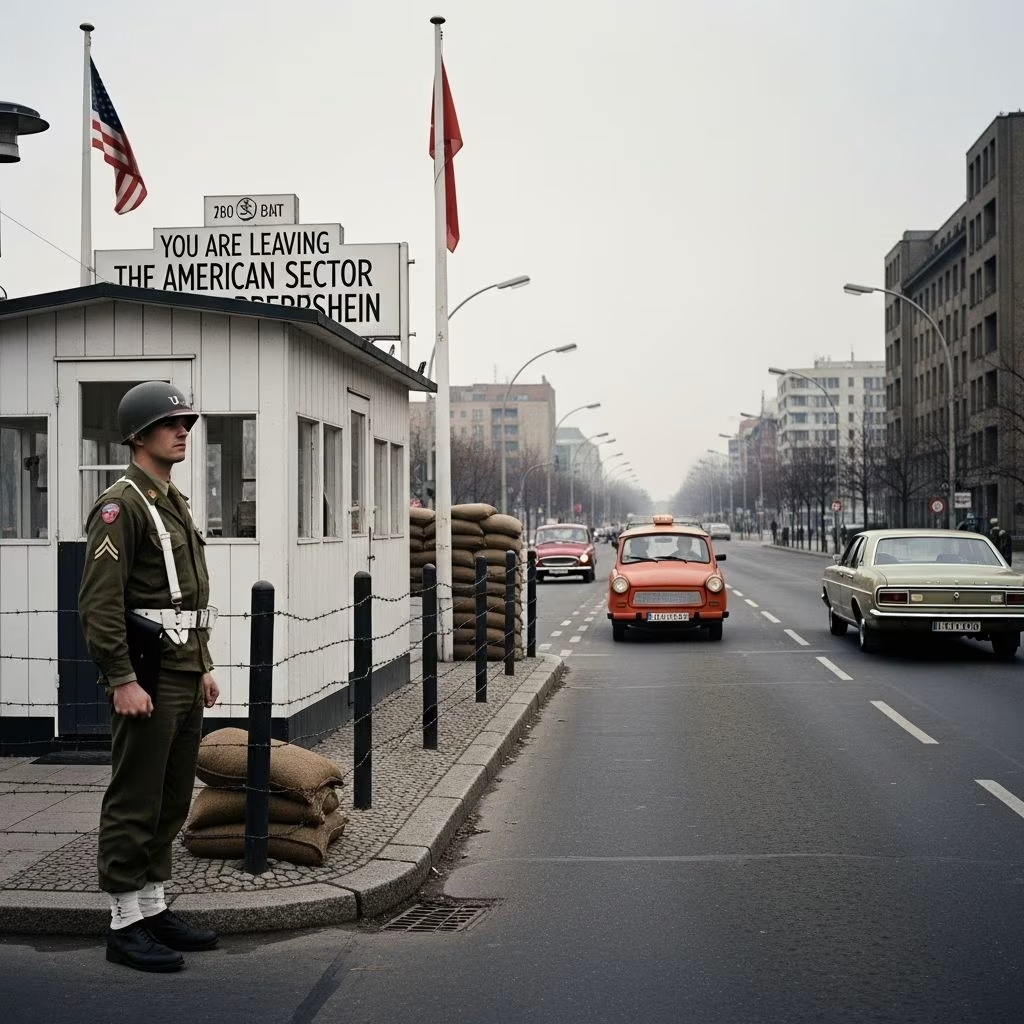
Explore Checkpoint Charlie’s role as Berlin’s most symbolic Cold War crossing, where tank standoffs, border control, and history converged.
 Travel Essentials
Nestled at the intersection of Friedrichstraße and Zimmerstraße in Berlin lies one of the world’s most recognizable symbols of Cold War division. Checkpoint Charlie served as the primary border crossing between East and West Berlin for nearly three decades, becoming far more than a simple checkpoint—it transformed into a living representation of ideological confrontation, geopolitical tension, and ultimately, the resilience of human determination to cross barriers both physical and political.
When the Allied forces divided Berlin following World War II, the city became a complex patchwork of occupational zones. The United States controlled the southwestern sector, Britain managed the western regions, France held the northwestern areas, and the Soviet Union maintained authority over the eastern portion. This division, initially intended as a temporary administrative arrangement, would persist for decades and create one of the era’s most visible symbols of global conflict.
The designation of Checkpoint Charlie emerged from practical military logistics and NATO’s phonetic alphabet system. After the establishment of crossing points at Helmstedt-Marienborn (designated Alpha) and Dreilinden-Drewitz (designated Bravo), Checkpoint Charlie became the third Allied checkpoint in the Berlin region. Its naming convention reflected the systematic approach Western powers took to organizing their military presence in the divided city.
The checkpoint’s significance intensified dramatically when East Germany, seeking to stem the exodus of its population to the West, constructed the Berlin Wall on August 13, 1961. Within two days, permanent concrete barriers replaced the initial barbed-wire installations. This monumental act of division transformed Checkpoint Charlie from a routine border crossing into the frontline of Cold War confrontation.
The East German government established Checkpoint Charlie with explicit restrictions on who could utilize the crossing point. Initially, the location served exclusively as a passage for Western Allied military personnel, accredited diplomats, and foreign nationals. This calculated limitation reflected East Germany’s strategy to control movement while maintaining the façade of diplomatic normalcy.
The Western Allies protested this restriction, asserting their guaranteed rights of movement throughout Berlin based on the city’s four-power status agreement. Despite their objections, the Allies eventually accepted the arrangement and established their own checkpoint on the West Berlin side, creating a mirrored security apparatus that would characterize the checkpoint for decades.
American military police personnel typically manned the Western checkpoint, performing identity verification and documentation checks. On the Eastern side, the arrangement differed significantly—while American soldiers stood guard at their posts, no corresponding Soviet military presence operated the East German checkpoint. Instead, East German border police and security officials managed access from their perspective, creating an asymmetrical arrangement that reflected broader Cold War dynamics.
The most dramatic episode in Checkpoint Charlie’s history occurred just months after the Wall’s construction, when tensions between superpowers escalated to unprecedented levels. In late October 1961, a seemingly routine dispute over military access rights triggered an extraordinary military mobilization.
East German authorities began systematically preventing American military personnel dressed in civilian clothing from crossing into East Berlin. When uniformed American military police arrived to escort these individuals through the checkpoint, East German forces would forcibly turn them away. This pattern of confrontation repeated multiple times over several days, testing American resolve and threatening to destabilize the precarious balance of power in Berlin.
The situation reached a critical juncture on October 25, 1961, when American military leadership decided to demonstrate its determination to maintain access rights. The U.S. Army deployed ten M-48A1 tanks and three M-59 armored personnel carriers to Checkpoint Charlie—a display of force designed to communicate American commitment to freedom of movement throughout Berlin. The tanks advanced to the checkpoint but then withdrew within minutes, a tactical maneuver that nonetheless signaled serious American intent.
This American show of force prompted an immediate Soviet response. Hours later, Soviet tanks rolled into opposing positions at Checkpoint Charlie, creating a scenario that had seemed confined to Cold War nightmares. For more than 24 hours, American and Soviet armored vehicles sat barely one hundred yards apart, their main guns trained directly on each other. The world’s attention fixed on this small Berlin intersection, recognizing that the line separating Cold War rhetoric from actual military conflict had become dangerously thin.
What prevented catastrophe during these tense hours remains partially attributable to secret diplomatic negotiations conducted simultaneously with the military standoff. Behind the scenes, American and Soviet leadership engaged in careful communication, each superpower seeking an exit strategy that would allow both sides to claim victory while avoiding actual combat. These parallel channels of communication proved essential—they allowed military posturing to continue without crossing the threshold into open warfare.
On the morning of October 28, 1961, Soviet tanks withdrew from their positions. Shortly afterward, American armor pulled back as well. The confrontation ended as swiftly as it had begun, but its implications resonated throughout the Cold War era. The episode demonstrated that the Soviet Union, not the East German government, wielded ultimate authority over Berlin’s division. It confirmed American willingness to risk direct military confrontation to maintain its position in the city. And it revealed the terrifying proximity at which Cold War tensions could approach actual shooting war.
Beyond its role as an actual border crossing, Checkpoint Charlie functioned as a symbolic stage where Cold War ideology played out continuously. The checkpoint represented competing visions of freedom, security, and national sovereignty. For the West, it symbolized persistence in defending Western values and maintaining access to an isolated allied population. For the East, it represented the necessity of controlling borders to prevent the “brain drain” that threatened the viability of socialist society.
The checkpoint’s evolution reflected broader Cold War trends. As initial tensions gradually moderated, the checkpoint transformed from a potential flashpoint into a managed intersection of two competing systems. Thousands of diplomats, military personnel, and authorized civilians crossed through Checkpoint Charlie annually, each crossing reinforcing the reality of division while simultaneously maintaining fragile lines of communication between opposing superpowers.
Decades after the Cold War’s conclusion, Checkpoint Charlie retains powerful symbolic resonance. In the summer of 1990, at the very location where tanks had faced each other with hostile intent, foreign ministers of the four victorious powers negotiated an end to German division. The transformation from military confrontation to diplomatic reconciliation at this identical location underscored how dramatically global circumstances could change.
Today, Checkpoint Charlie functions as a primary destination for Berlin tourists seeking connection to Cold War history. A famous light box installation by photographer Frank Thiel displays an iconic portrait of a former American sergeant who served at the checkpoint. This artistic intervention, featuring both American and Soviet soldiers, attracts millions of visitors annually who recognize in these images the human dimension of Cold War tension and division.
The photograph chosen for permanent display captures Jeff Harper, a young American serviceman who arrived in Berlin during the military tension of the early 1960s. Harper’s presence in the installation serves an important function—it personalizes the abstract concept of Cold War confrontation, reminding visitors that real people stood at these borders, executing orders while aware they might be participating in history’s most dangerous moment.
Checkpoint Charlie’s historical significance extends beyond its immediate Cold War context. The checkpoint reminds contemporary observers of how quickly military tensions can escalate, how fragile peace can be when ideological differences create fundamental distrust, and how accidents or miscalculations can transform political crises into military confrontations with potentially catastrophic consequences.
The checkpoint also illustrates how symbols accumulate meaning through historical events. A simple border crossing became a powerful representation of global division because extraordinary events occurred there and because its location embodied larger historical forces reshaping the world.
The operational procedures at Checkpoint Charlie reflected sophisticated Cold War bureaucracy. Different categories of crossing permits existed for military personnel, diplomats, and foreign civilians. Documentation requirements varied based on citizenship and authorization level. The checkpoint thus functioned not merely as a physical barrier but as an administrative apparatus through which Cold War regulations were enforced daily.
American military police personnel received specialized training for checkpoint operations, requiring them to make split-second decisions about authorization and potential security threats. These soldiers confronted the ideological division embodied in their posting—standing at a barrier separating not just geography but competing political and economic systems.
The significance of Checkpoint Charlie transcends Berlin or even Cold War history. The checkpoint represents a moment when humanity stood on the precipice of direct superpower military conflict. The October 1961 tank standoff demonstrated that ideological competition could rapidly escalate toward actual warfare. This recognition shaped Cold War policy for decades, encouraging both superpowers to develop crisis communication mechanisms and to approach confrontations with heightened awareness of potential consequences.
The checkpoint’s ultimate closure—not through conflict but through the peaceful collapse of the Wall and the end of Cold War division—offered a different historical lesson. It demonstrated that even entrenched divisions rooted in ideological opposition could be resolved peacefully when historical circumstances shifted sufficiently.
Contemporary visitors to Checkpoint Charlie encounter multiple layers of historical memory. The original checkpoint building no longer stands, but reconstructions provide visual reference points for understanding the site’s historical appearance. The Frank Thiel light box installation serves as the primary artistic intervention, offering visitors both aesthetic experience and historical context.
The site functions as an open-air museum of sorts, with information panels explaining historical events and the checkpoint’s significance. Tour guides routinely incorporate Checkpoint Charlie into broader Berlin Wall narratives, helping visitors understand how this single checkpoint represented larger Cold War struggles.
For many visitors, Checkpoint Charlie represents a touchstone connecting them to a dramatic historical period. The ability to stand at the actual location where tanks faced each other, where Kennedy stood looking into East Berlin, and where countless individuals crossed between two worlds, creates powerful emotional and intellectual connections to history.
