

 Travel Essentials
 Travel Essentials

Explore China's most remarkable high-speed rail routes connecting diverse regions, from ancient capitals to modern megacities, showcasing engineering excellence.
 Travel Essentials
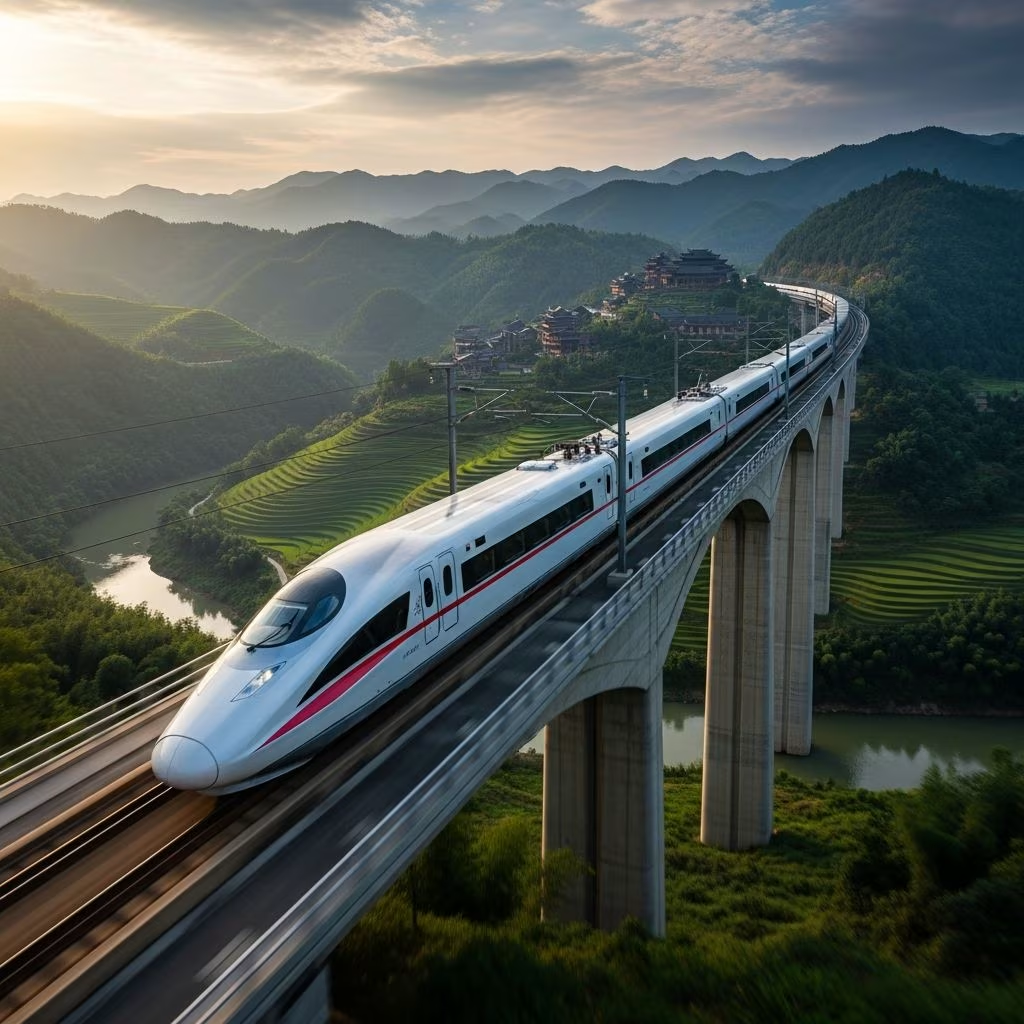
Over the past decade, China has revolutionized continental travel through an ambitious infrastructure expansion that has fundamentally transformed how millions of people move across the country. The nation now operates the world’s most extensive high-speed rail network, comprising over 22,000 kilometres of track that connects remote mountainous regions with bustling metropolitan centres. This engineering marvel represents not merely a transportation achievement but a gateway to experiencing China’s extraordinary geographical and cultural diversity in ways previously unimaginable.
China’s commitment to high-speed rail technology represents a strategic national initiative that has reshaped travel patterns across the continent. The introduction of the Fuxing train system in 2017 marked a watershed moment, establishing China as the undisputed leader in rail transportation technology. These cutting-edge trains operate at speeds reaching 350 kilometres per hour, fundamentally reducing travel times between major urban centres and making previously distant destinations accessible for day trips and weekend excursions.
The technological sophistication embedded within these rail systems extends beyond mere velocity. Modern Chinese high-speed trains incorporate advanced safety mechanisms, climate control systems, and passenger amenities that rival aviation experiences while maintaining the comfort and spaciousness that rail travel traditionally offers. The investment in this infrastructure reflects a broader vision of sustainable transportation that reduces carbon emissions while enhancing connectivity across regions.
The Beijing to Kunming route stands as the longest high-speed rail journey currently operating globally, representing an extraordinary passage through China’s most geographically and culturally significant territories. This epic voyage covers more than 2,700 kilometres in approximately 11 hours, allowing passengers to witness the transformation of landscape and culture without the fatigue associated with extended travel.
Departing from China’s imperial capital, the train embarks on a southwestward trajectory through industrial Hebei province before penetrating the historic Henan region, where the legendary Yellow River bisects the landscape. The journey continues through Hunan province—birthplace of revolutionary figure Mao Zedong—and subsequently enters the spectacular karst geological formations of Guizhou, where dramatic limestone peaks create an otherworldly panorama. The final destination, Kunming, represents the gateway to Yunnan province, a region renowned for its ethnic diversity and natural splendour.
The route’s nomenclature—the Shangri-La Train—honours one of Yunnan’s most mythical destinations, a place of legendary beauty nestled within mountainous terrain that future rail connections will make increasingly accessible.
The journey connecting Nanjing and Chengdu represents a fascinating intersection of natural wonder and cultural heritage. Spanning 1,690 kilometres in approximately 12 to 13 hours, this route traverses regions steeped in both historical significance and contemporary vitality.
Originating in Nanjing—a city layered with complex historical narratives of both imperial grandeur and wartime tragedy—the train accelerates through the Yangzi River basin toward Chongqing, an enormous metropolitan region serving as the crucial junction between eastern and southwestern China. From this strategic gateway, the route penetrates into Sichuan province’s mountainous heartland, ultimately arriving in Chengdu, home to the internationally renowned Giant Panda Breeding and Research Base. This destination has become synonymous with wildlife conservation and provides passengers with opportunities to observe these iconic creatures in carefully managed environments.
Representing the first high-speed rail extension into China’s expansive western regions, the Ürümqi to Lanzhou route stretches 1,776 kilometres and completes its journey in just under 12 hours. This remarkable achievement in infrastructure development opens previously isolated regions to contemporary transportation networks while honouring ancient trade routes that shaped civilization itself.
The journey follows pathways originally traversed by Silk Road merchants, passing through the historic oasis town of Turpan, located at 154 metres below sea level—geographically the lowest point in China. The train subsequently races through the Hexi Corridor at Zhangye, where passengers can observe the otherworldly rainbow-hued geological formations of Danxia National Geopark. The route’s most dramatic engineering achievement involves crossing the Qilian Mountains, where the track itself reaches 3,607 metres above sea level, establishing the distinction of being the world’s highest high-speed rail track.
Spanning 1,623 kilometres and requiring approximately 12 hours of travel time, the Shanghai to Hong Kong route showcases China’s prosperous southern seaboard and connects two of Asia’s most dynamic metropolitan centres. This connection weaves through Zhejiang, Fujian, and Guangdong provinces, regions historically significant for maritime commerce and contemporary economic dynamism.
The journey represents more than mere transportation; it symbolizes the economic integration of China’s most developed coastal regions and facilitates both tourism and business connectivity on an unprecedented scale.
One of China’s longest high-speed rail journeys connects Shanghai in the prosperous south with Harbin in the frozen north, spanning 2,400 kilometres in approximately 12 hours. This epic traverse encompasses remarkable geographical and climatic diversity, journeying through eastern seaboard provinces of Jiangsu and Shandong.
The route encompasses cultural landmarks of international significance, including Suzhou, celebrated for its imperial gardens and historic canal systems. Along the pathway lies Tai’an, the traditional departure point for expeditions to Tai Shan, revered as the holiest of China’s five sacred Taoist mountains.
When it commenced operations in 2015, the Hainan island circular high-speed railway represented a global first—the world’s inaugural circular high-speed railway line. This unique route circumnavigates China’s tropical island, positioned geographically between Guangdong province and northern Vietnam.
Portions of this route traverse parallel to coastal expanses, offering passengers unobstructed vistas of the South China Sea—a distinctive feature that elevates the journey beyond mere transportation into experiential tourism.
| Route Name | Distance (km) | Duration | Primary Highlights |
|---|---|---|---|
| Beijing-Kunming | 2,700+ | 11 hours | Mountains, rivers, karst formations |
| Nanjing-Chengdu | 1,690 | 12-13 hours | Ancient capitals, panda reserves |
| Ürümqi-Lanzhou | 1,776 | 12 hours | Silk Road heritage, highest track |
| Shanghai-Hong Kong | 1,623 | 12 hours | Coastal megacities, Fujian province |
| Shanghai-Harbin | 2,400 | 12 hours | Seaboard diversity, sacred mountains |
| Hainan Island Circular | Variable | Variable | Tropical coastline, island circumnavigation |
Modern high-speed trains operating across these routes incorporate sophisticated engineering features that enhance both safety and comfort. The Fuxing trainsets represent the pinnacle of contemporary rail technology, offering passengers spacious seating arrangements, advanced dining facilities, and climate control systems that maintain optimal environmental conditions throughout extended journeys.
These trains operate on dedicated rail corridors engineered to support sustained high-velocity travel while maintaining exceptional safety standards. The infrastructure supporting these routes includes sophisticated signalling systems, collision-avoidance mechanisms, and comprehensive maintenance protocols that ensure consistent operational reliability.
Contemporary Fuxing trainsets achieve maximum operational speeds of 350 kilometres per hour on dedicated high-speed corridors, enabling rapid intercity connectivity.
The Beijing to Kunming route spans over 2,700 kilometres and requires approximately 11 hours to complete, making it currently the world’s longest operational high-speed rail journey.
This route represents the first high-speed rail extension into China’s western regions and includes the world’s highest high-speed rail track at 3,607 metres elevation.
Yes, international visitors can purchase tickets through designated travel agencies, hotel concierge services, or official railway booking platforms with assistance from English-speaking personnel.
Most primary routes operate multiple daily departures, with schedules varying based on day of week and seasonal demand patterns, ensuring flexibility for diverse travel requirements.
China’s investment in high-speed rail infrastructure represents a significant commitment to sustainable transportation solutions. These electrically-powered trains operate with substantially lower carbon emissions compared to aviation alternatives, particularly for routes spanning distances under 1,500 kilometres. By facilitating passenger transition from aviation to rail, these networks contribute meaningfully to national climate objectives while reducing transportation-related environmental degradation.
China’s high-speed rail network transcends conventional transportation infrastructure, representing instead a comprehensive system enabling intimate engagement with the nation’s extraordinary geographical and cultural landscape. Whether traversing mountain ranges, crossing ancient river valleys, or connecting ultramodern metropolitan centres, these railway journeys provide transformative travel experiences that reveal China’s remarkable diversity. The investment in these technological achievements demonstrates how infrastructure development can simultaneously enhance connectivity, promote sustainability, and facilitate cultural exchange across geographically dispersed regions.
