

 Travel Essentials
 Travel Essentials

Explore the world's coldest spots, including record-breaking Antarctic plateaus and inhabited Siberian towns, with details on temperatures, records, and unique features.
 Travel Essentials
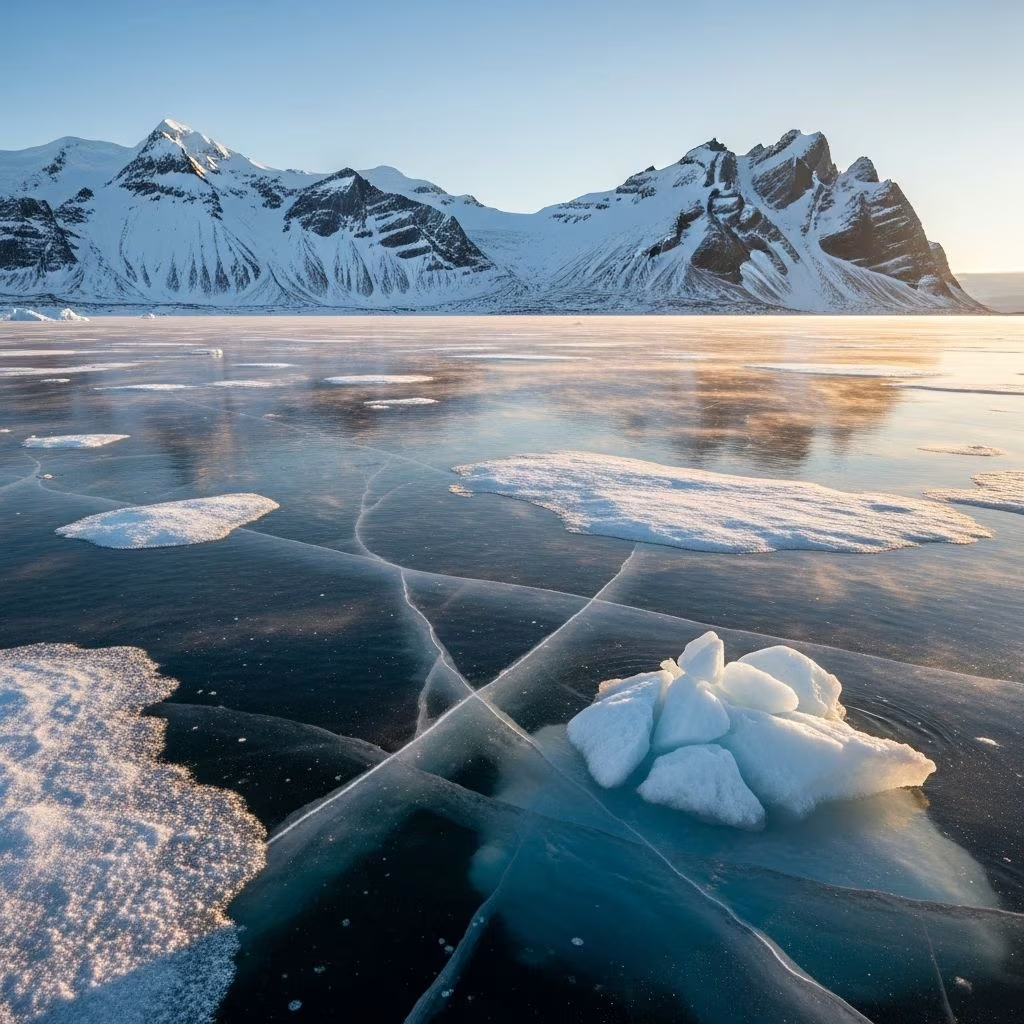
Planet Earth harbors regions where temperatures plummet to unimaginable lows, challenging both nature and human endurance. These extreme cold zones, primarily in Antarctica and the Arctic, hold the planet’s most severe weather records, shaped by high elevations, clear skies, and vast ice sheets.
Antarctica dominates as the coldest continent, with its East Antarctic Plateau featuring the absolute lowest temperatures ever measured. Satellite data from NASA reveals a high ridge between Dome Argus and Dome Fuji where surface temperatures reached -93.2°C (-136°F) on August 10, 2010, surpassing prior ground records.
These frigid pockets form in small hollows just off the ice ridge, where katabatic winds and minimal sunlight create ideal conditions for radiative cooling on winter nights. Researchers analyzed 32 years of satellite imagery to pinpoint these sites, confirming dozens of instances below -92°C.
Earlier, the Vostok Research Station logged -89.2°C (-128.6°F) on July 21, 1983, the lowest ground-level measurement using traditional instruments. This Soviet-era outpost, perched at 3,488 meters elevation, remains a benchmark for polar science.
These locations are uninhabited during peak winter, as bases like Vostok shut down, underscoring the harshness that prevents permanent settlement.
While Antarctica claims the overall records, northern Siberia hosts the coldest permanently populated places. Verkhoyansk and Oymyakon, both in Russia’s Sakha Republic, vie for the title of coldest inhabited town, with lows of -67.8°C (-90°F) recorded in 1892 and 1933, respectively.
Verkhoyansk, home to about 1,000 residents within the Arctic Circle, saw -69.8°C in February 1892. Nicknamed the ‘Pole of Cold’ for the north, its river valley location traps cold air.
Oymyakon, nearby, matched with -67.8°C in 1933 and claims even lower unofficial readings. These Yakutian villages endure months of sub -50°C weather, relying on reindeer herding, hunting, and mining.
Yakutsk, the nearest major city with over 350,000 people, is dubbed the coldest city globally, dipping to -71°C in extreme years, though daily life persists with insulated homes and underground permafrost barriers.
Beyond the poles, other locations have notched remarkable lows. Here’s a table of the top 10 coldest recorded spots based on verified measurements:
| Rank | Location | Lowest Temperature | Date | Notes |
|---|---|---|---|---|
| 1 | Dome Fuji, Antarctica | -93.2°C | Aug 2010 | Satellite record on East Plateau ridge. |
| 2 | Vostok Station, Antarctica | -89.2°C | Jul 1983 | Ground measurement record. |
| 3 | Dome Argus, Antarctica | -82.5°C | Jul 2005 | High ice dome. |
| 4 | Plateau Station, Antarctica | -82.8°C | Jun 1982 | Remote research site. |
| 5 | Verkhoyansk, Russia | -69.8°C | Feb 1892 | Coldest northern inhabited. |
| 6 | Oymyakon, Russia | -67.8°C | Feb 1933 | Rival northern pole of cold. |
| 7 | North Ice, Greenland | -66.1°C | Jan 1954 | Expedition camp. |
| 8 | Snag, Yukon, Canada | -62.7°C | Feb 1947 | Abandoned valley village. |
| 9 | Other Siberian sites | ~-68°C | 1930s | Northern Asia extremes. |
| 10 | Denali, Alaska (USA) | -62°C | Recent | North American record. |
This ranking blends satellite and ground data, highlighting Antarctica’s dominance while noting northern resilience.
What enables such lows? In Antarctica, elevation above 3,000 meters thins the atmosphere, reducing heat retention. Clear winter skies allow heat to radiate into space unimpeded, amplified by the plateau’s snow cover reflecting sunlight.
Small topographic depressions trap denser cold air, mimicking a natural refrigerator. Satellite infrared sensors detect these precisely, as ground stations can’t access all spots.
In Siberia, continental interiors far from oceans experience extreme aridity and radiative cooling, worsened by inversions where cold air sinks into valleys. Permafrost stabilizes the ground but complicates infrastructure.
Residents in places like Oymyakon adapt with fur-lined clothing, centralized heating from coal and gas, and diets heavy in meat to generate internal heat. Schools close at -55°C for safety, and cars start with block heaters.
Indigenous Evenks and Yakuts have thrived for centuries via nomadic herding, now supplemented by modern tech like GPS for reindeer tracking. Tourism draws adventurers to witness -60°C ink monitors freezing mid-sentence.
Paradoxically, warming trends affect these areas. Antarctic records persist, but Arctic Siberia sees shorter winters and thawing permafrost, releasing methane and threatening villages. Monitoring continues via stations like Vostok.
The satellite-measured low is -93.2°C at Dome Fuji, Antarctica, in 2010. Ground record: -89.2°C at Vostok.
Yes, Siberian towns like Verkhoyansk (pop. 1,000) endure -70°C winters with adaptations.
Higher elevation, more land (ice sheet), and southern summer timing keep it chillier.
Satellites like Landsat use thermal bands; ground thermometers at stations confirm.
No, Antarctic records are remote; coldest inhabited is northeastern Siberia at -67.8°C.
Travel to Yakutsk or Verkhoyansk requires winter gear, guided tours, and health checks. Antarctic sites demand scientific permits. Expect frozen rivers as roads and aurora displays as bonuses.
